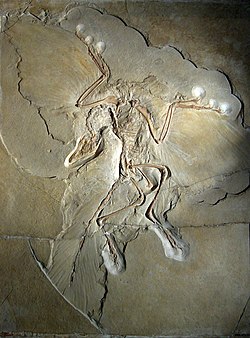
A research article published in this week's Nature describes a fossil, named Xiaotingia, that comes from the boundaries of birds and (non-bird) dinosaurs. As part of their work the researchers performed a statistical analysis designed to give the best picture of who is related to whom, and the result has led to talk in the press of a fall from grace for the iconic fossil Archaeopteryx.
Archaeopteryx was discovered in 1861 and quickly attracted attention. Darwin's theory, published two years prior, held that new species formed by branching off existing ones, which when viewed backward in time meant that taxonomic divisions of organisms would gradually merge. And if that was the case, it meant that there should be transitional fossils--fossils that show characteristics intermediate between otherwise distinct lineages. Archaeopteryx fit the bill of a transitional fossil as a small dinosaur-like creature that also had feathers and a bird-like opposable toe. It's precise relationship to birds has been controversial over the decades, but it has widely been viewed as an early representative of the lineage connecting dinosaurs to modern birds.
Paleontologists don't generally think of fossil organisms as being direct ancestors or descendants from one another, since such relationships are very difficult, or impossible, to prove. Rather, they group them according to relatedness and as more specimens are collected, the relationships can shift around and be refined. Over the past couple of decades a number of fossils of feathered dinosaurs have been discovered, which has complicated the picture of how different lineages relate to one another. With this new fossil thrown into the mix, it now appears that Archaeopteryx was a sister lineage to the lineage that led to birds.
Whether these results hold up under further scrutiny and as more fossils are found remains to be seen. However, none of this changes the broader meaning for Archaeopteryx. It is still a transitional fossil.
The August issue of the Ensign has a seven page story about the Church in the Galápagos (link). [In my best Church Lady voice]: Now let's see. Who do the Galápagos islands remind me of? What person is famously and intimately connected with them. Oh, I don't know. Could it be DARWIN?! [a.k.a. SATAN?!]
Before reading the story, I said to my wife, "I bet you that there isn't a single mention of Darwin." Then I started reading. In the second paragraph we get this:
Here, on the Galápagos, islands born of fire, life takes on precious meaning. It is a land where science and faith intermingle, where we come to understand that we are all part of a common humanity.
Then the article talks about the experience of individual members of the Church. OK, no mention of Darwin but the article is firmly focused on Church members, so I guess those sentences will do.
But then in a section titled, "What the Galápagos Teach Us," the article starts talking about ecology and my ears perk up.
As a tour guide and naturalist, André explains, "The Galápagos teach us that an ecosystem is like a living being. It's like a body. It has pressure, fluids, and organs. If one of those things goes wrong, then everything suffers."
Interesting. Ecology in the Ensign? Cool.
The Galápagos Islands also teach us about the vast grandeur of God's creations. Nothing is indigenous to the Galápagos. All life, plants, animals, and people are imports.
Yes!
"If you think about it," André explains, "the chances of life beginning here on the Galápagos are incredible. First, the lava rock had to decompose to the point where it would support life. Then freshwater sources had to develop. Then seeds had to arrive in a condition that would allow them to germinate. And they had to be able to pollinate each other.
"Then creatures had to arrive, whether floating on the water or flying or whatever. And members of each sex had to arrive at the same time and place and condition so that they could reproduce and find food and water. There are thousands of species of animals in the Galápagos.
Yes! Yes! We're almost there! (Except a pregnant female would do as well as an opposite sex pair.) Go on!
"Remember, the nearest land mass is 600 miles [1,000 km] away. For all of these conditions to be met is something of a miracle."
Yes! You've got it! Bring it home!
And yet that is exactly what the Lord, in His infinite wisdom, caused to happen.
Oh, Ensign. You're supposed to be feeding my faith, not my cynicism.
I guess I should congratulate the author for his skill at dancing within a Book of Mormon's width of Darwin and evolution without touching them. And nice use of the word 'grandeur,' which Darwin used in his famous closing of Origin of Species. I think it's best if it serves as the end of this post, too.
There is grandeur in this view of life, with its several powers, having been originally breathed by the Creator into a few forms or into one; and that, whilst this planet has gone cycling on according to the fixed law of gravity, from so simple a beginning endless forms most beautiful and most wonderful have been, and are being, evolved.
Update: The Church magazines deserve credit for an online photo gallery, as I explain in this post.
We're about half-way through summer, and maybe you are looking for something to read. I have intended to post a required reading list for evolution to add to the others on the sidebar for a long time, but have not because (i) I am lazy and (ii) I lent out one of the books and didn't get it back for a longgggg time. Maybe you've already read these books. But if you haven't they contain some of the clearest explanations of the evidence for evolution that I know of. As a bonus, it's been long enough since their publication that you can probably find them in your local library.
Why Evolution is True, by Jerry Coyne - This is the single best book on the evidence for evolution that I have seen. In 225 pages Coyne simply and clearly explains what evolution is, how it operates, and describes many of the evidences for it. Reading this book is like attending a class by a great teacher. If you read nothing else, this is the book to read.
The Greatest Show on Earth: The Evidence for Evolution, by Richard Dawkins - This book was published soon after Coyne's book and makes references to it, so I recommend reading Coyne's book first. Both treat some of the same themes, but this book is complementary and has some material not covered in Coyne's book. It is worth reading in its own right, and I think of it as a companion volume. If Coyne's book is like attending a class, this book is like having the professor to your house for a more intimate discussion in your living room.
Both Dawkins and Coyne are famous for their vocal atheism. However, you won't find strident criticism of religion in these books. It would be impossible for these books not to discuss some religious beliefs because they provide contrasting ideas--still widely held--that bear on interpretation of the evidence. But as Dawkins put it, "This is a book about the positive evidence that evolution is a fact. It is not intended as an anti-religious book. I've done that, it's another T-shirt, this is not the place to wear it again [p. 6]."
Relics of Eden: The Powerful Evidence of Evolution in Human DNA, by Daniel J. Fairbanks - I am not aware of another popular book that tackles the evidence for evolution found in DNA as in detail as this one. Fairbanks is a geneticist formerly at Brigham Young University and now at Utah Valley University. (For my summary of the book, see here.) The purpose of the book is is "to present just a fraction, but a very compelling fraction, of the DNA-based evidence of evolution. I have chosen to focus on human evolution because some people are willing to accept the idea that other species have evolved but draw the line with humans, usually for religious reasons."
Naomi Oreskes is a historian of science at the University of California, San Diego. The focus of her work over the last few years has been the large role that a small group of cold war physicists have played in casting doubt on science that they have perceived as being threatening to capitalism and freedom. These include the connection between tobacco and cancer, and climate change.
Her latest book is Merchants of Doubt, and NCSE has made the chapter, "The Denial of Global Warming," available for free. The chapter only covers the controversy up until the 1990s, so it serves as background information on how we got to this point. Nevertheless, I think you'll find plenty of material to raise your blood pressure.
I've highlighted Oreskes before (see Evils and Designs of Conspiring Men). I haven't read the book yet, but I've read descriptions of it and heard Oreskes discuss it in interviews. It sounds like a more detailed version of what is described in that post.
If you find Merchants of Doubt interesting, you may also want to check out Doubt is Their Product, which I highlighted here.
Flood Geology is the Young-Earth Creationist (YEC) version of geology that seeks to put the geological and paleontological record into the context of Noah's flood. Originally, Whitcomb and Morris (and George McCready Price before them) attributed the whole fossil record to the Flood, but over the years a number of creationists have obtained advanced degrees in the pertinent fields and sought to bring their knowledge and training to bear on the topic.
The latest issue of Reports of the National Center for Science Education has an article by biologist Phil Senter where he looks at what Flood geologists have said about how the various strata and geological periods relate to the Flood. Through a collective process of elimination, Flood geologists have whittled the influence of the Flood to practically nothing. This is illustrated by the following figure from the article:
On the left are the names of the various geological divisions. All those symbols in the center-right represent different reasons for eliminating those periods from flood activity. These include raindrops, charcoal (i.e. fire), animal tracks, etc. From the article:
Several Flood geologists have presented geologically sound reasons why strata assigned to specific parts of the geologic column cannot have been deposited during the Flood year or at least during the part of it when the entire planet was under water, hereafter called the PWS (period of worldwide submergence). In fact, compilation of such studies shows that together Flood geologists have eliminated the entire geologic column as having any record of a PWS.
Further:
This means that—according to the results of the studies by Flood geologists themselves—if the Flood occurred during Phanerozoic time then all Flood deposits are stratigraphically sandwiched between a pair of non-Flood deposits within the stratigraphic span of a single one of the geologic periods. If this is the case, then the Flood left little if any geologic evidence of its occurrence. Flood geologists have difficulty accepting that a worldwide cataclysm would leave but a small geological scar, but they themselves have provided evidence that either such is the case, or the Flood was pre-Phanerozoic, or it is mythical.
It seems to be dawning on at least some Flood geologists that they have a problem. I wonder if perhaps we may be coming full circle. People forget that it was believing Christians who figured out the problem of geology for the Flood in the first place. They gave rise to mainstream geology, but Creationists convinced themselves that mainstream geology was just ideologically anti-Bible. Perhaps the cycle will repeat. At any rate, I expect that this will have little effect on regular folks, for whom nothing but the Bible matters anyway.
By the way, this kind of treatment is not a first for Senter. He has published two articles in the past year (one recently) in scientific journals that undercut Creationism using Creationist methods.
I've been traveling for work lately, and was lucky enough to spend some time in Europe, which is why things have been so dead around here for the past few weeks. While there I went to a museum that contained a piece that represented the solar system in both the Copernican (heliocentric) and Ptolemaic (geocentric) forms. As I was about to move on, a tour group swarmed around and the tour guide began to tell about the piece. In discussing the Ptolemaic portion of it, she briefly gave some background about how medieval beliefs were backward, including the belief that the Earth was flat. Then she spoke of how people had believed that the solar system revolved around Earth, but that Copernicus had come along and said that that was ridiculous.
Although her tour group probably wouldn't care, I felt that the guide did them a disservice by giving such a cartoonish picture of science history. For starters, the notion that medieval people thought that Earth was flat is a myth. It's one of those things that everybody knows, but that isn't true. Beyond that is the implied notion that geocentrism was self-evident nonsense. It is easy for us to look back at beliefs that we now know to be wrong and sniff at what imbeciles people who held those beliefs were. But aside from being uncharitable, this tendency reinforces (and perhaps derives from) a cartoonish version of how science works and progresses--that it's a simple matter of smarter people coming on the scene.
In truth, the path of scientific knowledge and understanding is often crooked, with many false turns and dead ends. Science is a matter of evidence, and it turns out that geocentrism had a lot going for it, in spite of Copernicus. (Thanks to Mormon Metaphysics, for bringing the linked post to my attention.) Heliocentrism was the new kid on the block, and it would take time before it would prove its worth. That it ultimately succeeded does not nullify its need to do so in the first place, and the same holds for any successful theory that was initially resisted (e.g. plate tectonics)--something that is often missed by cranks pushing self-proclaimed revolutionary ideas.
It seems to be human nature to want to stone false prophets. We see it in politics constantly. In science there is no dishonor in being wrong (or at least there shouldn't be), as long as the mistake is one of pure intention in the quest of discovery. Being wrong is often a step toward being right.
While waiting at the airport for a flight, I was catching up on some of the blogs I keep tabs on. One blog led to another and soon I was reading about David Barton and Christian nationalism. Barton's basic claim is to have collected many documents from the founding of the U.S. that show the true Christian character of it. To put it in poker terms, he'll see your Thomas-Jefferson-was-a-deist and-cut-out-the-miraculous-material-from-the-New-Testament and raise you a document signed by Jefferson with, "in the year of our Lord Christ [1]."
I had seen Barton on the The Daily Show and he is a fast, confident, and likeable talker who really seems to have the evidence on his side. He apparently has been a consultant on a number of court cases as well as to members of Congress of both parties, and has been involved in history textbook selection for Texas. He has been enthusiastically promoted by Mike Huckabee and Glenn Beck. Part of his appeal, as described by Huckabee, is that he just lays out the documentary evidence for all to see.
Historians are quite critical of Barton. It's not that every claim he makes is false (although many of them are), it's that he distorts history in a way that serves his own religious-political agenda, which is apparently to give Christians a sense that they have been betrayed and marginalized by a government that has lost its way from the idyllic days when it protected and promoted them, as desired by the Founders. But who cares what those irreligious historians think, anyway? In the words of one historian,
That's why historians' takedown of his ahistorical approach ultimately won't matter that much. Nor will historians' explanations of his presentism, and his obvious and unapologetic ideological agenda (albeit considerably muted for his appearance on The Daily Show). While historians' refutations are good and necessary, ultimately they won't matter for the audience which exists in his alternate intellectual universe, one described in much greater detail in my colleague Randall Stephens' forthcoming book, The Anointed: Evangelical Experts in a Secular Age.
There is a connection here to science, most directly to the evolution-creationism battles, but also to other public controversies over scientific issues. It seems to me that Barton is the history counterpart to creationists Ken Ham or Kent Hovind, but more charming and politically powerful. They are not in the business of making intellectual arguments and establishing truth. They are in the business of pushing a religious/political view (the Truth) and marshaling science or history in the service of that view, and doing so in a way that makes serious study look superfluous or even dangerous. After all, if the so-called experts can't see what is staring them in the face then that just goes to show how biased or deluded the academy has made them. Evangelicals like Barton, Ham, and Hovind are not the only ones constructing an alternate intellectual universe (creationism of the kind that claims to offer a decisive refutation of evolution is a growing problem in Muslim culture, and there are also various anti-medical or technology groups as well) but the population they represent is a significant one in the U.S. and I wonder how far and deep these divisions will go, and at what expense to truth and the public's understanding of it.
Back to Barton, my airport blog-browsing led me to history professor John Fea and his book, Was America Founded as a Christian Nation?. It seemed legitimate and was recommended by what seemed like knowledgeable and intellectually honest people. I like to think that I have developed a nose for discriminating good sources of information from bogus, but I'm not a historian--how do I know whether Fea is an ideological crank or not? I happened to come upon a list of historians who approved of the book, including (drum roll.........) Richard Bushman. In fact, he wrote this blurb for the book:
This is a book for readers who want a credible account of how religion affected the settlement and founding of the United States. It brings out the indisputable importance of religion without claiming more than sound historical scholarship can support. Its most original feature is the fascinating history of the long campaign to defined the United States as a Christian Nation.
So now the book is on my Amazon wish list.
Coincidentally, after I had written most of this post the following video clip was brought to my attention. In it, Barton claims that the evolution-creationism debate extends back to the Founders and that even Thomas Paine agreed that creationism should be taught in public schools.
This is absurd on its face since Darwin didn't publish Origin of Species until 1859, not to mention the paucity of public schools back then.
This is kind of nuts, but also illuminating. Barton has emerged as a force by bridging two sometimes disparate strains of conservatism—the Chamber of Commerce crowd with the Christian Coalition crowd. In his lectures, they become one: Jesus opposed the minimum wage; Jesus opposed the progressive income tax; etc. You can only imagine the fervor with which Jesus would have endorsed the Paul Ryan budget. When someone like Bachmann says, as she famously did earlier this year, that the Founding Fathers worked to abolish slavery, Barton is where it starts. When Texas Gov. Rick Perry, another potential GOP presidential candidate, says we need to return to our Biblical principles to escape from our current system of economic slavery (yes, he really said this), he's channeling Barton.
I don't think truth, science, or religion (to say nothing of politics) are well served by this kind of stuff.
Notes:
1. The words, "in the year of our Lord Christ" were part of a pre-printed form letter that Jefferson signed as President. Somehow that makes Jefferson an orthodox Christian rather than a deist.


 Posts
Posts


 A research article published in this week's Nature describes a fossil, named Xiaotingia, that comes from the boundaries of birds and (non-bird) dinosaurs. As part of their work the researchers performed a statistical analysis designed to give the best picture of who is related to whom, and the result has led to talk in the press of a fall from grace for the iconic fossil Archaeopteryx.