


 Posts
Posts


Anti-Uniformitarianism or Causes Without Effects
Mormonism has a long history of viewing miracles as being in accordance with the laws of nature. Brigham Young said:
The providences of God are all a miracle to the human family until they understand them. There are no miracles, only to those who are ignorant. A miracle is supposed to be a result without a cause, but there is no such thing. There is a cause for every result we see; and if we see a result without understanding the cause we call it a miracle.Similarly, Parley P. Pratt wrote:
Among the popular errors of modem times, an opinion prevails that miracles are events which transpire contrary to the laws of nature, that they are effects without a cause.Uniformitarianism
If such is the fact, then, there never has been a miracle, and there never will be one. The laws of nature are the laws of truth. Truth is unchangeable, and independent in its own sphere. A law of nature never has been broken. And it is an absolute impossibility that such law ever should be broken.
With this in mind, I want to highlight a 1983 BYU Studies article, "Hutton's Uniformitarianism", by (retired?) BYU professor of geology Jess R. Bushman. Uniformitarianism is sometimes misunderstood, but Bushman explains it clearly.
Uniformitarianism, or cause and effect, is a very important and basic concept in geology. The heart of the concept is that there is order and regularity in the operation or functioning of natural laws. This consistency is what gives significance to cause-and-effect patterns. What we see happening today helps us to identify the results of natural processes which were active million of years ago. We observe ripple marks being formed by wave action on beaches today; when we see similar ripple marks in ancient sandstone, we use cause and effect or uniformitarianism to suggest that the ripple-marked sandstones were once part of an ancient beach....Uniformitarianism is traditionally contrasted with catastrophism.
Violent events such as volcanic eruptions, which are convincing evidence that not all change occurs slowly, are still part of uniformitarianism change so long as there is a pattern of cause and effect that reflects the orderly function of natural laws.
Catastrophists support the idea that the earth is just a few thousand years old, and they are determined to discredit the evidence of slow gradual change. They insist that rates of erosion, for example, were much more rapid or violent in the past than they are today. Catastrophists ignore the cause-and-effect relationship which indicates that if you change the rate you also change the results. For example, if the rate or energy of stream erosion is increased to that which occurs with a destructive flood, it produced thicker and coarser deposits with numerous erosion channels within the deposits. On the other hand, very fine grained evenly laminated sedimentary deposits indicate that deposition occurred in low-energy quiet water. The rock record contains evidence of not just the type of process but also the rate at which it occurred.Bushman's descriptions are probably accurate enough today, but they belie some of the historical excess and nuances of these competing approaches to geology. (Bushman notes that Charles Lyell was the source of some of that excess.) The rest of the essay presents uniformitarianism as it was described by James Hutton, followed by some supporting statements from Mormon tradition and scripture, including the quote above by Brigham Young.
Causes Without Effects
Modern criticisms of uniformitarianism are usually religious in nature. In fact, two such articles have appeared in the Ensign [1], and similar writings exist elsewhere in LDS literature. Donald Parry, the author of one of these articles, described uniformitarianism as follows:
Uniformitarianism...proposes three primary concepts: (a) there were no processes (such as geologic processes) operating in the past which are not operating now; (b) there are no processes operating now which were not operating in the past; and (c) process rates have not changed.To be fair to Parry, there have been some historical excesses in defining and applying uniformitarianism, as noted above. But notice the contrast between the descriptions offered by Bushman and Parry. Bushman's definition focuses on concern for cause-and-effect relationships; Parry's definition is an obvious intellectual straight-jacket.
Parry's version of uniformitarianism is easy to reject, and that serves the purpose of his article, which is to support the reality of a global flood. But he and other similar critics usually excuse themselves from doing the needed rearrangement of cause-and-effect relationships. This allows them to cast doubt on science without engaging it. If I may invert Brigham and Parley's critique, their miracles are causes without effects.
The Earth Divided
To use a different example, let's consider the division of the continents. According to one Biblical interpretation, following Noah's flood the continents were separated as indicated by Genesis 10:25.
And unto Eber were born two sons: the name of one was Peleg; for in his days was the earth divided; and his brother’s name was Joktan.The observed distances between the continents today requires that this separation--which allegedly occurred a few thousand years ago--was a catastrophic event. A number of scientific lines of evidence support the idea that the continents have joined and separated over time, and the theory of plate tectonics describes how the movement of the continents is possible. However, these movements have been measured and are on the order of inches (or centimeters) per year. Superficially, it appears that we have a simple choice to make based on whether we are willing to believe that movement of the continents has always been slow. Why couldn't a catastrophic or miraculous event cause quick separation?
Can a rock change its stripes?
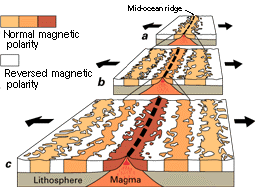 We need to look deeper [2]. Mid-ocean ridges are mountain ranges on the ocean floor where seafloor spreading occurs as tectonic plates move away from each other. The Mid-Atlantic Ridge runs north-south between the the Americas on the west, and Europe and Africa on the east. At these ridges magma is released, cools, and adds to the crust. Magnetic minerals within these volcanic rocks align with the earth's magnetic field and are frozen in place as the lava cools. Periodically the Earth's magnetic field reverses, and these reversals are reflected in the alignment of the magnetite in the crust. Mapping of the ocean floor has revealed that mid-ocean ridges are sandwiched between symmetrical bands of rock with differing magnetic polarity. These bands can also be dated radiometrically and compared to other volcanic rocks on land, and scientists have found that there is good correspondence in the magnetic polarity of land and ocean rocks of the same age. These ages also show that the magnetic field reversals occur on the order of tens of thousands of years. This is strong evidence that the movement of the continents has been a slow and gradual process.
Dismissing the accepted time period for the continental movements as mere uniformitarianism without explaining these findings just won't do. If South America and Africa were ripped apart by a catastrophe, or even a miracle, the resulting gash in the Earth's crust would have to be filled with something--presumably with the magma underneath. Under such a scenario we would expect the magma to cool more-or-less simultaneously, and the magnetic polarity of the newly formed crust should be uniform. Furthermore, the new crust should give a uniform radiometric date. But this is not what is found. To ignore this contradiction and maintain a catastrophic separation of the continents is to decouple cause and effect by asserting that a catastrophic event caused the effects of a gradual process.
Conclusion
When viewed as concern for cause-and-effect relationships, it becomes clear that the principle of uniformitarianism provides a foundation for reasoning that extends into everyday life. Instead of an arbitrary assumption born of human arrogance, it is a practical guide in a lawful universe, which is why Bushman sees ties between uniformitarianism and LDS theology. This view also reveals most criticism of uniformitarianism to be scientifically empty rhetoric that subtly undermines the basis for belief in a lawful universe.
Notes:
1. The Flood and the Tower of Babel and The Gospel and the Scientific View: How Earth Came to Be
2. See This Dynamic Earth, especially here and here.


9 comments:
Only a dyed-in-the-wool Gradualist would look for support of that theory in the statements of Latter-day prophets and general authorities. What you interpret as supportive of Uniformitarianism in their statements really aren't about that at all. You must be completely selective in your reading to miss the multitude of their statements to the contrary, which, in their totality, contradict your reading. Joseph Smith and his successors were Catastrophists, plain and simple.
One example: Elder Orson Pratt said, "...the present geological conditions of our globe, are not, in their general changes; but the effects of sudden convulsions and catastrophes under the control and superintendence of the All-powerful Being who formed all things." He declared that "divine revelation" teaches these truths.
What say you?
Anthony,
Joseph Smith and his successors were Catastrophists, plain and simple.
You're probably right--I haven't surveyed their views. But this is not about what early leaders thought about catastrophism vs gradualism--not forgetting that those terms might have had somewhat different meaning back then. It's about what uniformitarianism means now as a principle of reasoning (which, I might add, is broad enough to encompass "catastrophic" phenomena such as the Chicxulub asteroid), and how that connects with Mormonism.
Your post reads like something out of a well written textbook. I'm convinced that uniformitarianism is a useful perspective. But uniformitarianism can't explain all things about earth. For example, uniformitarianism will be at a total loss to explain the impending restoration of earth's pre-Fall paradisiacal state in which, among other things, there was and will be no death.
Jared*, You continue to encourage me that there is great thinking going on in the Church. Your point about Natural Law is an important one. I saw some work by someone in my department at BYU recently that pointed out that although Natural Law was talked about often and abundantly by the prophets from the beginning of the church, in the late 50 the talk became less and less common. I wonder why? Well done again. Keep up the good work.
Jared,
I also am a fan of these write-ups. Uniformitarianism is a satisfactory foundation of reason for understanding the formation of the earth. We Mormons should be discussing these things fervently with a hope of learning from and by each of our individual contributions.
Good on ya!
Excellent post. In my opinion, the idea that the universe is strictly constrained by natural laws is the only way for LDS theology to make any sense.
The necessity of a suffering atonement, for example, is inexplicable without reference to a natural law or constraint of some kind.
Thanks for the compliments, all.
Gary,
No death doesn't seem to me like a problem for uniformitarianism per se. It's a new cause and effect.
Steve,
I can't help but look forward to your comments. That's interesting about the decline in usage of "natural law."
Mark D.,
Interesting thought. Can you elaborate a little?
I second your confusion as to why an end to death would entail anything about uniformalism.
I think you're thumping Don Parry a little too hard. The very word "uniform-itarianism" intuits his three points with a voice of thunder. The whole concept is based in the notion that we can deconstruct the geological past by studying the geological present.
Jack
Post a Comment