


 Posts
Posts


Archaeopteryx is Still a Transitional Fossil
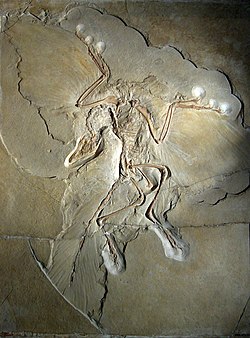 A research article published in this week's Nature describes a fossil, named Xiaotingia, that comes from the boundaries of birds and (non-bird) dinosaurs. As part of their work the researchers performed a statistical analysis designed to give the best picture of who is related to whom, and the result has led to talk in the press of a fall from grace for the iconic fossil Archaeopteryx.
Archaeopteryx was discovered in 1861 and quickly attracted attention. Darwin's theory, published two years prior, held that new species formed by branching off existing ones, which when viewed backward in time meant that taxonomic divisions of organisms would gradually merge. And if that was the case, it meant that there should be transitional fossils--fossils that show characteristics intermediate between otherwise distinct lineages. Archaeopteryx fit the bill of a transitional fossil as a small dinosaur-like creature that also had feathers and a bird-like opposable toe. It's precise relationship to birds has been controversial over the decades, but it has widely been viewed as an early representative of the lineage connecting dinosaurs to modern birds.
Paleontologists don't generally think of fossil organisms as being direct ancestors or descendants from one another, since such relationships are very difficult, or impossible, to prove. Rather, they group them according to relatedness and as more specimens are collected, the relationships can shift around and be refined. Over the past couple of decades a number of fossils of feathered dinosaurs have been discovered, which has complicated the picture of how different lineages relate to one another. With this new fossil thrown into the mix, it now appears that Archaeopteryx was a sister lineage to the lineage that led to birds.
Whether these results hold up under further scrutiny and as more fossils are found remains to be seen. However, none of this changes the broader meaning for Archaeopteryx. It is still a transitional fossil.
For more authoritative information, see here.


4 comments:
Feh, morphologists. At this level of species phylogenetics I don't think morphologically based parsimony is very robust. This case itself proves the point, where a single species will pull apart the cladistic relationships that have stood for 150 years.
Of note from the supplemental material: "It is notable that only a few clades meet [the standard] criterion in the present analysis." The various support measures for the clades in the analysis are quite low, suggesting that the answer to your question of whether these results will hold up is "probably not." That's not to say future analyses will necessarily put Archaeopterix back on top (or rather on the bottom), since there's definitely a lot of complex relationships that far down the tree as you mentioned. What's even more complex is that every time the tree changes, our interpretation of evolutionary development changes too... boo.
Thanks for a phylogenetics post!
Thanks for the input, raedyohed. If you like phylogenetics, you might also be interested in a post I did a few years ago, Religion, Cladograms, and Mormons (Part 1 and 2), where I explain how Christianity is paraphyletic.
Nice posts. Lateral gene transfer hits it on the head. It brings to mind various infusions of different religious traditions into Mormonism itself, as just one among many lines which cross over and tangle up with each other. Of course this makes the graph reticulate rather than strictly hierarchical, in which case phyletic concepts break down. Interesting and useful nonetheless to investigate religious identification in cladistic terms, since I think this is how many people view much of the world.
Post a Comment