Friday, April 29, 2005

There is Trickery Afoot (A-Wing, Actually)

Maybe if I were more of a naturalist I wouldn't think this is so cool, but I do. A paper in Science describes an interesting feature of Horsfield's hawk-cuckoos. This species of bird is a brood parasite--the eggs are laid in another bird's nest and the host bird's eggs and young are evicted from the nest. The parasitic bird tricks the host bird in to feeding it. Some types of parasitic birds make intense feeding calls to trick the host parent into thinking there are more hungry mouths to feed than there actually are, and thus increase the amount of food delivered. The Horsfield's hawk-cuckoo uses a different strategy.

Continue Reading


Rather than make a lot of noise, this little bird uses a colored patch on its wing to trick the host bird, visually, into thinking there are additional mouths to feed (see picture). Host birds have even been seen to actually try to put food into this decoy mouth. The authors tried painting the patch on the wing black and observed a drop in the rate of food delivery.

Nature is full of trickery in the competition for survival.


Continue reading...

Thursday, April 28, 2005

Gallup Poll on Evolution

The following figure, derived from Gallup, is in an article from this week's Nature. There are certainly nuances lacking, but it seems pretty reasonable in the way it breaks up the groups.

Continue Reading


Continue reading...

Wednesday, April 27, 2005

Microbes Rule the World

This new story from Scientific American.com suggests that we may be able to harness microorganisms breaking down organic matter as a means of producing hydrogen. One of the main criticisms I've seen of using hydrogen fuel cells is that there are no readily useable sources of hydrogen around. Instead, we would have to produce hydrogen by (the only example I know off the top of my head) splitting water into hydrogen and oxygen. But that requires energy, so we would have to burn fossil fuels in order to produce the hydrogen that replaces our use of fossil fuels. It doesn't make sense to me either--maybe someone more knowledgable can explain. Anyway, this news article suggests that microorganisms--those master chemists--may be able to help us out.

Microbes don't get the attention and respect that they deserve--they really form the foundation of life on this planet. Evidence suggests that the very mitochondria and chloroplasts that provide us and plants with energy are derived from microorganisms. There are areas of research that seek to harness their abilites. Research in bioremediation, for example, seeks to harness microbes in the breaking down of man-made toxic chemicals. How practical these strategies are, I don't know--but they sound good.

While I'm at it, here are a few factoids I heard at a meeting: There are 50 million viruses per milliliter of coastal sea water. Viruses in the ocean constitute 27-270 megatons of carbon; whales constitute 4-12. Ninety-five percent of biomass in the ocean is microbial. Between 5 and 40% of marine microbes are lysed (broken open) by viruses each day. Viruses are therefore responsible for an enormous turnover of organic material in the ocean.

Continue reading...

Tuesday, April 26, 2005

Ovulating and Overweight

No, this is not a strange, yet suprisingly frank, personal add. I just wanted to call attention to two unrelated items.

First from Dienekes' Anthropology Blog, a study concludes that most women don't know when they ovulate. "The most motivated study participants were right about half of the time." I don't know what relevance this might have to your life, but you have been informed--act accordingly.

Second is commentary by John Rennie at SciAm Perspectives, where he worries that people may be misinterpreting the news about the CDC's recent study on obesity.

If anything, the JAMA study suggests that people who exercise and eat a moderate, balanced diet should probably not worry if their weight has stalled a few pounds above some "ideal weight" on an actuarial table. And even that interpretation could be premature because what's most clear now is that we need to study the consequences of overweight much more carefully to sort out what they mean. To use the work as an excuse for saluting the joys of immoderation and ridiculing the fit is asinine.

Looks like the June issue of Scientific American will have more to say on this.

Continue reading...

Monday, April 25, 2005

PZ Myers on ID

PZ Myers of Pharyngula had an op-ed published in the Minneapolis Star-Tribune arguing why ID should be left out of science classes. Here is an excerpt:

Science is a conservative process. Most college-level introductory textbooks contain only material that has stood the test of time and has been confirmed independently. ID proponents have not only failed to provide any evidence for their thesis, they aren't even trying. There are no labs doing research on this subject; all the papers the Discovery Institute has tried to publish are exercises in spin, in which they try to distort biology researchers' work to fit their preconceptions.

With no established body of results, no current work and no promising prospects for future research, why should ID be supported? It's a dead end. It is absurd to propose that our kids learn about a subject that no legitimate scientists are pursuing and that has no utility. With no track record to earn the respect of scientists and educators, ID is attempting to circumvent the accepted standards of testing and validation to sneak into our schoolrooms -- it's cheating. It takes a great deal of hard work and persistence and time and evidence to establish a scientific idea, work that should not be shirked by taking the easy route and asking the government to legislate a concept into the schoolrooms. Yet this is exactly the strategy ID proponents are following: spreading propaganda to persuade school boards and state education departments to insert the ideological dogma of ID into classrooms.

Contrast ID with how legitimate scientific work gets into the curriculum. There is an active ferment of new ideas, new experiments, and new evidence constantly bubbling up in the scientific literature. Many controversies work themselves out in the pages of Nature or Science or other journals, and prompt hypothesis testing and the gathering of new evidence. If an idea is well-supported by the evidence, it gains wider currency within the scientific community, and eventually works its way into the science textbooks. Biology books are written by biologists, not by the hodge-podge of lawyers, philosophers, theologians, rhetoricians and rare scientists willing to abandon scientific principles found in the ID movement. Textbook content should accurately reflect the general opinion of the scientists who do real work in a field.


I agree.

Continue reading...

Friday, April 22, 2005

The Visible Human


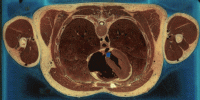
I saw a documentary recently on the National Library of Medicine's Visible Human project. The documentary discussed the project as well as the background of the man who was used. The goal of the project was "the creation of complete, anatomically detailed, three-dimensional representations of the normal male and female human bodies."

The Washington Post reported:

Continue Reading


The convict who became the Visible Human male was Joseph Paul Jernigan. On July 3, 1981, he stabbed and then killed with a shotgun a 75-year-old man who surprised him during a robbery. He was convicted of murder and, after more than a decade on death row, was executed Aug. 5, 1993.

Jernigan had willed his body to the Texas anatomy board but almost certainly did not know that he was a candidate for the Visible Human Project at the time of his death... The advantage of using executed prisoners was obvious. Their deaths could be anticipated, and work on preserving their remains could begin almost as soon as they were officially declared dead. Of seven male cadavers under consideration, one other besides Jernigan's was that of an executed murderer.

Jernigan's body was not perfect. He had gained nearly 50 pounds since his arrest and was just under the weight limit. One testicle had been removed surgically when he was 15, and his appendix was taken out when he was 21. He was missing a tooth.

His body was frozen and cut into thirds. Then, millimeter by millimeter, layers were ground off and the remains were photographed. The ground-up bits were ultimately cremated. The result can be seen in this movie. Also you can browse the resources available through these links. I recommend the "real-time slice navigation" at this site.

Continue reading...

Wednesday, April 20, 2005

Suprises of Genetic Ancestry

A few days ago I posted about the Genographic Project and briefly compared it to the Sorenson Molecular Geneology Foundation project. When talking about the history of your genes it is easy to be misled, because different parts of your genome can have different histories, and some of your ancestors are not detectable in your genome. In light of this, it seems to me that the SMGF has a more practical immediate benefit to participants. However, as we look back through time, there may be some suprises.

Continue Reading


For example, in discussing a video promoting the Genographic Project, Dienekes at his (I'm assuming gender) anthropology blog asks:

It would be much more realistic to show some unexpected results, e.g., a Native American who was descended from a European, or a European who was descended from an African. What goes through the mind of a black man when he is told that his forefather was white? What happens to a would-be-jihadi when he is told that he is carrying Crusader DNA? What are the consequences when a people who think that they are descended from Alexander the Great are told that they are actually not?


In The Ancestor's Tale, Richard Dawkins describes a documentary where black people, whose families came to Britain from Jamaica, had their Y chromosome and mitochondrial DNA characterized and matched against databases in order to find their long lost relatives in Africa. After describing some of the emotional meetings, Dawkins says:
Sentimental rubbish, and she should never have ben deceived into thinking this. All that she, or Mark, were really visiting--at least as far as there was any evidence to suppose--were individuals who shared their mitochondra. As a matter of fact, Mark had already been told that his Y chromosome came from Europe (which upset him and he was later palpably relieved to discover respectable African roots for his mitochondria!). Beaula, of course, has no Y chromosome, and apparently they didn't bother to look at her father's although that would have been interesting, for she was quite light-skinned. But it was explained to neither Beaula nor Mark, nor the television audience, that genes outside their mitochondria almost certainly came from a huge variety of 'homelands,' nowhere near those identified for purposes of the documentary. If their other genes had been traced, they could have had equally emotional 'reunions' in hundreds of different sites, all over Africa, Europe and very probably Asia too. That would have spoiled the dramatic impact, of course. (p. 55-56)

Continue reading...

All Things Denote There is a Virgin Mary


The Virgin Mary has appeared in an underpass in Chicago. You can read the CNN story here.

She sure picks some unexpected places to appear.

Continue reading...

Tuesday, April 19, 2005

Terri Schiavo: Not Abused

I don't think this news story received much attention, but in justice it should have. The bottom line is that there is no evidence that Michael Schiavo abused Terri.

You know, I felt bad for her parents, but there is a part of me that wonders if they just might be psycho in-laws from hell. Some of you have in-laws in that category, or at least you know someone who does, so don't tell me it isn't possible. [Disclaimer: my in-laws are great.]

Continue reading...

Role for BYU in Ancient Text Discovery

I've seen the discovery of the Oxyrhynchus Papyri mentioned on several blogs including Clark at Mormon Metaphysics. However, it wasn't until I saw this discussion by the editors of Scientific American, that I realized that BYU played a role. (The article Clark linked to also mentions BYU about 3/4 of the way down.) Must be the university's Institute for the Study and Preservation of Ancient Religious Texts (ISPART).

Go Cougars!

Continue reading...

The Genographic Project

You may have read about The Genographic Project--I've seen it discussed on a number of blogs. The researchers behind the project are seeking to obtain 100,000 DNA samples from around the world, especially from aborigines, in order to understand ancient population migrations.

This reminded me of the work going on by BYU's Dr. Scott Woodward and the Sorenson Molecular Geneology Foundation, so I contacted them to get their perspective as to how their work compares with GP.

Continue Reading


Their response reads, in part:

The short answer to your question on how we differ from the Genographic Project (GP) is that our study is genealogical in nature, while the GP is anthropological. Our personal feelings on this matter is that the two studies are complementing each other, as the data we are collecting and analyzing is used to reconstruct lineages that are close to us in time (within the last 6-10 generations), while the GP's goal is to link people back 10-60 thousand years ago.

Some of the genetic techniques used in both studies are similar, but they are used to produce different type of data and answer different questions. In addition, GP is not collecting any pedigree information, which is a key point in our study.

The SMGF project has already been going for over four years and has collected 50,000 samples from around the world. The GP is just starting and will collect samples for the next five years.

You can visit the respective websites for information about participation. SMGF will send you a free kit; GP's kit costs $100.

I definately recommend a visit to GP's website. It is pretty slick--in addition to some nice tutorial information, there is an interactive map that shows current understanding of human migrations over time with respect to specific genetic markers. Clicking on elements of the map will allow you to read specific information on that element.

Continue reading...

Sunday, April 17, 2005

Approaches to Quitting Smoking

Dave recently pointed out The Elder Barr Blog, via The Bloggernacle Times. It's an interesting idea for a blog. I didn't read any of it, I just scrolled down and looked at pictures--the same type of pictures that have been taken probably millions of times now. However one picture caught my eye. There is a picture of Elder Barr on the street holding a sign that says "Free Stop Smoking Workshop."

I could be wrong, but I think I have a pretty good idea of what that workshop involves--cinnamon mouthwash, gum, and toothpaste.

Continue Reading


On my mission we had a stop-smoking program, but I always thought it was odd because it didn't have the Church's stamp of approval anywhere on it. In fact it was copyrighted and we technically were not supposed to copy it--it said so right on it. But I just went with the flow--this was what we were supposed to use, so I used it.

As time has passed, I've become more skeptical. Not only do I wonder where the heck that thing came from, I also wonder if it has ever worked. I don't think any of my smoking investigators successfully quit. (My wife says hers did.) If it is the offical way to quit, why aren't the Church's fingerprints anywhere to be found on it?

For as much press and discussion the issue of smoking gets in church, there is precious little in terms of guidance as to how to quit. A quick look on the Word of Wisdom section of Provident Living.org reveals a number of links to talks in the Ensign and lessons from manuals, but none seem to give much advice.

The closest I've seen to scientific treatment of the problem was in the February 2002 Ensign article "Tobacco: Quitting for Good." It provides links to professional and government organizations such as CDC and the Dept. of Health and Human Services. (Interestingly, this article is not included in the list of Ensign articles on ProvidentLiving.org.)

As a missionary, having never battled addiction before, it made sense to me that prayers and cinnamon were the answer to quitting. The push for baptisms perhaps squeezes out more effective or lasting approaches. The above referenced Ensign article states:

Because no single condition leads to tobacco dependence, no single solution cures smokers of their dependence on cigarettes. Some people are able to quit smoking easily, while some find quitting so difficult that they do not quit even when facing tobacco’s serious health problems. Smokers who believe that quitting smoking will be easy or that God will make it easy for them may become disillusioned if they experience the normal withdrawal symptoms or if they relapse back to smoking. Therefore, it is wise for smokers to take time to plan this important change carefully and prayerfully.

Successful treatment can include at least three components: (1) counseling and advice from a skilled, knowledgeable professional, with a focus on developing problem-solving skills, overcoming barriers to quitting, and preventing relapse; (2) support from friends and family members; and (3) the possible correct, careful use of legal stop-smoking medications, including nicotine replacement and other drugs tested for safety and effectiveness.

Can you imagine a missonary suggesting nictotine replacement? Some people quit cold-turkey and are successful. However this approach does not work for eveyone. In fact it is the least successful approach.

So when I hear the missionaries say that they are going to do a stop-smoking program with someone, I can't help but think, "Been there--done that--doubt it'll work." Do I have too little faith, or should we approach smoking from a different angle--a more effective angle? Should we have good evidence that investigators have overcome their WoW addictions before baptism?

Continue reading...

Thursday, April 14, 2005

Richard Dawkins: Friend or Foe?

If there is a single modern person who draws the most ire from critics of evolution, I think it has to be Richard Dawkins. His popular science writings on evolution are pointed and powerful, and his atheism outspoken and unyielding. This makes him controversial both on scientific and philosophical grounds. And yet I quite enjoy his books. I certainly don't agree with his atheism, nor necessarily his politics, but I don't see him as a threat--I see him as a challenge. His writings make you think and introduce you to new perspectives. And sometimes I even make religious connections with his arguments.

Continue Reading


Several years ago I read his well-known book, The Blind Watchmaker. I rather liked the book and thought he made some good points. One passage in particular caught my interest. Near the end he discusses non-Darwinian conceptions of the creation of life on earth and why they fail. In response to theistic evolution--that God used evolution to create--he says:

All that we can say about such beliefs is, firstly, that they are superfluous and, secondly, that they assume the existence of the main thing we want to explain, namely organized complexity. The one thing that makes evolution such a neat theory is that it explains how organized complexity can arise out of primeval simplicity. If we want to postulate a deity capable of engineering all the organized complexity in the world, either instantaneously or by guiding evolution, that deity must already have been vastly complex in the first place.


He says a similar thing in Carl Zimmer's Evolution book:
If you're allowed just to postulate something complicated enough to design a universe intelligently, then you've sold the past. You've simply allowed yourself to assume the existence of exactly the thing which we're trying to explain. The beauty of the theory of evolution by natural selection is that it starts with simple things, and it builds up slowly and gradually to complex things, including things complex enough to design things--brains, in other words. If you allow yourself to use the idea of design right from the start, then you are simply giving up the beginning. You're simply not providing any kind of explanation at all.

When I read the that first passage I thought, "you know, he's got a point here." It also occured to me that Mormon theology comes closer than any other I am aware of, particularly Christian, to addressing this issue.

We don't have any final answers for the issue Dawkins raises, but we have more of a start than anyone else. Joseph Smith broke with strong tradition with his King Follet Discourse, and other similar teachings. The ideas that the elements are eternal, that God progressed to become what and who he is--these are mind expanding and daring ideas. Who else would sing a hymn asking, "Do you think that you could ever, in all eternity, find out the generation where gods began to be?" We don't know much about these issues so we don't emphasize them, but Joseph opened doors that would be unthinkable in other Christian traditions--and we are often criticised for them.

So in some ways, when I read Dawkins, I see him as a kindred spirit rather than the enemy. He is bold enough to ask big questions, and while I don't have the answers, I at least appreciate the questions.

Continue reading...

Review of Evolution: The Triumph of an Idea

I recently finished reading Evolution: The Triumph of an Idea, by Carl Zimmer and want to share a few of my thoughts about it. It is the companion book to a PBS series. (The PBS website is worth browsing as well.)

I think Evolution is a great book for anyone wanting a broad introduction to evolution. It is well written and has many beautiful color pictures, illustrations, and figures. I was suprised at the quality of my paperback version--the paper is not the cheap kind usually used in novels. The book has a textbook feel and look, but with clear, mostly non-technical writing. It gives a broad overview of evolutionary theory using many fascinating examples, along with some discussion of its history and implications. Although a biology background is certainly helpful, I think the writing is clear enough that anyone with rudimentary science education would easily understand the concepts presented. I thought it was also written in a balanced way. For example, I knew ahead of time evolutionary psychology is a controversial area. To its credit, the book presents the views of both proponents and critics.

Here is a basic outline of the content:

Continue Reading


  • Biography of Charles Darwin and how he was influenced in developing his theory.

  • The basic principles of natural selection.

  • Discussion of the history of life on earth including its beginning, and major steps forward in complexity.

  • The role extinctions have played in natural history and their future implications.

  • Coevolution--how evolution of one species affects the evolution of others.

  • The role of evolution in infectious diseases.

  • The purpose of sex and how sexual selection shapes life.

  • The evolution of humans

  • The history of the conflict between science and religion in America, and current issues.


Throughout the book there are many illustrative examples of how evolution has shaped life and they represent a challenge to think of a more reasonable explanation. This is especially true in the strange world of sexual selection. Why do certain male insects allow the female to eat them after mating? Why do peakcocks have such big tails? Why do male lions kill lion cubs that are not their own? Why do some animals display signs of altruism? Why do chimpanzees display such violence but bonobos (another type of chimpanzee) make love, not war? These and other questions, it seems, can only be answered in the context of evolution.

The final chapter deals with religious controversies. It provides multiple perspectives and is done respectfully, I think. At the end is a brief discussion of Darwin's view of religion. He was not a raging atheist--he was rather private in his views and shunned the spotlight. He did move to agnosticism, but this cannot be attributed to his theories alone--personal tragedy, combined with uninspired (in my view) theology played an understandable role. I came away quite sympathetic to him--I do not believe he deserves the personal hostility often shown toward him by critics.

I do have a couple of brief criticisms of the book. First, instead of a footnote or endnote format, the book has a bibliography. This makes looking up references for specific claims or examples a little more difficult. Also, when discussing extinctions and the evolution of resistance in microbes and other pests, the writing seemed a little alarmist to me. They are important issues, but my impression was that these discussions had a little too much doom and gloom to them.

My criticisms are minor. At around twenty dollars, this book is a good buy for the money. I certainly recommend it.

Continue reading...

Wednesday, April 13, 2005

Zimmer and Viral Evolution

Carl Zimmer has a post responding to some criticism that one of his posts received from the creationist organization, Answers in Genesis. The topic was the evolution of HIV, and Zimmer noted that in studying these types of things, nobody uses creationist assumptions. Follow the link and you can catch up on the argument if you wish.

Continue Reading


Zimmer caught a sentence contained in an Answers in Genesis article.
Viruses can have no evolutionary relationship to any other form, and so whatever may have happened to say, the AIDS virus, has no relevance to the supposed history of truly living organisms in any case.
Actually they do. He also correctly notes that sometimes viruses insert themselves into our genome. He then links to several interesting papers.
 
I'd like to add a couple of links of my own. First, I recently posted about co-speciation of simian foamy viruses and their primate hosts. Also, check out this paper--it's free.
 
Now I know you won't understand everything in it. Some of the technical details I don't fully comprehend either, but here is the upshot:
 
Retroviruses replicate by first inserting their genome into the host DNA (as is the case for HIV). If the viral genome is inserted into a germline cell, the viral genome will be passed on to future generations as part of the host genome (assuming the virus is not too pathogenic). A number of these retroviral genomes (or remnants of them) have been identified in primate (and even more broadly, vertebrate) genomes. Looking at the sequence of these viral remnants and where they have integrated allows scientists to make comparisons among related species. If the concept of common descent is true, you would predict that species that share a common ancestor would share the same viral integration events (ignoring a few potential complications). This turns out to be true and is, in my mind, powerful evidence for common descent. The researchers go a step further and show that certain features of these viruses can be used to support the time of divergance.
 
Viral evolution is a topic I'd like to have a better handle on. It is a difficult topic in some respects because we don't have much to go on in terms of studying ancient viruses. We can, however, make comparisons and those comparisons can tell as much.

Continue reading...

Tuesday, April 12, 2005

Marburg Outbreak Continues

There is a big Marburg outbreak going on in Angola (Marburg virus is related to Ebola virus), but locals are apparently scared of the WHO wokers that are trying to help contain it. This article describes the problem.
Fear and ignorance are fuelling the world's deadliest outbreak of Marburg fever in Angola, where locals are too suspicious of medics in "astronaut" suits to let them take away infected loved ones, aid workers said on Monday.
 
Terrified residents stoned World Health Organisation (WHO) workers' vehicles late last week, putting a brief halt to their operations to contain the disease in Uige province, northeast of Angola's capital Luanda.
 
"We no longer have people coming to the isolation ward -- people are hiding their patients at home because they're scared. That means the virus keeps on spreading in the community," Monica Castellarnau, emergency coordinator for Medecins Sans Frontieres (MSF) in Uige, told Reuters by phone from Uige.
 
The outbreak has killed 194 of the 214 known cases, according to the WHO.
One the great blessings of our civilization that often goes unnoticed is the combined effect of education and our public health system.

Continue reading...

Monday, April 11, 2005

Adam and Eve: When and Where?

[The following is a cross-post from Mormons and Evolution.]

Earlier I discussed some of the issues surrounding how Adam and Eve were created, and listed two tentative suggestions for reconciliation with science. Here I will discuss some of the issues involved in placing Adam and Eve in time and geography. Up front I want to point out that I am not a geneticist, archeologist, or anthropologist. My understanding of the issues involved come primarily from writings for non-expert audiences.

Continue Reading


The LDS Model:

The traditional LDS placement of Adam and Eve is straightforward. Using Biblical chronology and other supportive scriptures, Adam and Eve became mortal around 6,000 years ago. Scriptural statements place the future (and by implication the past) site of Adam-ondi-ahman in Missouri. A number of personal accounts state that Joseph Smith identifed Jackson county as the site of the Garden of Eden, and identified some stones as part of an altar that Adam built after leaving the garden. Some presume that Noah was responsible for transfering the human race to the Eastern Hemisphere.

The Scientific Models:

One of the components of evolutionary theory is the concept of common descent--that all living organisms descend from previously living organisms and that ultimately, all living organisms share common ancestors. For humans this means that our physical bodies share common ancestry with other primates. Long ago it was recognized that the closest living relative, with which we share a common ancestor, is the chimpanzee. This hypothesis is supported by both anatomical, archeological, and genetic evidence. Since chimpanzees are only known to have lived in Africa, the origination of humans was hypothesized to have taken place there.

Accumulating evidence has continued to support Africa as the place of human origins. The oldest hominid (including Homo sapiens) remains are found there. Genetic diversity in humans is greatest in Africa and less diverse outside of Africa, which suggests that populations throughout the rest of the world are descended from a subset of early African populations.

The relatedness of hominid species is still under debate. As I understand it, the current dominant model of human development and expansion is called "Out of Africa 2." In this model, modern humans developed in Africa after other hominids had migrated to Asia and Europe. Modern humans eventually moved out of Africa and replaced other hominids who became extinct. The other main model is called the "Multiregional" model. In this model, early hominids moved out of Africa to colonize Asia and Europe as described above, but modern humans arose gradually through genetic mixing of these populations. Other models contain a mixture of these two models. One recent paper, based on genetic evidence, argues for genetic mixing with several major migrations, including three from Africa.

Below is a rough, brief timeline of significant events in hominid evolution:

>1 million years ago: First hominids leave Africa
200,000 years ago: First anatomical Homo sapiens in Africa
~160,000 years ago: "Mitochondrial Eve"
~60,000 years ago: "Y-chromosome Adam"
40-50,000 years ago: Development of culture (more sophisticated tools, art, ceremonial burial of dead)
15-30,000 years ago: Colonization of North America
10,000 years ago: Development of Agriculture
3-4,000 years ago: Development of written language

Placing Adam and Eve in light of current scientific understanding and without additional revelation is highly problematic. The qualities associated with Adam and Eve in the scriptures include intelligence, writing, and agriculture. Further, the LDS model places Adam and Eve in North America around 6,000 years ago. This timing is reasonably consistent with agriculture and writing, but is inconsistent with genetic or geneological ancestry to all living humans. Placing Adam and Eve in a position of genetic or geneological ancestry is inconsistent with writing and agriculture, as well as with placement in North America. The concepts of "mitochondrial Eve" and "Y-chromosome Adam" are not helpful her because, in spite of their naming, they do not refer to the biblical persons. That this is true is evident from the different times that these two individuals lived.

With scientific debate still surrounding how early hominids relate to each other it seems premature to pose any scenario that accounts for Adam and Eve, much less their placement in North America. Such a proposal would also require revelatory clarification on the timing and geography of Adam and Eve, and whether the identification of stones derived from Adam's altar was a matter of speculation or literal truth. (Duane Jeffery recently pointed out the problem these stones pose for a worldwide flood scenario.) Until information is more forthcoming, on both sides, it seems best not to force a reconciliation. Speculation is all we can do right now.

Further Reading
There are a number of explanations of human development and migration available on the internet. I will list just a few here.
Origins of Modern Humans: Multiregional or Out of Africa, by Donald Johanson
Alan Templeton, Out of Africa again and again
Becoming Human
Out of Africa, EvoWiki
Human mtDNA Migrations

There are a number of books that likely give good general explanations of current scientific thought. Since science moves, sometimes quickly, it is important to seek out information that is as fresh as possible. It is also important to read from multiple sources in order to not mistake one person's opinion for generally accepted conclusions. This advice applies to all scientific fields.

Comment at Mormons and Evolution.

Continue reading...

Friday, April 08, 2005

The Order of the Universe

In Michael Shermer's book review that I mentioned here, he says that he once did a survey where he asked people to explain why they believe in God. "The most popular reason given was: 'Good design, natural beauty, perfection, and complexity of the world or universe.'" Is that the first reason that comes to your mind? It isn't for me.

Continue Reading


 Why should we believe in God? It seems to me that one of the first answers should be, "Because he has revealed himself to us." Now depending on denomination, the form of that revelataion is different. One of the things that has always set Mormonism apart from other major denominations is that God's revelation of himself is much more recent that any of those in the mainstream Christain tradition (or Jewish or Muslim).
 
Closely connected to this ought to be answers based on personal experience. I think one of the best pieces of advice one of my undergraduate science professors gave was that our belief in God should be based on positive experience, not gaps in our knowledge. Is a belief in God that does not include personal experience worth much?
 
So why would the most popular response be something along the lines of "order of the universe?" It seems to me that some form of this answer is really the common denominator of all believers, and sometimes the last reason left to believe. Maybe this explains its popularity. It was used by those who have no other reasons, and by those who think of it as the only answer that others will accept.
 
I certainly don't see it as a strong argument--not by itself. Used alone, is it any more powerful than, "Because chocolate tastes really good"?
 
At a recent priesthood meeting, a member of the Stake presidency put me on the spot during his lesson by asking me, "Jared, you're a scientist--how orderly is the universe?" My mind raced through a number of answers. It was really a digression from his main point and I didn't want to cause trouble, so I just said, "Pretty." While some aspects of the universe are like clockwork, others seem much more like the swirling of water. Purpose and progress can be different from or encompass more than order, I think. It was not the appropriate time to get into that, but I didn't want to give pseudo-scientifc endorsement to an orderly idealism, so I tried to give a supportive answer with some wiggle room.
 
If you were to take that survey, what would your first answer be? What should it be?

Continue reading...

Two Items from Science magazine

This week's Science is out today and I found a couple of interesting non-research items.

Continue Reading

First is the editorial by editor-in-chief Donnald Kennedy titled, "Twilight for the Enlightenment?" I think it is a little on the alarmist side, but he points at several trends that worry him. First is the meddling with public education to the detriment of the sciences. He does not give any citations, but he says that even "geology materials are being rewritten because their dates for Earth's age are inconsistent with scripture (too old)." Second he criticises President Bush's Emergency Plan for AIDS Relief policies. Although it is supposedly "evidence-based," Kennedy apparently sees it as "faith-based" without grounding in reality. However he is a little vague on this point. Lastly he laments that certain scientific inquiries are proscribed (ie embryonic stem cell research) based, not on universal ethical problems, but on religious beliefs held by some and not others.
 
I'm not going to express any opinion on it--just take it for what it is.
 
The other item of interest is a book review by Michael Shermer of Skeptic magazine. The book is Dawkins' God, by Alister McGrath. I haven't read it, but it apparently takes on Richard Dawkins' criticisms of religion. Overall the review is more positive than I expected it to be. However, Shermer is disappointed because McGrath does not engage a central issue.
 

I was eager to read Dawkins' God because of the gladiatorial weight of the contestants and what they represent. And although McGrath presents many side issues in a pleasantly readable fashion (e.g., Darwin's religiosity, the historiography of science and religion, and how and where religion embraces science), he dodges the biggest question of all, the question at the heart of Dawkins's writings: Is there a God? Whether Dawkins is simplistic or sarcastic or sardonic is a secondary issue. By elevating it to the primary focus of the book, McGrath missed an opportunity to make his case, pace Dawkins, and give us the very best arguments in his arsenal. With McGrath, I still do not know why he believes in God. With Dawkins, there is no doubt about where he stands.


Continue reading...

Thursday, April 07, 2005

Is an Academic Bill of Rights a Good Idea?

There has been a little bit of discussion about the concept of an "Academic Bill of Rights" on some of the science blogs lately. The latest issue of Nature has a little write-up on the trend being pushed by David Horowitz, and it seems like a bad idea to me.


Continue Reading


Along with introducing protection from discrimination based on political or religious convictions, a bill being proposed in Florida calls on faculty members to refrain from introducing "controversial matter" unrelated to the course subject. It also requires them to present "serious scholarly viewpoints" other than their own.

Although the bill was written primarily with the humanities in mind, it would apply to all academic disciplines. On 22 March, Dennis Baxley (Republican, Ocala), who is backing the bill, said that it would make sure that alternatives to evolution are not shut out of universities.

Alright--so you are a professor at a university. You've spent years researching and defending your particular area of interest. You have to teach undergraduates the basicis of your discipline and hopefully inspire a few to follow in your footsteps. But since some non-experts don't like your field of study, the law mandates that you also provide other perspectives than your own.

Questions: How many alternatives should you have to cover and how much time should they get? Do you have to present the alternatives with a serious look or are you allowed to roll your eyes and speak in a sarcastic tone? Don't most serious scholars cover serious alternatives anyway? Are you allowed to say why your perspective is superior or do you have to make it look like a tie? As students move through their major, do they have to hear about the same alternatives in every class--after all if someone didn't take the introductory course they may have missed the alternative perspectives? Does this apply to graduate courses also? How would this be enforced? Doesn't this whole idea violate conservative principles regarding government intrusion?

Republicans ought to run away from garbage like this.

Baxley, a close ally of Governor Jeb Bush, says the outraged reception is evidence that academics are too inflexible. "I've been called an ass in the school newspaper at the University of Florida," he says, "and that demonstrates exactly what I am talking about."

It also demonstrates what I am talking about.


Continue reading...

Wednesday, April 06, 2005

Must Read Articles in Dialogue

I recently purchased a DVD that contains all issues of Dialogue: A Journal of Mormon Thought up through 2004. (Thanks to Justin Butterfield for bringing it to my attention.) For $35 I think it was a pretty good deal. Each article is in PDF format, which is nice. However, since each element of the magazine (table of contents, articles, etc) is a separate file, and all of the files are in one folder, browsing is a little difficult. You can search an index, which is definately helpful but not perfect. (You can also read some Dialogue back-issues online. See the links on my sidebar.)
 
Relative to some on the bloggernacle I am new to the more serious world of Mormon scholarship, but I do know that Dialogue has published some important articles over the years. I would like to invite participants in the bloggernacle to comment on what they see as must-read articles in Dialogue. Articles need not be science related. I'm not interested in poetry or fiction, but if you really love those you can post them too. Give as much of the author's name, title of the article, vol, no, (or year) as you can remember. I'll fill in the info as necessary.

Continue reading...

Tuesday, April 05, 2005

Do I Smell Pseudoscience in the Air?

I ran across this MSNBC.com report about Shaper Image's Ionic Breeze air purifier. Consumer Reports says that the thing is bunk--it does not remove dust, smoke, and pollen very well, and produces ozone. In response, Sharper Image's lawyer said something lawyerly:
It is astonishing that Consumers Union [publisher of Consumer Reports] would continue its misguided efforts to attack the judgment and experience of millions of Americans who are satisfied with the performance of the Ionic Breeze products.
Really got to the issues didn't he? I've seen an info-mercial and heard radio commercials for the thing and I've always been a little skeptical. Looks like my skepticism was justified.
 
However, if anybody would like to provide testimonials in the comments, feel free to do so.

Continue reading...

Monday, April 04, 2005

Virus-Host Co-speciation: SFV

Nature recently had an interesting article about parasite-host co-speciation. Simian foamy viruses are retroviruses that are prevalent among non-human primates. Although they establish a persistant infection, they have not been associated with any disease and no naturally occuring SFVs have been isolated from humans yet.

Continue Reading


Switzer et al looked at the polymerase gene of 44 different monkey and ape SFVs and a mitochondrial gene from 55 primate species. These genes are highly conserved, so they don't change much over time. Using the sequences of these two genes, the researchers built independent phylogenetic trees. The resulting trees gave similar results both in grouping and in divergence times. In other words, the SFV evolution matched the host evolution in terms of who split off from who, and when. There were some incongruities that suggested cross-species transfer of virus. Overall they had statistical support for 22 co-speciation events.

Here is the abstract:

Although parasite-host co-speciation is a long-held hypothesis, convincing evidence for long-term co-speciation remains elusive, largely because of small numbers of hosts and parasites studied and uncertainty over rates of evolutionary change. Co-speciation is especially rare in RNA viruses, in which cross-species transfer is the dominant mode of evolution. Simian foamy viruses (SFVs) are ubiquitous, non-pathogenic retroviruses that infect all primates. Here we test the co-speciation hypothesis in SFVs and their primate hosts by comparing the phylogenies of SFV polymerase and mitochondrial cytochrome oxidase subunit II from African and Asian monkeys and apes. The phylogenetic trees were remarkably congruent in both branching order and divergence times, strongly supporting co-speciation. Molecular clock calibrations revealed an extremely low rate of SFV evolution, 1.7 x 10(-8) substitutions per site per year, making it the slowest-evolving RNA virus documented so far. These results indicate that SFVs might have co-speciated with Old World primates for at least 30 million years, making them the oldest known vertebrate RNA viruses.

I think that co-speciation is one of the more fascinating and supportive aspects of evolutionary theory. There are also foamy viruses that infect other mammals (eg. cats). I will leave it to the reader to predict what we should find if those viruses and their hosts were included in the above analysis.

Continue reading...

Conference and Other Musings

Another GC has come and gone. It wasn't a very intense one for me, but a few talks did stand out to me.

Continue Reading


I thought it was interesting that Pres. Hinckley talked about a scholarly book he was reading about the Bible. It shows that he has an active and inquiring mind (more on this in a moment.) He then talked a little about the celebration of Joseph Smith this year. It will be interesting to see how this develops. I am especially eager to read Richard Bushman's forthcoming biography. (I've put my wife on notice that when it comes out, I am buying it.) With the increased focus on Joseph Smith will also come greater discussion of controversial issues. Some are uncomfortable but we'll have to face them anyway.

I think that anybody with even a little intellectual curiosity has a private list of issues that they would like to hear discussed in Conference. However, usually the Brethren don't even get near these issues--at least the ones on my list. Perhaps this is more of a blessing than a curse, since it would multiply reasons for people to disagree with them. There are some issues that I think cannot be avoided for much longer, in my non-seer opinion, because they will begin to affect missionary work. (Can I coin a new LDS on-line abbreviation: IMNSO?) But we shall see.

To change the topic slightly, I have been reading a little about LDS intellectual controversies that have occured in the last few decades. I have been impressed that when Pres. Hinckley has been involved, he has usually shown tolerance--or even support--for the intellectual community. He has by no means been a door-mat and has acted against them from time to time, but he seems to respect honest inquiring minds. Perhaps his early interest in journalism has played a role here. Perhaps his association with David O. McKay also contributed.

Continue reading...

Friday, April 01, 2005

Links You May Like

I've seen some interesting things out on the web lately and thought I would bring them to your attention.

Continue Reading


First of all let me say that I'm not a big fan of the April Fool's thing. Nevertheless I think this joke and its legacy are pretty funny--Neandertals playing bagpipes with their noses, and creationists that believe(d) it.

This page over at FAIR is kind of interesting. It deals with demographics of Mormons. Things like suicide rate, divorce, birth rates, etc.

By way of Clark at Mormon Metaphysics, I read this post dealing with anti-intellectualism in Christianity. Read both links.

If you aren't already familiar with these websites and you are interested in the natural sciences, you need to visit Talk.Origins.org and EvoWiki.

If you want a basic introduction to evolution, or even if you know a fair amount about it, you should check out Understanding Evolution. It is written so that a high school student could understand and I think it is worth your perusal. The web resources page has a lot of interesting links that you should explore. I'll highlight a couple of them next.

If you have high-speed internet, you need to check out Becoming Human. It is an interactive documentary that discusses hominid palenontology and anthropology. It is narrated by Donald Johanson and among other things, he tells the story of his discovery of the hominid fossil named Lucy (he tells why "Lucy" stuck as the name). Anyway I think it is a pretty cool site and worth your time if you are interested in such things.

This site has some interesting information. There are brief overviews/interviews by notable evolution experts such as Donald Johanson, Douglas Futuyma, and Niles Eldredge.

Well, that should keep you busy for a while. You'll probably be watching General Conference this weekend, but be sure to come back and follow some of these links.

Continue reading...

  © Blogger templates The Professional Template by Ourblogtemplates.com 2008

Back to TOP