Showing posts with label climate. Show all posts

Saturday, January 13, 2024

A Brief Retrospective on the Global Warming Debate

You may have seen news reports that 2023 was the warmest year on record. The same thing is said every few years, so there's a risk that we just become numb to it. As I thought about this new record, it occured to me that a whole generation has grown up almost in the amount of time since I have been paying attention to the issue. They may not realize how little the political debate has changed in comparision to what has developed in the data. Even for those of us who have been around for a while, it's easy to lose track. I think it's worth taking a brief look back.

The graphic above is the latest temperature data from NASA with my addition of a few semi-arbitrary landmarks. The first is from 1988 when NASA climate scientist James Hansen testified to Congress that the signal of global warming due to greenhouse gases had been detected, and forecasted additional warming with an effect on extreme climate events, like summer heatwaves. This testimony put the public on notice that global warming was real.

The second is the 2006 film, An Inconvenient Truth, in which then-recent democratic Vice President Al Gore sought to educate and warn the public about global warming and climate change. Naturally, the political right was stirred to indignation and launched a campaign to savage him. A flood of commentary picked apart alleged flaws and hyperbole, and blamed Gore for making climate change a political issue (as the political right began cementing it into a tribal identity marker).

Finally, I've indicated the "Climategate" controversy of 2009, in which hackers obtained emails and documents from climate researchers. The contents were then leaked in an attempt to discredit climate scientists. Emails were taken out of context to make it seem that climate scientists were manipulating the data in order to mislead the public. These claims were picked up in the national press and amplified on blogs, etc. However, it didn't take that much effort to figure out that the scientists had been misrepresented. After a variety of official investigations, none of the scientists were found to have been dishonest. But the damage to the public perception of climate science was done.

I stopped at 2009 because the terms of the debate about global warming really haven't changed much since then. Year after year, the warming trend continues, and year after year, the political right offers up the same basic set of excuses for refusing to believe that there is a problem or that anything can (or should) be done about it. Just a few months ago an article was brought to my attention by that annoying feature Microsoft added to the Windows task bar that pops us with suggested content. It was essentially another right-wing diatribe about how scientists who don't believe in global warming are excluded, and blah blah blah. It could have been written in 2009 because it was just another recycling of the same old talking points without any recognition of the temperature data since then. But I guess it makes for evergreen right-wing content.


Fox News and other right-wing content providers will continue to huff and harumph about this issue, and assure their watchers/readers/listeners that THEY are the wise ones in a world gone mad. But eventually it will be clear to all but the most daft who was right about what was happening. Unfortunately, by then the deceivers will have made their money and lived their lives. Nobody will be accountable [1]. In the meantime, keep pointing to the data.

Notes:
1. I mean, what good does it do to rail against, say, Rush Limbaugh now? He's dead. And with each year that goes by, fewer people will even remember him. But the attitudes he helped foster live on.


Continue reading...

Thursday, June 01, 2017

On Paris and Tribal Politics

I don't have much to say about President Trump's announcement today that the U.S. will pull out of the Paris climate agreement. It's certainly not surprising. It was a campaign pledge, and one that he could easily keep. Plus, it's another easy way for him to feel superior to Obama. Thus, the urging of many leading businesses to stick with it was not enough to change his mind. Trump is going to be Trump, and this decision is frankly not at the top of my list of political worries these days.

On the broader issue of climate change, I think Jonathan Chait is basically right.

The dominant spirit of conservative thought — or, more precisely, verbal gestures that seek to resemble thought — is not even skepticism but a trolling impulse. The aim is not so much to reason toward a policy conservatives would favor as to pierce the liberal claim to the moral high ground....

[The predominant conservative argument on climate change] contains a defiant refusal to take the policy questions seriously, combined with a gleeful reproach of the urgency with which liberals view the issue. A crude tribalistic impulse overrides any reckoning with the problem. The proximate issue in conservative minds is not climate change itself but the fact that liberals are concerned about all these things. Disintegrating ice shelves, extinctions, or droughts are abstractions.
Let me provide one modest supporting example: Back in 2009 on this very blog, I highlighted the following quote from Rush Limbaugh about climate change.
The whole thing's made up. And the reason I know it is because liberals are behind it. When they're pushing something, folks, it's always bogus.
If that's not the driving sentiment behind current conservative politics, I don't know what is. This mindset, it seems to me, has spread far beyond climate change, and is manifested by the increasing dismissal of experts, outside of conservative-approved sources, on a variety of topics (not to mention the propensity of conservatives to turn against their own policies when adopted by Democrats).

As a young Limbaugh-listening lad in the 1990s, I believed that Republicans were the party of smart policies. Whatever the truth of that proposition back then, for my money the party has increasingly become regressive, selfish, angry, and afraid of the future. (There are exceptions, of course.) I'm not sure what the driving reason for this is, though I am certainly not the first to suspect that the consumption for hours a day of conservative media that constantly tells people that they are being victimized is a big factor.

Donald Trump will not be the president forever, and many commentators see the trend of greening the economy (and the death of coal) as inevitable. The larger questions in my mind are how long conservative politics will be driven by tribalism combined with a sense of grievance, and how long will it be a winning combination?


Continue reading...

Saturday, February 25, 2017

Mitt Romney Supports A Carbon Tax / Dividend

Earlier this month, Mitt Romney posted the following message on Twitter:


What is the Climate Leadership Council? It's a new advocacy group that includes prominent Republicans such as former Secretary of State/Treasury James Baker, former Secretary of Treasury Henry (Hank) Paulson, and former Secretary of State/Treasury/Labor George Shultz. It also includes Harvard professor Gregory Mankiw, who served as Chairman of the President's Council of Economic Advisers under President George W. Bush [1].

So what is the CLC pushing for? Let's take a look at their position document: The Conservative Case for Carbon Dividends. It's a short document that outlines "Four Pillars" of policy. First they lay out the problem (emphasis added):
Mounting evidence of climate change is growing too strong to ignore. While the extent to which climate change is due to man-made causes can be questioned, the risks associated with future warming are too big and should be hedged. At least we need an insurance policy. For too long, many Republicans have looked the other way, forfeiting the policy initiative to those who favor growth-inhibiting command-and-control regulations, and fostering a needless climate divide between the GOP and the scientific, business, military, religious, civic and international mainstream.

On to the pillars of their proposed policy, which I list below with my one-sentence summary of each:
1. A Gradually Increasing Carbon Tax - Tax fossil fuels when they enter the economy, and increase the tax with time.

2. Carbon Dividends for All Americans - Distribute the entire tax revenue back equally to all American citizens.

3. Border Carbon Adjustments - Treat exports/imports in a way that is consistent with the policy.

4. Significant Regulatory Rollback - Remove regulations that are made obsolete by the above policy.

The idea, of course, is that making fossil fuels more expensive will make alternatives more attractive. Meanwhile, some of that expense will be returned to you. Use less fossil fuel and you can come out ahead (i.e. dividend > extra fuel expense). Aside from a reduction in the use of fossil fuels, the document then goes on to argue that the tax/dividend policy would have additional benefits including helping low-income families and spurring the economy.

Clearly, the CLC and Mitt Romney are trying to signal to Republicans that it is OK to be concerned about climate change, it is OK to want government to do something about it, and that it is OK to want a carbon tax [2]. Moreover, they argue that their proposal is the BEST policy for addressing the problem. The CLC documents take occasional swipes at Obama and Democrats (as if it never occurred to them to implement a carbon tax), but that's OK. We all know that Republican politicians think sticking it to Democrats is more important than implementing good policy [3]. If making them feel superior is what it takes, so be it. A little hypocrisy in the service of the greater good is tolerable.

Unfortunately, as The Atlantic notes, the biggest obstacle to implementing this conservative policy is Republicans.
The problem in fighting climate change has never been a natural Democratic love for onerous regulatory regimes. It has been Republicans who have long refused to even entertain the idea that climate change is dangerous or human-caused...

Last year, the House G.O.P. unanimously supported a resolution that declared a carbon tax “would be detrimental to American families and businesses, and is not in the best interest of the United States.”
Indeed. In fact, if you click Romney's tweet above and go to the original, you'll see that many of the replies are a testament to that point.

Is this the best policy for addressing the issue? I don't know; I'm not going to pretend that I'm a policy expert, but it seems like as good an option as any. Do I think it has a snowball's chance in hell of being passed? Not as long as Mitch McConnell is the Majority Leader of the Senate, given his representation of the coal industry. However, my longer-term view is more optimistic [4]. Is this something that Trump could get on board with? Who the heck knows?

But none of that matters at the moment. What is important is that Republicans (including voters) now have permission to support a carbon tax without feeling like they have taken on the identity of a liberal.

Mitt Romney says so!


Notes:
1. In other words, these are not a bunch of hippie liberal communists. Baker and Shultz, for example, served in, and for most of, the Reagan administration.

2. Romney's signal does have a bit of plausible deniability: 'Hey, I only said it was interesting.'

3. Oh, come on. You know it's true. See the presidency of Barack Obama.

4. McConnell won't hold that position forever. Not to be morbid, but if electoral politics doesn't take it away from him, death eventually will. In the meantime, the issue will only become more pressing and holdouts will become more isolated.


Continue reading...

Wednesday, January 20, 2016

Earth's Warming Enters a New Pause

Richard Muller is a University of California, Berkeley physicist who took an interest in climate science. Concerned that the temperature data analysis done by other climate research groups might be flawed, a popular accusation of climate skeptics at the time [1], in 2010 Muller founded Berkeley Earth, an independent non-profit organization, to independently investigate the modern climate record. Climate skeptics were enthusiastic, with Anthony Watts even pledging to accept whatever result Muller found. Unsurprisingly, when Berkeley Earth's results basically confirmed those of NOAA, NASA, etc [2], Watts and other skeptics found reasons to be dissatisfied.

With that as background, last week Berkeley Earth released their analysis of 2015 and found it to be "unambiguously" the warmest year of the modern era.


In their press release, Berkeley Earth highlights the fact that they were conservative in not being willing to declare 2014 as the warmest year, as NASA and NOAA did.
Berkeley Earth has taken a cautious approach to announcing hottest years. A year ago, we announced that 2014 was not a clear record, but only in a statistical tie with 2005 and 2010. Now, however, it is clear that 2015 is the hottest year on record by a significant margin.
As you can see from the figure above, the average global temperature fluctuates from year to year, yet there is clearly an underlying trend. Skeptics have charged that there has been no warming since 1998, which was a strong El Niño year. This 'pause' in warming has been trumpeted as though it is incompatible with warming due to CO2 emissions. Although the timescale was too short to be certain of any particular trend, even some mainstream climate scientists began to treat the pause as a real phenomenon, though usually attributing it to temporary secondary factors (e.g. La Niña). Others thought it might just be statistical noise. In the press release Muller says,
This new high temperature record confirms our previous interpretation that the pause was temporary and that global warming has not slowed.
Now that 2015 is the unambiguously warmest year (NOAA, NASA, and the U.K.'s Met Office Hadley Centre all agree on this), will talk of the pause vanish? It would not be surprising if the next few years--maybe even a decade--are not as warm as 2015 [3]. Is it too cynical of me to think that skeptics will start speaking of 2015 as the beginning of a new pause? Alternatively, they may discount 2015 as a strong El Niño year, ignoring the fact that 1998 was also a strong El Niño year. Or perhaps we will hear a lot more about the virtues of satellite data, which are more amenable to the skeptical view as demonstrated by a recent hearing held by Rep. Lamar Smith and Sen. Ted Cruz?

I'll end this post by including a short video of an interview with Richard Muller from a couple of years ago, where he explains how he came to join the scientific consensus.


Notes:
1. The 'climategate' brouhaha began at the end of 2009. You remember climategate, right? Remember how stolen emails were breathlessly reported to show that the warming was based on a biased and dishonest analysis?

2. It turns out that government grants are so powerful that even an organization not funded by the government is compelled to arrive at the scientific consensus. Government grants are some seriously strong stuff!

3. Just from a purely statistical standpoint.


Continue reading...

Wednesday, December 02, 2015

Climate Science and the Republican Soviet-Style Dictatorship

The post title may be a little clickbaity, but the words aren't mine. Conservative New York Times columnist David Brooks published a column yesterday in which he wrote that on climate change,

the G.O.P. has come to resemble a Soviet dictatorship — a vast majority of Republican politicians can’t publicly say what they know about the truth of climate change because they’re afraid the thought police will knock on their door and drag them off to an AM radio interrogation. [1]

Comparisons to Hitler, the Nazis, Stalin, or other authoritarian regimes of history are a dime a dozen these days. Ordinarily we might expect the charge that Republicans are acting like Soviets to come from someone on the left wing of the U.S. political spectrum, but Brooks comes from the right and seems to be giving voice to a quiet minority (presumably) within his own party [2].

Brooks's column led New York Magazine's Jonathan Chait to muse about the GOP's orientation toward climate change, citing data from the National Oceanic and Atmospheric Administration (NOAA) to rebut a Wall Street Journal columnist's recent assertions. Continuing, Chait wrote,
Of course, refuting climate-science skepticism with NOAA data runs into the problem that Republicans reject NOAA data. House Science Committee chairman Lamar Smith has used his power to accuse federal scientists of falsifying climate data. Smith has no evidence to support his charge, but the accusation is in keeping with the conservative belief that the theory of anthropogenic global warming is the product of a vast conspiracy among thousands of scientists worldwide to enrich themselves. (The chairman of the Senate’s environment committee is a fellow subscriber to this theory.) The theory is just as bonkers as the belief that the government faked the 9/11 attacks or the moon landings, with the main difference being that it informs a first-order public policy question and is also accepted doctrine within one of the two major American political parties.

The current spat between Smith and NOAA is where Brooks's comparison to the Soviets perhaps becomes most relevant. Soviet agriculture and biology were harmed for decades because the ideas of Trofim Lysenko became party doctrine. Thousands of mainstream Russian biologists were disposed of in one way or another and the Russian people suffered the consequences of such wrong-headed biology. It may seem absurd that a political organization would take a stand on the proper way to understand biology, but such is life in the political world, I guess.

This is not to say that the GOP treatment of government scientists in any way rises to that of the Soviets. Nevertheless, the Soviet experience does serve as a historical warning of the foolishness of political parties standing against the scientific mainstream. And it certainly must be demoralizing to many scientists to persistently be held in such contempt by roughly half of the legislative branch of government, and most of their potential executive heads.

It doesn't have to be this way. Just a couple of weeks ago The Atlantic did an article on conservative solutions to climate change. If Republicans would take the issue seriously, they might be able to build a legacy on this issue to be proud of.

Increasingly I have seen political commentators suggest that the GOP is becoming post-truth and post-policy [3]. I hope that they are wrong, but lately my hope finds little encouragement. However, as the saying goes, hope springs eternal.


Notes:
1. Maybe it's just me, but I get the feeling Brooks's statement is true for a number of issues.
2. Senator Lindsay Graham has been outspoken on this, but he seems to be alone among presidential candidates. And anyway he has almost no support in the polls.
3. Post-truth, meaning that party leaders tell blatant lies as a matter of course. Post-policy, meaning that the party has no meaningful policy solutions, but lives only by stoking resentment over current policies and advancing purely symbolic fights.


Continue reading...

Friday, January 16, 2015

NASA: 2014 Hottest Year on Record

NASA and NOAA have officially declared 2014 as the warmest year on record. This in spite of parts of the United States being colder than usual, and the lack of El Niño. Here is the NASA temperature record with El Niño-La Niña cycles shown:


And here is the difference from average for 2014. Did you know that part of the U.S. can be cool while most of the rest of the planet is warmer than usual? I know it sounds crazy, but it's true!


Think about this for a second and let it sink in. That blue spot over the eastern U.S. is what makes people say, "What ever happened to global warming?" It's like residents of Detroit wondering what happened to global population growth.


Continue reading...

Friday, September 26, 2014

How Climate Change Skeptics Made Me Feel Better About Ebola

The bad news is that the Ebola outbreak is awful and is likely to get worse in western Africa. I'm feeling a little impish, so here are reasons not to worry based on the kinds of things global warming skeptics say.

1. Cases of Ebola are down in some villages, and in most of Africa and the rest of the world they remain at record lows.
2. Disease epidemiological models can be manipulated to get inflated results. They also can't take into account future medical advances.
3. Scientists who study Ebola are totally dependent on government funding. They have an incentive to make Ebola seem like a crisis.
4. The earth, and humans in particular, have experienced disease outbreaks before. They're still here, and they will adapt.
5. Resources sent to Africa are a drain on our economy.
6. The Ebola scare is an excuse to give the government and the United Nations control over people's lives.
7. Even if we do contain this outbreak, Ebola will pop up somewhere else.
8. It could be that other factors like poor nutrition are more to blame.
9. Intervention efforts may actually kill more people than would die if the epidemic was left to burn itself out.

See? Problem dismissed.

Obviously this is satire, but it's worth pointing out that most of the above statements are true. How can they be both true and wrong? The answer is: context.

On the other hand, maybe there really is reason to worry. Just for fun I did a search for Ebola conspiracy theories. Should I be surprised that the Tea Party was claiming that the outbreak is part of a plot to take away our freedoms (i.e. guns)? And for the sheer fun of sheer madness, watch this:


I like how he repeatedly said, "pathenogens".


Continue reading...

Sunday, August 03, 2014

Blessed Are the Nerds

My Saturday web surfing alerted me to a small controversy over the role of nerds in American culture. National Review's July cover story was a piece by Charles C. W. Cooke attacking scientist Neil deGrasse Tyson and America's sanctimonious nerds. To the extent that the piece is a reminder that smart people can fall prey to their own biases and that data alone cannot drive decisions, I suppose it is a useful commentary. But I have to say that, to my eye, the whole piece drips of bitterness and projection.

One part insecure hipsterism, one part unwarranted condescension, the two defining characteristics of self-professed nerds are (a) the belief that one can discover all of the secrets of human experience through differential equations and (b) the unlovely tendency to presume themselves to be smarter than everybody else in the world. Prominent examples include MSNBC’s Melissa Harris-Perry, Rachel Maddow, Steve Kornacki, and Chris Hayes; Vox’s Ezra Klein, Dylan Matthews, and Matt Yglesias; the sabermetrician Nate Silver; the economist Paul Krugman; the atheist Richard Dawkins; former vice president Al Gore; celebrity scientist Bill Nye; and, really, anybody who conforms to the Left’s social and moral precepts while wearing glasses and babbling about statistics.
No condescension here! You might also notice that all of the nerds mentioned come from the Left [1]. I guess that makes sense on the article's own terms because Cooke asserts that "First and foremost, then, “nerd” has become a political designation." That the word had been redefined to carry primarily political meaning was news to me, but since I only moderately identified with the term in the first place, I don't have much investment in the definition. Someone should inform high school students, though.

How smug are the nerds?
These are the people who insisted until they were blue in the face that George W. Bush was a “theocrat” eternally hostile toward “evidence,” and that, despite all information to the contrary, Attorney General Ashcroft had covered up the Spirit of Justice statue at the Department of Justice because he was a prude. These are the people who will explain to other human beings without any irony that they are part of the “reality-based community,” and who want you to know how aw-shucks excited they are to look through the new jobs numbers.
I can see how calling yourself "reality-based" might be off-putting. On the other hand, maybe it should be pointed out that the term was coined by a Bush aide (thought to be Karl Rove) as a term of derision.
The aide said that guys like me were "in what we call the reality-based community," which he defined as people who "believe that solutions emerge from your judicious study of discernible reality." ... "That's not the way the world really works anymore," he continued. "We're an empire now, and when we act, we create our own reality. And while you're studying that reality—judiciously, as you will—we'll act again, creating other new realities, which you can study too, and that's how things will sort out. We're history's actors…and you, all of you, will be left to just study what we do."
Given the history, is it any wonder that "reality-based community" has been adopted by nerds as a term of honor?

Cooke's piece has come in for criticism, but I guess you would expect that from those jerk-nerds of the Left. Personally, I liked this bit from Andrew Leonard at Salon:
Cooke argues that leftists are embracing the nerd-designation because it says to the world what they are not: “… which is southern, politically conservative, culturally traditional, religious in some sense, patriotic, driven by principle rather than the pivot tables of Microsoft Excel, and in any way attached to the past.”

Oh NO! Cooke dares attack nerdish chart-love! That really stings. But you know what? It’s not the fault of liberal nerds that Ken Hamm’s Creation Museum, which claims that dinosaurs were wiped out in a flood 4300 years ago, is in the South. And for better or worse, it’s not the fault of liberal nerds that large swathes of Republican politicians in the South have lined up behind the breath-taking rejection of the scientific method that is symbolized by the Creation Museum.
I might also add that those are some gratuitous assertions on Cooke's part.

Cooke ridicules nerd identification as a fad adopted by posers.
“Ignorance,” a popular Tyson meme holds, “is a virus. Once it starts spreading, it can only be cured by reason. For the sake of humanity, we must be that cure.” This rather unspecific message is a call to arms, aimed at those who believe wholeheartedly they are included in the elect “we.” Thus do we see unexceptional liberal-arts students lecturing other people about things they don’t understand themselves and terming the dissenters “flat-earthers.” Thus do we see people who have never in their lives read a single academic paper clinging to the mantle of “science” as might Albert Einstein. Thus do we see residents of Brooklyn who are unable to tell you at what temperature water boils rolling their eyes at Bjørn Lomborg or Roger Pielke Jr. because he disagrees with Harry Reid on climate change.

This is interesting. My wife's education was in the liberal arts, so I guess she isn't allowed to assert the value of childhood vaccination to her stay-at-home-mom peers. But more interesting is that Cooke chose to pit Bjørn Lomborg or Roger Pielke Jr. against Harry Reid. Really? I think what Cooke meant to say was "rolling their eyes at Bjørn Lomborg or Roger Pielke Jr. because he disagrees with many climate scientists and economists, whose work has informed Harry Reid's views." You see, nerds would know that Lomborg and Pielke's reputations have very little to do with what Harry Reid thinks. (As an aside, Cooke seems to have taken Pielke's departure from Nate Silver's FiveThirtyEight as a personal slight. In searching the web for information about Pielke, I found this note by Cooke lamenting the terrible vitriol of the Left. It's not the Left's fault Cooke apparently crushed on a guy that has gained a reputation for distortion.)

Cooke also calls out progressives for themselves believing some unscientific things:
Progressives not only believe all sorts of unscientific things — that Medicaid, the VA, and Head Start work; that school choice does not; that abortion carries with it few important medical questions; that GM crops make the world worse; that one can attribute every hurricane, wildfire, and heat wave to “climate change”; that it’s feasible that renewable energy will take over from fossil fuels anytime soon — but also do their level best to block investigation into any area that they consider too delicate.
First of all, I thought we were talking about nerds, not progressives in general. Second, just this last week Chris Mooney at that lefty magazine Mother Jones highlighted a video of Neil deGrasse Tyson--the man Cooke chose as his nerd symbol--telling anti-GMO folks to "chill out." Also, nerds would not simplistically attribute every hurricane, wildfire, or heat wave to climate change. Rather, they would bend over backwards to explain that climate change will statistically increase the frequency and severity. Unfortunately such efforts seem to be lost on Cooke and his non-nerds and, for their part, they like to use every snow storm or regional cold snap as an opportunity to remind everyone that Al Gore was wrong [2]. What is it with them and Al Gore?

Look, if conservatives like Cooke are losing out to the nerds, it's mostly their own fault. In the wake of the Great Recession and the election of Barack Obama, the Right has run to the fever swamps, leaving behind (or actively expelling) politicians and commentators who refuse to follow (i.e. "RINOs"). If you've lost the nerds, maybe that should tell you something.


Notes:
1. More or less.

2. I did a quick search to see if Cooke had ever done something like that. He had. Granted he was more nuanced in his commentary than most, but I took an interest in this claim: "The 1990 IPCC Report promised an increase in sea level of around 120 millimeters [or 12 cm] by 2014." A nerd might have a copy of the 1990 IPCC report and bother to look up what it said. Would it surprise you if the only justification I can find for Cooke's statement is an uncharitable reading of a graph? What the report actually says is, "Under the Business-as-Usual scenario, the best estimate is that, for the year 2030, global sea level would be 18cm higher than today. Given the stated range of uncertainty in the contributing factors, the rise could be as little as 8cm or as high as 29cm."


Continue reading...

Friday, May 23, 2014

Climate Science Versus the Ether

In my last post I highlighted the release of the National Climate Assessment (NCA) and stated that I would hardly have noticed it if it weren't for some of the reaction to it. It was brought to my attention that Bret Baier on Fox News hosted a panel discussion that included George Will, Charles Krauthammer, and Mara Liasson. Will and Krauthammer spent their portion of the time throwing doubt and contempt on climate science, while Liasson played it mostly down the middle.

To be honest, I found myself thinking that if this is what conservative thought-leaders have to say about climate science, then climate science is in a good place. I say this because I thought Will and Krauthammer's opposition was frankly pathetic. Krauthammer appealed to the weather and short-term variations as an excuse to dismiss climate science as legitimate (he should have consulted the report's FAQ). Then, somewhat self-contradictory, he said he would support reductions in carbon emissions if other countries would sign on. Will's argument was that his house in South Carolina hasn't been hit by a hurricane, and that climate scientists are socially induced to support mainstream climate science.

Jonathan Chait at The New Yorker did a nice job of responding to the panel, pointing out that Will was adopting an argument that applies to all of science. (All Science Is Wrong, Concludes Esteemed Fox News Panel.) I don't want to re-do the work done by Chait, so I will refer you to his column. However, I do want to comment on a few specifics. But before doing so, I want to provide a little historical framework.

A fair-minded public cannot weigh scientific evidence themselves, so they look to experts. However, when there is a dispute among experts, the public naturally has trouble coming to a conclusion. Many special interests have discovered that if they can find even a few experts to take their side, it helps to level the playing field in the public arena. This kind of confusion was perfected by the tobacco industry. As scientists increasingly found that tobacco caused cancer, the tobacco industry decided that the best way to defend themselves from the threat of legislation was to cast doubt on the science. One way that they did so was to appeal to scientists who did not think there was a link between tobacco and cancer. It didn't matter how much those scientists were in the minority; their mere existence served to strengthen the tobacco industry's side of the debate. What the tobacco industry understood was that a loud spokesperson for the extreme minority appears equally legitimate to a spokesperson for the majority in the eyes of the public. We see this same model employed for many issues, whether it be vaccination and autism, evolution vs creationism in public schools, or any other number of fringe controversies involving science. In each case, a few clear thinkers stand against the establishment, like David and Goliath.

It is a matter of historical record that some of the same people who fought on the side of the tobacco industry went on to take up opposition to climate science and were the early pioneering skeptics, presumably because of their ideological opposition to government regulation. So perhaps it is not coincidental that some of the same tactics have been used: always emphasizing the limitations of the science, and elevating the waning number of credentialed skeptics who disagree with the mainstream understanding of the science. Whatever the case, when Dr. So-and-so says that global warming is happening because of humans, but Dr. Other-guy says it is not, what conclusion should the public draw?

This is why, to certain extent, there is a proxy rhetorical battle. The word 'consensus' is often invoked by supporters of mainstream climate science. It is an attempt to put the debate in context for the general public. In response, skeptics of mainstream climate science accuse the mainstream of being unscientific for agreeing TOO much and thinking the science is 'settled.' It is a rhetorical battle over expertise.

With that as background, let's come back to the Fox News panel.

BAIER: So you don't buy that 97 percent of scientists who studied the issue --

WILL: Who measured it? Where did that figure come from? They pluck these things from the ether. I do not. The New Yorker magazine, which is impeccably upset about climate change, recently spoke about the report from the Intergovernmental Panel on Climate Change as "the last word on climate change." Now, try that phrase, "the last word on microbiology, quantum mechanics, physics, chemistry." Since when does science come to the end? The New Yorker has discovered the end of this. Who else has?
You can see what Will has done here. First he implies that the consensus does not exist because the 97 percent number has been invented out of nothing. Actually, the number comes from a study in Proceedings of the National Academy of Sciences where the authors did a literature search in order to quantify the size of the debate in the published literature. The authors reported:
Here, we use an extensive dataset of 1,372 climate researchers and their publication and citation data to show that (i) 97–98% of the climate researchers most actively publishing in the field surveyed here support the tenets of ACC outlined by the Intergovernmental Panel on Climate Change, and (ii) the relative climate expertise and scientific prominence of the researchers unconvinced of ACC are substantially below that of the convinced researchers.
It may be that George Will has difficulty distinguishing science from the ether [1].

Having dismissed the 97 percent number, Will then sought to re-cast the meaning of consensus. Rather than a sign of experts converging on truth, Will asserts that agreement is actually a sign of closed sclerotic minds. Krauthammer joined in:
99 percent of physicists [were] convinced that space and time were fixed until Einstein working in a patent office wrote a paper in which he showed that they are not. I'm not impressed by numbers.
Put aside the fact that the kind of revolution that Einstein started is rare, and that his work did not so much invalidate Newtonian physics as incorporate it into something larger. Do you see the dilemma here? If climate scientists disagree, then we are told that we should await further research. But if scientists come to largely agree, then we are told it is a sign of scientific weakness.

My favorite part was toward the very end, when George Will was obviously caught a little off guard by Mara Liasson.
WILL: ...Again, there is a sociology of science, there is a sociology in all of this, and engaging the politics of this, we have to understand the enormous interests now invested in climate change.

LIASSON: On both sides.

WILL: Sure.

LIASSON: The fossil fuel industry has a big interest and you say environmentalists have an interest.

WILL: It pales in comparison to the money flowing from the federal government.
The transcript doesn't capture it, but in the video Will seemed to stammer a little before squeaking out that "sure." But he's a pro, so he recovered quickly by emphasizing the magnitude of the money from the federal government propping up climate science. Thus, according to Will, mainstream science is a product of a combination of financial dependence on the federal government and factors of socialization. For some reason it never seems to cross the minds of Will and Krauthammer that there just might be a powerful sociology in the conservative disbelief in climate science. In fact, their appearance on Fox News bad-mouthing climate science is itself one contributor to the sociological currents of conservatives. How many people came away from that segment thinking, "Well, if George Will and Charles Krauthammer don't buy it, then I don't either?"

Back to Will, does the interest of the fossil fuel industry pale in comparison to the federal government? A quick search turned up a GAO report showing that in 2012 the federal government spent about $2 billion on climate science, about $4 billion supporting technological research, and about $1 billion in aid to developing countries. $7 billion is a lot of money. For comparison, the NIH budget for 2012 was almost $31 billion. What about the fossil fuel industry? I'm not a business guy, so this kind of stuff isn't really my thing. But maybe this is an indicator: excluding divestments and tax-related sources of profit, Exxon Mobile made $8.4 billion in the fourth quarter of 2012. I'm not a mathematician, but if the U.S. federal government's total spending on climate-related science in 2012 was about equal to Exxon Mobile's profits in one quarter of the same year, I'm going to go with "George Will is full of hot air" on this one.

Will and Krauthammer's analysis makes for good cable TV. Their arguments have a veneer of truth (science is an imperfect and social activity, and we can't know exactly what the future will bring), and they articulate them with gravitas. This makes their skepticism emotionally appealing and helps the viewer to feel superior to the other side. But when you drill down into their assertions, it turns out that their wells of truth have run dry. Fans of Will and Krauthammer ought to demand better.

Notes:
1. Chait caught someone else trying to knock down the 97 percent claim. My favorite quote is at the end:
[Anthropogenic global warming is] not a topic of serious debate among the climate science field. It’s a topic of serious debate in American politics because one of the two major parties is controlled by a movement that resorts to bizarre, paranoid explanations for facts that complicate its ideological priors.


Continue reading...

Sunday, May 18, 2014

Climate Change: Still Happening

Major life changes (good) have interfered with blogging for about the last six months. Things seem to be settling down, so I'm hopeful that I'll be able to pick up the pace of my occasional commentary here.

So, what's been going on lately? Well, the National Climate Assessment (NCA) was released earlier this month and a regular reader prodded me for some discussion. So I guess that's as good a place to start as any.

The 2014 NCA website is here. However, I think the website is a little difficult to navigate. If you just want to look at PDF copies you can go here.

Why does the NCA exist? Short answer: it's the law. Wikipedia offers the following:

The National Climate Assessment (NCA) is conducted under the auspices of the Global Change Research Act of 1990. The GCRA requires a report to the President and the Congress every four years that integrates, evaluates, and interprets the findings of the U.S. Global Change Research Program (USGCRP); analyzes the effects of global change on the natural environment, agriculture, energy production and use, land and water resources, transportation, human health and welfare, human social systems, and biological diversity; and analyzes current trends in global change, both human-induced and natural, and projects major trends for the subsequent 25 to 100 years
I should also note that the NCA involves many federal agencies and was reviewed by the National Academy of Sciences. So although it was released by the White House, it is not a partisan document.

The main messages of the NCA are not anything new. Basically, human activities have released, and continue to release, carbon dioxide and other gasses into the atmosphere. These gases trap heat and have begun to warm the planet. This warming is causing changes in climate, and a variety of changes are expected for the future. In general, these changes are expected to cause problems that will need to be dealt with. However, the poor, elderly, and children will be the most vulnerable.

As I said, this is pretty straightforward and is a reiteration of the scientific message we should all be familiar with by now. As such, there's not a whole lot to say about it. If you care at all about the topic, you should at least give it a perusal. You might even want to start with the frequently asked questions (FAQ), where you are most likely to encounter the talking points found in popular discourse.

Being a little absorbed in my life circumstances, I hardly noticed that the NCA had been released. It was the reaction to the NCA that caught my attention. That's the fun part and I'll come to that in my next post.


Continue reading...

Thursday, August 29, 2013

The Oceans Are Still Part of the Globe

There are a lot of news stories out today about a new study that explains the recent 'pause' in global warming. The background is that the rate of surface temperature warming over the last 10-15 years is lower than in decades previous, which has led some to claim that global warming has stopped or slowed down. The new study says that this can be explained by a natural cycle in the Pacific Ocean that has been burying some of the heat, thus masking the true warming.

Adopting the term 'pause' or 'hiatus,' as almost all of the stories do, is a little problematic and may lead to confusion, I think. So a couple of clarifications are in order.

1. While it is true that the short-term rate of warming has been lower than before, there is still a good case to be made that this is statistical noise, due to natural variability, in a long-term trend. If you look at the temperature record, you can find other similar 'pauses' in the middle of clearly upward trends. See the figure below.


2. Typical graphs (like the one above) show surface temperatures. But oceans are part of the globe, too! So slowing of surface temperature warming does not mean that global warming has slowed. If you move a big pot of hot soup from your kitchen counter to your refrigerator, the ambient temperature of your kitchen may fall for a little while. However, putting the soup in the refrigerator does not magically make the heat go away. It will eventually be dissipated back into the kitchen.

When you put this all together, you get something like the following: The new study suggests that global warming continues, but that natural cycles in the Pacific Ocean have pulled some of the heat from the surface, which may be the main reason that surface warming appears to have slowed. This cycle is temporary and the heat may be returned to the surface.

More here and here.


Continue reading...

Friday, May 31, 2013

My Plan for Stopping Tornadoes

What, if anything, should we do about tornadoes? James P. Pinkerton at The American Conservative thinks that the mainstream media are too wrapped up in sentimentalism and green ideology to be interested in practical solutions.

So these are the two dominant media narratives: sweetly sentimental and greenly ideological. And it’s a safe bet that the green agenda will resonate in the MSM long after reporters have lost interested in heartwarming stories from plucky survivors.

It might prove to be the case that climate change is the greatest threat that humanity faces. Maybe the American people can be persuaded that the changing climate is a more urgent problem than terrorism, or poverty, or joblessness. Maybe, also, the Chinese and Indians can be persuaded to forgo economic growth by reducing their carbon footprints. And even poorer peoples, too.

Yet even so, it still couldn’t hurt to give some consideration to shorter-term threats, such as people being killed, and places being wrecked, by tornadoes.

That is, whatever the future of climate-change efforts, we could have a dynamic, science-based discussion about reducing the lethality of tornadoes.
I'm willing to grant that the MSM can be a little ridiculous in the way they cover tragedies. And of course we'll have lots of tornadoes whether or not the globe continues to warm. So what about this science-based discussion?
But if we could pretend for a moment that tornadoes were threatening Washington, DC, and not some place in flyover country, we could then start thinking about next steps, beyond warning and basement-building.

We could, and would, think about actually stopping tornadoes. Ideas for stopping tornadoes are, in fact, abundant. Yet in the wake of this deadly tornado, the media will offer little, if any, discussion of such ideas. Why not? Why this lack of interest?

Perhaps it’s because, as we have seen, media bandwidth has been allocated to narratives of sweet sentimentalizing and green ideologizing. Either the storm proves the moral worth of Sooners, or else it proves the need for action on climate change. But that seems to be all. In other words, new action to stop tornadoes from killing is sort of beside the point; it’s certainly outside of the twin narrative.
The links are in the original piece. The first is a link to an online physics discussion forum and, while I didn't read all 6 pages, in my perusal I didn't find anything much more than arm-chair speculation. The second link is an interview with a tornado scientist where the last question addresses this question, and the answer is extremely vague--probably because of the enormity of such a task. The third link is to some guy's patented idea for shooting a water mist over a city to cool the air. Folks on that physics forum appear to be of the opinion that misting the air would only make things worse. I think it's also fair to ask whether that's a wise use of water in a place already under drought stress.

So in spite of the abundance of ideas, those are the three evidences offered by Pinkerton. He goes on to admit that we don't even know if stopping tornadoes is possible, but who knows what technology will bring?
...new technology will always confound the conventional wisdom. Such confounding is the nature of scientific revolutions, and it would help if the media, the great collective maker of conventional wisdom, could make room for that reality. That is, if the media could add a third narrative idea—the idea that we can apply science to solve deadly problems, even in the short run.
So let me get this straight. Renewable energy sources that reduce our contribution to CO2-mediated warming are the fevered dream of green ideologues, but if we would just put on our thinking caps we might find a way to stop tornadoes and save people now.

This is just silly, and it's pretty thin gruel for MSM bias--to the point that it's almost a parody of such complaints. I know this is crazy, but maybe nobody is chasing this angle because it is as impractical as moving Mt. Everest to Nebraska. I'm all for practical solutions, but stopping something that develops with little warning and has the energy of multiple nuclear bombs is a tall order. Why, at this point, should we expect the MSM to take this seriously?

But not to worry, because a solution is already at hand. We just need to get Pecos Bill better transportation than a horse.


Continue reading...

Friday, May 24, 2013

The Changing Political Climate on Climate

Good Republicans don't worry about climate change--except as a liberal plot to destroy freedom. That's the stereotype you get listening to conservative media outlets--or liberal outlets reporting on conservatives. But a National Journal article suggests that, much like the effects of climate change, quiet but real shifts are beginning to occur within the party.

Mother and daughter Roberta and Michele Combs are pillars of the Religious Right. Roberta, president and CEO of the Christian Coalition America, got her start in Republican politics working with celebrated strategist Lee Atwater. Michele, who was named Young Republican of the Year in 1989 and worked as a planner for events such as George W. Bush’s inauguration, is the coalition’s communications director. With their white-blond bouffant hair, penchant for fuchsia lipstick, soft South Carolina accents, and sterling conservative bona fides, the Combses are familiar presences in the ruby-red heart of the GOP establishment.

That’s why it’s so surprising to many that they are tackling climate change. But both women see global warming, and clean air and environmental protection more broadly, as issues that tie into their core conservative mission of protecting family values.

“This is an important issue for the Republican Party,” Roberta Combs says. “At one point in time, this was a Republican issue, but Democrats took it over.”
Took it over? That's kind of like saying the air took over the land when the tide ran out. Nevertheless, the article paints a picture of increasing concern about the climate among Republican operatives and politicians. They just can't be too vocal about it yet.
Already, deep fissures are emerging between, on one side, a base of ideological voters and lawmakers with strong ties to powerful tea-party groups and super PACs funded by the fossil-fuel industry who see climate change as a false threat concocted by liberals to justify greater government control; and on the other side, a quiet group of moderates, younger voters, and leading conservative intellectuals who fear that if Republicans continue to dismiss or deny climate change, the party will become irrelevant.
One thread I want to pick up on comes from the opening of the article, which introduces climate scientist Kerry Emanuel.
Kerry Emanuel registered as a Republican as soon he turned 18, in 1973. The aspiring scientist was turned off by what he saw as the Left’s blind ideology....Back then, Emanuel saw the Republican Party as the political fit for a data-driven scientist.
Emanuel sees an inversion taking place, at least with respect to the climate, which reminds me of something Kevin Drum wrote a couple of weeks ago.
On the right, both climate change and questions about global limits on oil production have exited the realm of empirical debate and become full-blown fronts in the culture wars. You're required to mock them regardless of whether it makes any sense. And it's weird as hell. I mean, why would you disparage development of renewable energy?

If the National Journal's article is to be believed, things are quietly changing.


Continue reading...

Saturday, May 11, 2013

Happy 400 ppm!

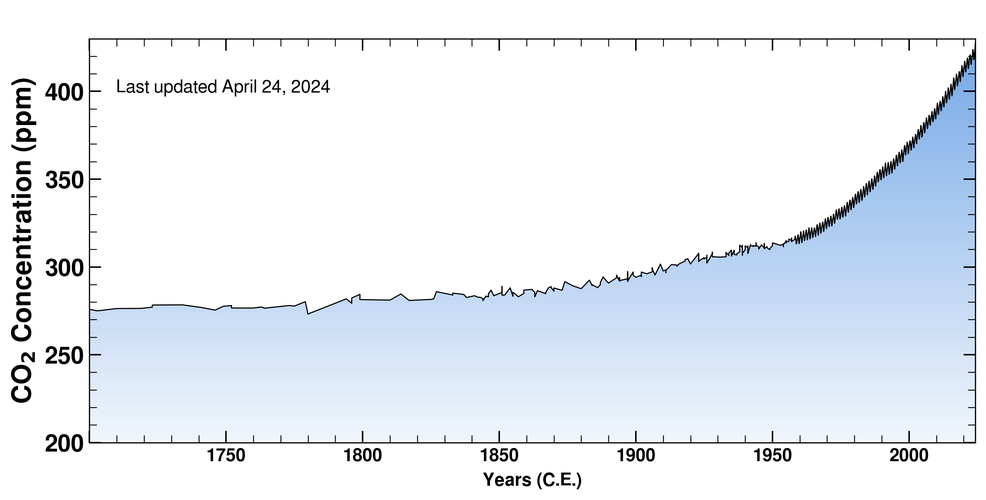
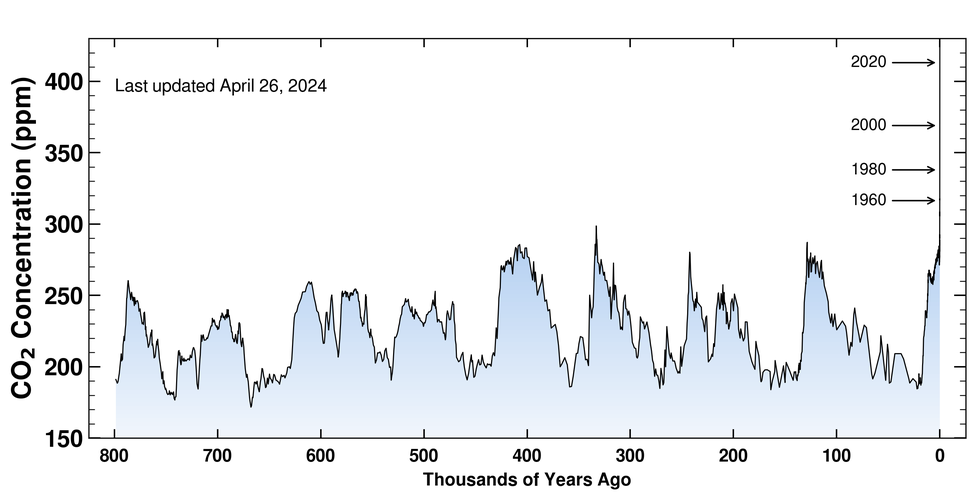
Carbon dioxide concentrations have hit 400 parts per million for the first time in human history. Some historical perspective is in order.

Here is the last 300 years:


And here is the last 800,000 years:


Make sure your poison ivy thanks you.


Continue reading...

Thursday, September 06, 2012

Arctic Sea Ice is Recovering

The summer of 2007 saw a record in seasonal Arctic sea ice melt. A few years later in an online discussion, I was told that Arctic sea ice was recovering. This was based on the fact that sea ice melt in subsequent years had not reached the low point of 2007. A look at decade-scale trends did not support the assertion, but hey--trends shmends!

This summer is smashing the 2007 record low (source).


We've already passed the previous record, and we probably have not hit bottom quite yet.

But here's the good news: Seasonal Arctic sea ice melt in the next couple of years will probably not reach this year's low. And that means Arctic sea ice is recovering! Yay!

Skeptical Science illustrates how this game is played (note that 2012 is not shown (yet?)):


Continue reading...

Friday, May 18, 2012

Stewardship and the Creation

I just finished reading Stewardship and the Creation: LDS Perspectives on the Environment, and the more I think about it the more remarkable the book seems. It's a compilation of essays and articles by LDS authors reflecting on environmental attitudes and issues. It levels some criticism at our western culture, and it even includes some soft criticism of creationism. What makes it remarkable is that it was published in 2006 by the Religious Studies Center of BYU, a research and publishing arm of the BYU religion department. You can read it for free at their website.

Environmental issues tend to be contentious, particularly in the current U.S. political climate. Skepticism--or even disdain--of environmental causes tends to emanate from the same political party that LDS members tend to belong to. As the bloggernacle's own Steven Peck (BYU professor and co-editor) writes:

While on a recent fishing trip with some good Latter-day Saint men who otherwise would never swear, they could not say the word environmentalist without putting the word damn in front of it.
He further notes:
From my experience with members of the Church, I see that they have a profound love for nature. They love camping, hunting, and spending time in the wilderness. ... Many of those who express outrage at the mention of environmentalism are Scouters who profess a strong conservation ethic. They have profound memories of being in wilderness areas, which they speak about with love and passion. But talk to these same people about environmental protection, and they vehemently denounce it and claim such legislation is supported only by extremists and malcontents. When I suggest to my good Latter-day Saint family and friends about global warming, the worldwide loss of species, or the protection of our wild areas, they scoff not only at the idea that we should be concerned about these things but that there is even such a problem that needs attention.
Yet, as Elder Neal A. Maxwell wrote,
This restored work not only involves the things of eternity but is also drenched in daily significance. True disciples, for instance, would be consistent environmentalists—caring both about maintaining the spiritual health of a marriage and preserving a rain forest; caring about preserving the nurturing capacity of a family as well as providing a healthy supply of air and water...Adam and Eve were to "dress the garden," not exploit it. Like them, we are to keep the commandments, so that we can enjoy all the resources God has given us, resources described as "enough and to spare" (D&C 104:17), if we use and husband them wisely. [A Wonderful Flood of Light, p. 103.]
Cultural and political leanings notwithstanding, this book repeatedly points out that environmental concern has strong foundations in our scripture and the teachings of the prophets. If you don't like the word environmentalism, call it conservation, self-reliance, stewardship, or provident living. It ultimately amounts to much the same thing.

In light of the knee-jerk polarization that can occur on this topic, it is unfortunate that the book didn't open with Peck's essay, "An Ecologist’s View of Latter-day Saint Culture and the Environment," because he explores how Latter-day Saints approach several environmental issues and compares it to the broader environmental movement. In spite of a few high-profile disagreements (e.g. population control) and different starting premises, he finds substantial overlap. I think this essay best lays the groundwork for understanding the rest of the book, and I would recommend readers start with it.

A number of the essays are excellent and overlap somewhat in their presentation. I will warn you that some of the chapters are a bit dry, so if they don't interest you, move on to others. Some essays focus more on Utah itself-- especially the late 1800s--while others are more general. I found chapter 11, "A House Divided: Utah and the Return of the Wolf," particularly interesting. Wolves have an image problem that they apparently do not deserve, and I did not realize what central players they were/are in western ecology. (I couldn't help but wonder if their re-introduction to Utah might reduce the number of automobile-deer accidents).

There is always difficulty getting people to accept cause-and-effect relationships. Chapter 8, "The Hope for Extraordinary Ecological Improvement," describes damage that was done in Utah by overlogging and overgrazing. The result was a loss of mountain watersheds and consequent catastrophic floods. Yet some opposed projects to restore and protect the watersheds, attributing the floods to acts of God. There is certainly a basis in scripture for attributing natural disasters to God, but the scriptures and prophets have also been clear about our subjection to the laws of nature.

Chapter 13, "Rattlesnakes and Beehives: Why Latter-day Saints Should Support Ecologically Sustainable Development," makes the interesting suggestion that the latter portion of Doctrine and Covenants 59 can be read as a prophetic forewarning of our environmental problems. In that vein, we might think of it as the Word of Wisdom for the planet.

Chapter 12, "How Can Church Members Increase Their Environmental Awareness?" has a handy little chart of Ensign articles that treat environmental topics. It's not very large, but it's not nothing, either.

For the rest of this post, I'll just quote parts that stood out to me. Maybe they'll pique your interest enough to go read the book.

Chapter 1:
The dilemma we face in organizing our economic activities is that financial capital that Brigham Young identifies as being the least important is also the easiest to measure. Consequently, conventional thinking about economic activity is focused almost exclusively on financial capital with very little attention given to those aspects of human and natural capital that do not have an easily measured financial value.

Humans are free to choose wisely to partner with nature in mutually effective ways, but we are also free to ignore or even interfere with or destroy the work of nature. However, humans are not free to choose the consequences of our actions, the one being sweet and the other being bitter. The penalties for violating natural laws are real and irrevocable, and we as a culture will surely bear the consequences.

There are many who confuse prosperity with the power to waste. An oft-spoken rationale for waste is that if people own something, they are entitled to do with it as they please. This rationale is based on an assumption of the primacy of financial capital while deemphasizing human and natural capital. Brigham Young offers a different perspective by reminding us that one can never have enough to be wasteful, that everything that was created was created for a purpose, and that we interfere with God’s plan when we waste something that He created for a purpose.

Most people realize that for democracy to succeed, it must have a responsible and informed electorate. What is not as obvious is that for free markets to succeed in bringing forth a just and lasting prosperity, the market must have a responsible and informed “consumerate” and “investorate.” For those of us who are fortunate to live in a free market democracy, it is an important part of our sacred stewardship to be part of the responsible and informed electorate, consumerate, and investorate.

Chapter 7:
The scriptures indicate that this arrangement [humans as dominant] has been in place since the creation of Adam, and anyone who takes them seriously has to concede a certain utilitarianism behind the Creation, with man as the designated utilizer. To view the earth, her creatures, and her products strictly in utilitarian terms, however, or to assign them values on the basis of their temporal, immediate, man-centered utility, does not seem justified—especially when it was God himself who started pronouncing his creations “good” long before Adam was on the scene.

Chapter 11:
None of our modern prophets were trained in the complexities of conservation biology. Nevertheless, because they recognize environmental stewardship as a commandment, they advocate the same fundamental ideals as conservationists, namely, that humans are responsible for all life on earth.

Chapter 13:
Of course, wherever human judgment is required, opposing and impassioned social argument is inevitable. Judgment surrounding questions of environmental protection is no exception, and naturally many Latter-day Saints prefer to avoid what could be contentious issues. However, the fact that decisions are difficult or politically loaded and that definitive or detailed instruction has not proceeded from Church leadership does not excuse Latter-day Saints from the obligation to apply wise judgment in the use of “all things which come of the earth” (D&C 59:18). Disciples of Christ cannot choose the do-nothing option simply because there are competing and politically sensitive arguments. The duty to obey supersedes the detail.

Though the natural environment is in a state of perpetual flux and there is in real terms no ideal environment, the past three to four decades have witnessed a global awakening to the fact that humanity, in its rush for the golden egg of economic prosperity, is threatening the very existence of the goose on which it is dependent; namely, this incredibly unpredictable and majestically beautiful natural environment.


Continue reading...

Saturday, February 25, 2012

Heartland Institute Heartbreak

The drama unfolding around the release of internal documents of the Heartland Institute (HI) has been interesting, if unfortunate, to watch. In case you've not been following the action, someone posing as a board member of the HI obtained internal documents concerning funding, plans, etc, and anonymously sent them to DeSmogBlog. The HI is probably the most prominent of global warming skeptic "think tanks," and DeSmogBlog covers the corporate attempts to obscure climate issues. We now know that the anonymous poser was climate scientist Peter Gleick, who publicly admitted his role and apologized.

My judgment was blinded by my frustration with the ongoing efforts -- often anonymous, well-funded, and coordinated -- to attack climate science and scientists and prevent this debate, and by the lack of transparency of the organizations involved. Nevertheless I deeply regret my own actions in this case. I offer my personal apologies to all those affected.
Gleick's actions are unfortunate for at least two reasons. First, they were arguably unethical and unlawful, but certainly dishonest, and that dishonesty will hurt more than just him. Second, they distract attention from what the HI has been up to (serving as a policy front group for corporate donors, creating an educational curriculum, etc), and may even create a feeling of sympathy for HI among the public.

I'm reminded of Doctrine and Covenants 10:28:
Verily, verily, I say unto you, wo be unto him that lieth to deceive because he supposeth that another lieth to deceive, for such are not exempt from the justice of God.

But I can't help but note the asymmetry here. Gleick's actions have been condemned by Nature and other climate scientists, as well as prompted his resignation from several science organizations. I expect that similar consequences will continue to play out.

Meanwhile, it seems that amongst the climate skeptic community that there is nothing too false or misleading that can't be used to undermine mainstream climate science. Whether taking stolen emails out of context or pushing plainly incorrect information, there just doesn't seem to be any cost for dishonesty, let alone incompetence, amongst climate skeptics.

Sign of the times, I suppose.


Continue reading...

Tuesday, November 22, 2011

Climategate 2

Two years ago, emails among climate scientists taken from the servers of the University of East Anglia were released to the world, which sparked a pseudo-scandal known as 'Climategate.' The emails, some taken severely out of context, were used to tar the whole field of research and create the impression that climate scientists are an insular group who break the law, falsify data, and suppress opposition in order to keep the global warming hoax alive so that [insert nefarious rationale]. In the intervening time, investigations have largely cleared the scientists swept up in the whirlwind, and the temperature record was recently re-affirmed by an independent analysis. Nevertheless, the storm of controversy had effects that can be seen to this day, with attempts to get all of Michael Mann's emails and files from the University of Virginia working their way through the courts, and commentators like Rush Limbaugh continuing to cite the emails as proof that global warming is a scam.

Now, in time for the holiday season, a new batch of emails has been released. However, like most sequels, Climategate 2 looks likely to be disappointing for those interested in stirring up controversy. The emails appear to be left-overs from the first batch released, and you can bet the scientists involved won't be caught flat-footed this time.

A quick digression: This business of trolling through emails looking for something salacious is understandable. After all, these are supposed to be the unguarded real thoughts of the people involved, and sometimes internal communications really do contain damning information (see: tobacco companies). But it's always struck me how this kind of storm could envelope any area of research. Every field has its contested concepts, its grandstanders, and its controversial figures. Scientific papers are not handed to us on tablets written by God, they are written by people who have to hash out the best way to tell the story--where to put the emphasis, what data to include, and how to contextualize it. In that respect it's a little bit like journalism or the law. (Hey, there's an idea. Imagine the stories we could get out of the internal communications of a decent sized law firm!) Probably nobody will ever care about my own work, but I sometimes imagine what kind of controversy could be spun out of my communications.

Hopefully we're all a little wiser this time. (But maybe not.)


More details:

The Guardian

BBC


Continue reading...

Thursday, October 20, 2011

Newsflash: Climate Scientists Knew What They Were Doing

The 'climategate' pseudo-scandal two years ago shook a lot of people's confidence in climate science--to the point that some skeptics questioned whether the instrumental record actually showed a warming trend. Occasionally someone would claim that the record had been fabricated, but more often suspicions were expressed that the data were manipulated to give a false warming trend.

Then there was Anthony Watts, who enlisted volunteers to find land temperature stations and made a big deal about how many of them were near asphalt, air conditioners, BBQ grills, and other warm objects. According to Watts, the warming trend is actually temperature contamination.

Enter physicist Richard Muller and the Berkeley Earth Surface Temperature team, whose aim was to re-analyze the temperature records to find the true story. Today they announced their results.

On the basis of its analysis, according to Berkely Earth's founder and scientific director, Professor Richard A. Muller, the group concluded that earlier studies based on more limited data by teams in the United States and Britain had accurately estimated the extent of land surface warming.

"Our biggest surprise was that the new results agreed so closely with the warming values published previously by other teams in the U.S. and the U.K.," Muller said. "This confirms that these studies were done carefully and that potential biases identified by climate change skeptics did not seriously affect their conclusions."

Previous studies, cared out by NOAA, NASA, and the Hadley Center, also found that land warming was approximately 1°C since the mid-1950s, and that the urban heat island effect and poor station quality did not bias the results. But their findings were criticized by skeptics who worried that they relied on ad-hoc techniques that meant that the findings could not be duplicated. Robert Rohde, lead scientist for Berkeley Earth, noted that "the Berkeley Earth analysis is the first study to address the issue of data selection bias, by using nearly all of the available data, which includes about 5 times as many station locations as were reviewed by prior groups."
Well, OK then.

(See also The Economist: The heat is on.)


Continue reading...

Saturday, September 17, 2011

If I Had a Side Blog (#4)

1. How does the drought in Texas stack up against over one hundred years of history? The Texas state climatologist explains, and it's worth reading. He also explains what he thinks it has to do with global warming.

2. This mormon butterfly was half-female, half-male. What was its spirit?

3. Naming and shaming: The Dr. Oz Show claimed that apple juice it tested contained unsafe levels of arsenic. The FDA says that Oz is wrong, in no uncertain terms.

4. And while we're at it, there's no evidence that antioxidants are good for you. In fact they may even be bad.

5. By the way, did you know that Senator Orrin Hatch helped exempt the supplement industry from the oversight given to other drugs and health products?

6. It was 20 years ago this month:


Continue reading...

  © Blogger templates The Professional Template by Ourblogtemplates.com 2008

Back to TOP