Monday, August 30, 2010

Hezekiah's Tunnel Refutes Flood Geology

BioLogos has a nice paper by two geologists titled, "Christian Geologists on Noah’s Flood: Biblical and Scientific Shortcomings of Flood Geology (PDF)." Here are two paragraphs from the introduction.

Our primary interest in this paper is...the widely promulgated notion that the Flood can account for the earth’s complex geology. Flood Geology derives from a belief that Genesis teaches that the world is very young – less than 10,000 years. To explain the vast thicknesses and incredible complexity of the earth’s sedimentary deposits within a short history, it is argued that the Flood must have been both global and violent. Flood Geology is thus synonymous with belief in a young earth. It is our conviction that this position is unreasonable from both a biblical and scientific perspective.
Flood Geology proponents would have us believe that there is extensive evidence for a violent, earth-wide flood that is apparent if one is willing to consider the possibility. As Christian geologists, we have no philosophical objection to a cataclysmic event of divine origin, and have long been willing to consider evidence of such an event. What we have observed, however, is that evidence for Flood Geology is largely, if not entirely, non-existent. Given the placement and character of sedimentary deposits currently on earth, deposition by a single flood is not only implausible, but utterly impossible unless God temporarily suspended His natural laws in order to establish layers and fossil beds that would subsequently communicate a story vastly different than what actually happened.
The authors then present several brief vignettes that show how geological features are at odds with Flood Geology. These include:
  • Salt Deposits
  • Grand Canyon: order of deposition
  • Fossil Sequence
  • Tree Rings and Varves
That last one is where Hezekiah's tunnel comes in, along with the Isaiah portion of the Dead Sea Scrolls. You'll have to read the paper to see how they fit in to the issue, but I will just say that that section was my favorite (Mmm, tastes good!) and, although I don't think it should be too difficult to understand, it's well worth taking the time to comprehend. Pay particular attention to Figure 6, which shows several alternative examples of what one would expect to see under different scenarios that represent common creationist arguments.

After reading the paper, come back here to discuss it, if you like.


Continue reading...

Wednesday, August 25, 2010

First Flesh

When a 1929 reading committee consisting of Apostles rejected B.H. Roberts' manuscript, The Truth, the Way, the Life, one of their chief objections was to the idea that the earth had suffered a cataclysm that eliminated all life, and that Adam was the first creation--the 'first flesh' (Moses 3:7)--of the new creation. Like many others, Roberts had noted that the creation account of Genesis 1 and 2 seems to actually contain two different stories with the second having a different order [1], and he thought comments by Joseph Smith to the effect that the earth was formed from broken-up planets provided the way to reconcile the difference. Roberts had previously published a similar interpretation in the late 1800s in the periodical, The Contributor, and in his book, The Gospel and Man's Relationship to Diety. The committee wrote:

We feel that the arguments as given contradict the accounts given in all our scriptures, and more especially in the temple ceremonies. As we understand the term, 'first flesh also,' does not have reference to Adam as being the first living creature on earth, but that he, through the 'fall' became the first 'flesh,' or mortal soul....We are taught in the Temple as well as in the scriptures that man was the last creation placed upon the earth, before death was introduced [2].
In support of this argument, several scriptures were quoted where the word 'flesh' is used as a synonym for mortality.

However, this interpretation appears to be a twentieth century product. I don't know whether or not this interpretation originated with Joseph Fielding Smith--the committee report asserted that the same view was held by then-deceased Presidents Joseph F. Smith and Anthon H. Lund--but he was the first that I know of to articulate it. He was on the reading committee and it seems likely that the committee report reflects his reasoning. His own writings published later contain almost identical arguments. For example, in Man, His Origin and Destiny he wrote:
The expression, "the first flesh upon the earth," is simply a statement of the fact that Adam—the first man on the earth—was, by reason of his transgression the first to partake of mortality. That is to say, the fall brought the mortal as well as the spiritual death. "Mortality" and "flesh" are often used as synonymous terms. The account in Genesis of creation informs us that Adam and Eve were the first to become subject to the mortal, or temporal, death. This fall brought death into the world....The mortal condition was extended so that it eventually embraces every creature on the land, in the air, and in the sea. In this way all creatures became "flesh," but not until after man had so become...

So Adam became the "first flesh on the earth," through the fall, not that he was placed here before any other creature.
Similar passages can be found in Doctrines of Salvation vol. 1, a collection of his sermons and writings, and in both cases a similar list of scriptures is cited. This interpretation of 'first flesh' was further amplified by his son-in-law, Bruce R. McConkie, and it has become the dominant interpretation in the Church.

But the rejected B.H. Roberts was not the only one who saw things differently. Orson Pratt gave two speeches in the 1870s in which he explained that the account of Genesis 1 was of the spiritual creation (something Joseph Fielding Smith and Bruce R. McConkie would later categorically deny), and that the physical creation began with the creation of Adam as the 'first flesh.'
We learn, therefore, when speaking of this spiritual creation, that not only all the children of men, of all generations, and of all ages, were created spiritually in heaven, but that fish and fowls, and beast, and all animated things, having life, were first made spiritual in heaven, on the fifth and sixth days, before bodies of flesh were prepared for them on the earth; and that there was no flesh upon the earth until the morning of the seventh day. On that morning God made the first fleshly tabernacle and took man's spirit and put within it, and man became a living soul—the first flesh upon the earth—the first man also. Though it was the seventh day no flesh but this one tabernacle was yet formed. No fish, fowl and beast was as yet permitted to have a body of flesh. The second chapter of Genesis, (new translation) informs us that the spirits of fowls were created in heaven, the spirits of fish and cattle, and all things that dwell upon the earth, had their pre-existence. They were created in heaven, the spiritual part of them; not their flesh and bones [3].
As late as 1904 the 'Editor's Table' of the Church's Improvement Era printed someone's objection to a youth manual that stated, "Last of all came beasts, insects, and animal life generally, with man to crown the whole work of creation." The correspondent explained, "Now, as I understand the first chapter, it relates the order of the spiritual creation of all things, and the second chapter that of the temporal, or earthly creation," and quoted Moses 3:4-7 as support [4]. The editor responded,
It must be stated that the text of the manual is very short, and teachers are expected to add facts not always found in the text, but to be obtained from other authorized books upon the subject. The correspondent is undoubtedly correct in his statement, and the text of the manual should be interpreted to conform with the views held by the Prophet Joseph, in the Pearl of Great Price.
It seems clear that the novelty of B.H. Roberts' interpretation was the element of cataclysmic destruction, not the order of creation. (Actually, outside of Mormonism, Roberts' idea wasn't novel.)

Joseph Fielding Smith's interpretation hinges on the meaning of 'flesh' in Moses 3:7. As mentioned above, he cited scriptural passages where 'flesh' is synonymous with 'mortality' as justification for his interpretation. Although this interpretive move allows for harmonization of the creation accounts, it does not account for three other uses of the word within the same chapter (verses 5, 21, and 23) where it seems clear that the equation with mortality does not apply.

None of these interpretations fit well with science. Joseph Fielding Smith's interpretation makes Adam the first mortal life on the earth, something contradicted by the vast fossil record. However, Orson Pratt's interpretation isn't any better. In fact, he actually attacked geology on the grounds that if Adam was the first creation, then the the fossil record could not be informative of Earth's history. Roberts' interpretation is speculative and ultimately not helpful. (For a more science-friendly interpretation, see Sterling Talmage's view here.)

An unstated premise of each of these interpretations is that the creation accounts are all intended to be consistent with one another, and that they are an accurate description of history according to our Greek-influenced way of thinking. However, although this premise is often assumed, perhaps the resulting conflict with science is an indication that it should be re-examined.

We often read the scriptures as if their meaning is self-evident. Like fish in water, we are often unaware of our cultural surroundings and their influence on us. Looking at how different leaders have interpreted 'first flesh' serves as a reminder that current, dominant interpretations may not always have been dominant, and may not be final.


Notes:

1. Mainstream biblical scholarship recognizes these two creation stories as having been composed by different people at different times. Aside from the different order, one of the most obvious clues supporting this interpretation is the use of different names for God. In Genesis 1-2:4 God is always 'elohim.' In the rest of the creation narrative God is always 'yahweh elohim' (i.e. Jehovah Elohim, or LORD God in the KJV).

2. B.H. Roberts, The Truth, The Way, The Life, BYU Studies, p. 292-293.

3. Orson Pratt, Journal of Discourses, Vol. 21, p. 200 (1879). See also Vol. 15, p. 253 (1872).

4. Improvement Era, Vol. VII, No. 5, March 1904.


Continue reading...

Thursday, August 19, 2010

The Tale of Barry, Christopher, and Joe

I recently highlighted BYU geology professor Barry Bickmore's climate change blog where he has been spending considerable effort taking apart the credibility of Lord Christopher Monckton. Monckton is not a scientist, but is the 'Chief Policy Adviser' of the Science and Public Policy Institute and has traveled the world lecturing to the public as well as testifying before government bodies such as the U.S. Congress about his skeptical views toward anthropogenic global warming.

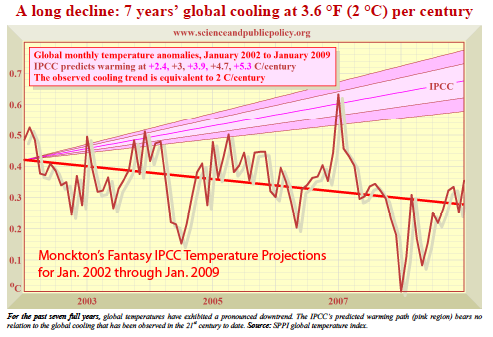
Last week Bickmore had a post criticizing the methods of Monckton featured at the blog RealClimate, which is run by a number of climatologists (see follow-up here). What caught my attention was his criticism of this figure by Monckton.


The messsage of the figure, of course, is that temperatures of the last few years are way off the prediction of the IPCC. Bickmore, however, says that the IPCC 'prediction' is actually a result of Monckton's aribtrary choosing of a future CO2 atmospheric concentration and the misapplication of an equation, and that if you look at what the IPCC actually projected, the measured temperatures largely fall within the bounds of the projection. (Note: The IPCC doesn't make any single predictions. They use a number of different emissions scenarios to plug into their models so that the outcome is a range of possibilities.)

I think the figure can be criticized on additional grounds. I'll just hit a couple of angles. It seems clear from the figure legend that the IPCC 'prediction' represents the trend of a century, and that the trend was made by picking endpoints in 2100 and drawing straight lines back to 2002. But there is no reason to expect that the actual temperatures and their small-scale trends moving forward will always fall within those lines--especially at the beginning! It's kind of like comparing the actual path a drunk walks in order to reach his destination with 'as the crow flies'.

To make my point, I've re-drawn Monckton's IPCC (middle) trend and plotted the annual means with their trend in orange. Just like Monckton's figure, the temperature trendline deviates downward from the IPCC upward trend.


Wait! Did I just say that I re-drew Monckton's figure? Oops. What I should have said is that I plotted the temperature trend over the previous century (1902-2001), along with the annual means of the first ten years with their temperature trend. It looks a lot like Monckton's! Now look when I fill in the annual means for the whole century.


Do I need to belabor this issue any longer? I hope not.

Another interesting thing about this graph is the range of temperature rise attributed to the IPCC. Monckton's graph says it's between 2.4 and 5.3 degrees C over the next century. Now we could look at the 2007 IPCC report to see what their most recent projection looks like. However, a skeptic might argue that by 2007 the IPCC knew reality wasn't matching up to their predictions, so they altered their predictions. So instead, let's look at what the 2001 report says.

The globally averaged surface temperature is projected to increase by 1.4 to 5.8°C (Figure 5d) over the period 1990 to 2100.
Hmm. That's more leeway than Monckton allows. And just for kicks, what if we plot the annual means since 1990 and compare their trend (black) to the minimum in the 2001 report (blue)? [Note: My original post mistakenly switched the colors.]


That's kind of weird. It's as though global mean temperatures since 1990 are exceeding the low side of the 2001 IPCC projection.

OK, but so what? Well, when I read Bickmore's post I realized that I had seen that graph before. Lest you think I have a photographic memory, let me assure you that I do not. Sometimes it's almost Homer Simpson quality.

Last September AccuWeather meteorologist Joe Bastardi made an appearance on The O'Reilly Factor where he claimed that the last few years of temperatures have had a downward trend, in contrast to IPCC predictions. In support of this claim, he used Monckton's graph.


The picture has poor resolution, and the big "AccuWeather.com" graphic on the upper left might make you think that this was an analysis done by either him or his AccuWeather colleagues. Wrong. A few days later he made an internet video, ironically titled "Is the Earth cooling, or is the data just fooling?", to defend himself against criticism in the wake of his TV appearance.


It is clear as day that he used a graph from Monckton's May 2009 "SPPI Monthly CO2 Report". Later in the video he mentions using graphics from the Science and Public Policy Institute--i.e. Monckton's organization. Indeed, Bastardi's data are just fooling.

Earlier this year at another blog, I was referred to the second video as evidence of global cooling. For whatever reason, the graph stuck in my mind--probably because the superficial contrast between IPCC predicitons and actual temperatures is so striking. So when I saw Bickmore's critique of it, I put two and two together.

So let's list some of the lessons here:

1. Be careful who you get your information from.
2. Be wary of people who stand against mainstream science--especially if they make the issue appear to be so simple that any idiot can see that the science is wrong.
3. It's a good idea to check the IPCC reports for yourself. Claims that the IPCC says such-and-so may not be accurate, especially when they come from a hostile source. In fact, Bastardi gives some good advice: Don't believe him, look it up for yourself.
4. A few years of temperatures are not informative of long-term trends.

Notes:

Monckton apparently generates his temperatures by combining various data sets. I simply used the HadCRUT3 global means (here). Skeptics like the HadCRUT data because it has 1998 as the warmest year instead of NASA GISTEMP's 2005. Also note that my graphs represent changes in temperature (anomalies) relative to a baseline (1961-1990) rather than actual temperatures.

Inasmuch as I am not a climatologist nor a statistician, I welcome corrections if I have made any errors.


Continue reading...

Tuesday, August 03, 2010

Sons of God Smackdown

Elder Mark E. Petersen, formerly of the Quorum of the Twelve, published a book in 1982 titled Noah and the Flood. In the sixth chapter, "Sons of God," Elder Petersen argued against ancient Jewish and Christian legends of sexual relationships between humans and heavenly beings. Toward the end of the chapter he pivoted and attacked the idea that humans are physically the children of God. Although there is more, I'll just quote the first and last paragraphs.

Certain persons try to use Luke 3:38 to sustain their mistaken point. The King James Version reads: "Which was the son of Enos, which was the son of Seth, which was the son of Adam, which was the son of God." (Luke 3:38.) But when the Prophet Joseph revised the scriptures, he changed that and made it read: "And of Enos, and of Seth, and of Adam, who was formed of God, and the first man upon the earth." (JST, Luke 3:45.) This harmonizes with the Genesis doctrine and other references to the origin of Adam....

Of course, any who suppose that God had children in the flesh, as suggested by the false worldly theories, would do well to remember that Jesus Christ of Nazareth is the Only Begotten Son of God, as is repeated so often in the scripture. That alone should settle the matter.
Certain persons? I wonder if he had in mind his junior quorum member, Elder Bruce R. McConkie, who wrote the following in Mormon Doctrine under the heading, "Son of God":
Father Adam, the first man, is also a son of God (Luke 3:38; Moses 6:22, 59), a fact that does not change the great truth that Christ is the Only Begotten in the flesh[*], for Adam's entrance into this world was in immortality. He came here before death had its beginning, with its consequent mortal or flesh-status of existence.
This is doubly interesting in light of the fact that Elder Petersen was assigned to thoroughly review Mormon Doctrine when it was first published. (Elder McConkie was a Seventy at the time.) He generated a lengthy list of corrections that played at least a partial role in President David O. McKay's decision that the book should not be further published. (Obviously that decision didn't stick.) I don't know if Elder Petersen's list of corrections exists anywhere, but it sure would be interesting to know if the Mormon Doctrine entry was among them.

It may be that this is mostly coincidence. I think it's more likely that Elder Petersen developed this argument as a polemic against Adam-God, which he addressed in his November 1980 General Conference talk, Adam, the Archangel, rather than as a response to Elder McConkie. But either way the end result is the same: two opposite interpretations of scripture and views on the creation of Adam.

This is all mostly of passing interest. However, there are some people who not only believe Elder McConkie's position, but also seem to think that acceptance of it is a mark of spiritual insight and faithfulness to the plain meaning of scripture. So if you find yourself in disagreement with Elder McConkie on this point, you've got good company in Elder Petersen.


*Fun fact: The phrase 'Only Begotten in the flesh' does not exist in the scriptures.


Continue reading...

Thursday, July 22, 2010

Creationism, Bacon, and First Presidency

Nick Matzke has an article in Evolution: Education and Outreach titled, The Evolution of Creationist Movements, that does a nice job of tracing the history of the modern creationist movement and shows why Intelligent Design, especially as championed by the Discovery Institute, is really just re-labeled creationism. There are whole books written on this, but if you want to get a basic overview, this article does a pretty nice job.

What caught my attention was the background on 19th century religion and the religious adoption of Baconian ideals. I don't want to pretend that I'm an expert on this, but I'll sketch out what I've gathered from my reading of this and other material.

Before the scientific revolution, Western civilization was ruled by a combination of religious teachings and inherited knowledge from ancients such as Aristotle and Galen. Reasoning began with premises established by ancients because they wrote during an earlier period when the world was less decayed. (In other words, they were closer to Adam and Eve.) So, for example, if you dissected a cadaver and found that the anatomy differed from what Galen had written, there was something wrong with you, not Galen.

Francis Bacon (1561-1626) broke with centuries of tradition and dogma by arguing that the way to understand the world was to gather facts about it, and use them as a basis to state general laws. This is called induction--collecting particulars and making general conclusions. It is usually contrasted with deduction, where general statements are used to determine particulars. That's probably kind of confusing, so let's try a couple of examples.

Induction: As a physician, you start to see patients who complain of gastrointestinal symptoms. In exploring their history you find that they all ate the potato salad at a local buffet. You conclude that the potato salad at the buffet was contaminated.

Deduction: As a physician, you see a patient who is experiencing paralysis as the result of an apparent stroke. Based on the location of paralysis and your knowledge of the brain, you diagnose the stroke as having occurred in a certain part of the brain.

Followers of Bacon eschewed theories and hypotheses because they were thought to prejudice proper viewing of facts, and this view of science dominated for a while. The inductive approach to science was imported into American Protestant Christianity where it was used as the basis for scriptural interpretation. Given the assumption that the Bible was the infallible word of God, the way to answer questions was to gather up the various passages (i.e. the facts) dealing with the issue, weigh them, and come to a conclusion. This approach to scripture was combined with the sentiment that the scriptures be read according to the plain meaning of the text. This Baconian view of both science and scripture created a superficial harmony between the two, because all facts gathered from nature could be interpreted in the light of the facts of scripture.

However, the Baconian approach to scripture was not without problems, especially when it came to the issue of slavery. The Bible simply did not condemn slavery, and even seemed to support it. Thus, religious authorities who argued that slavery was immoral had do to so without Biblical support. Meanwhile, science moved beyond the Baconian view, and theories and hypotheses came back into favor. This is encapsulated in a quote from a letter by Charles Darwin.

About thirty years ago there was much talk that geologists ought only to observe and not theorize; and I well remember someone saying that at this rate a man might as well go into a gravel-pit and count the pebbles and describe the colours. How odd it is that anyone should not see that all observation must be for or against some view if it is to be of any service!
Darwin's theory has been seen as a threat to religion, so it's no wonder that his detractors have sought to delegitimize theory itself. Matzke writes,
Historians have argued that fundamentalist opposition to evolution was, in part, an attempt, however quixotic, to return science to its Baconian, theory-free state, and to return the culture to a time when the Bible commanded the same kind of cultural authority that science has, particularly with the elites in government and academia. This is expressed in the common creationist statement (actually, misstatement) that they agree with scientists on all the facts, but that the creationists’ interpretation of the facts differ. Their hope is that modern culture can be returned to a state similar to that in the early 1800s, when science was Baconian and didn’t conflict with Baconian Bible interpretation, and when this unified biblical, evangelical worldview was the cultural consensus and had great cultural power
You can see the contempt for theory in the writings of George McCready Price. Price was a Seventh-day Adventist who is usually considered the grandfather of modern-day flood (as in Noah) geology, which is the backbone of young-earth creationism. At the bottom of this post I've embedded his 1913 book, The fundamentals of geology and their bearings on the doctrine of a literal creation. Enter "inductive" into the search box and you will see example after example of Price extolling the value of inductive science as "true" science.

Why the obsession with inductive science? At least one reason is because it adds value to what would otherwise be considered anomalies or special cases under a competing theory, thus seeming to refute the theory. A classic example of this for Price was his assertion that out-of-order strata refuted mainstream geology, with it's order of layers and the fossils contained therein. Of course such anomalies could be accounted for as special cases where pressure caused folding or overthrusting of geological layers. But Price would have none of that, and dismissed these explanations (no matter how well supported) as speculation. He could then argue that the fact of out-of-order strata actually teaches us something about geology, which is that there is no actual order.

All of this background gives a 1910 statement by the First Presidency additional color.
Our religion is not hostile to real science. That which is demonstrated, we accept with joy; but vain philosophy, human theory and mere speculations of men, we do not accept nor do we adopt anything contrary to divine revelation or to good common sense.
This language seems to come straight out of the Baconian tradition--separating fact from theory. Yet we need to be careful because the word theory can be used in at least two different ways, and equivocation between them causes confusion. On the one hand, the word is often used as a synonym for hypothesis, hunch, or guess. Even scientists use this common meaning, which reinforces it in the public mind. And it probably doesn't help that many of the things that come out of 'theoretical physics' sound so strange. On the other hand, the word can be used to refer to the overarching structure that organizes a field of study. I once saw a textbook titled something like, "Organic Chemistry Theory," but nobody would dismiss organic chemistry as mere guesswork (except maybe students!).

So where does this leave us with respect to the First Presidency statement? I'm not really sure. Mostly I just wanted to share some interesting intellectual history and the seeming connection to the First Presidency 1910 statement. Clearly the statement is one of caution that we not chase every new fad. And I doubt that they intended to weigh in on the philosophy of science. But to the extent the statement seems to echo Baconian ideals, it fits into the religious culture of the time.


Continue reading...

Thursday, July 15, 2010

Anti-Climate Change Extremism in Utah

Barry Bickmore is active in Mormon apologetics. He has written material for both FARMS and FAIR, including a book, Restoring the Ancient Church: Joseph Smith and Early Christianity. He's also a professor of geology at BYU, an active Republican, and he's mad as he** about how climate change is being distorted among Utah politicians, and he's not taking it lying down.

He was among the BYU faculty that previously urged the Utah legislature not to embrace fringe views, and he's got a blog, Anti-Climate Change Extremism in Utah, where he takes apart the right-wing of the Utah legislature as well as the climate disinformer Lord Christopher Monckton.

Go check out his blog. As a fun place to start, try: Do Wackos Control the Utah Republican Party? See also his reason for creating the blog.


Continue reading...

Sunday, July 11, 2010

Five Strikes. Is Climategate Out?

The New York Times editorial, "A Climate Change Corrective," does a nice job of summing up the latest. Here's an excerpt:

Perhaps now we can put the manufactured controversy known as Climategate behind us and turn to the task of actually doing something about global warming. On Wednesday, a panel in Britain concluded that scientists whose e-mail had been hacked late last year had not, as critics alleged, distorted scientific evidence to prove that global warming was occurring and that human beings were primarily responsible.

It was the fifth such review of hundreds of e-mail exchanges among some of the world’s most prominent climatologists. Some of the e-mail messages, purloined last November, were mean-spirited, others were dismissive of contrarian views, and others revealed a timid reluctance to share data. Climate skeptics pounced on them as evidence of a conspiracy to manipulate research to support predetermined ideas about global warming.

The panel found no such conspiracy. It complained mildly about one poorly explained temperature chart discussed in the e-mail, but otherwise found no reason to dispute the scientists’ “rigor and honesty.” Two earlier panels convened by Britain’s Royal Society and the House of Commons reached essentially the same verdict. And this month, a second panel at Penn State University exonerated Michael Mann, a prominent climatologist and faculty member, of scientific wrongdoing.
The website for the investigation is The Independent Climate Change Email Review, where you can download the report (PDF).

Reactions are predictably polarized. To those who believed the fraud claims, but change their mind as a result of these investigations, I say: Be more careful about who you listen to next time.


Continue reading...

Thursday, July 08, 2010

The First Man

[This is part of a series of posts I initiated with Book of Mormon Scholarship as an Elias for Evolution.]

It's time to wrap up this series. Any attempt within LDS circles to accommodate human history as revealed by science must sooner or later deal with the following fact: the scriptures refer to Adam as the 'first man' several times. In my opinion the most important one is the one most often quoted--Moses 3:7--so we will concentrate on it.

Moses 3:6-8

6 But I, the Lord God, spake, and there went up a mist from the earth, and watered the whole face of the ground.

7 And I, the Lord God, formed man from the dust of the ground, and breathed into his nostrils the breath of life; and man became a living soul, the first flesh upon the earth, the first man also; nevertheless, all things were before created; but spiritually were they created and made according to my word.

8 And I, the Lord God, planted a garden eastward in Eden, and there I put the man whom I had formed.
The first thing to notice is the strange choice of wording. The reference to 'man' is rather generic. God "formed man," and "man became a living soul, "the first man." Why doesn't it use the name of Adam, or refer to the man, as it does in the next verse? This oddity may or may not have any relevance to the overall discussion, but it is worth noting.

One other thing should be noted up front. This passage from the Book of Moses comes from Joseph Smith's revision of the Bible--the 'Joseph Smith Translation' (JST). Although some parts of the JST are entirely original material, it is clear that this passage is grounded in the Biblical (KJV) text. I don't think it out of bounds to suggest that this passage may reflect Joseph's understanding based on Biblical tradition more than the actual words of God. In Joseph's day, it was obvious that Adam was the 'first man,' so it seems unlikely that this passage was intended to bear such theological weight as it has now come to. However, many people would undoubtedly reject this idea, and I'm not ready to defend it, so I won't press it further.

One popular way of dealing with this passage is to play with the meaning of the word 'man.' The usual argument is that although there were many anatomically modern humans on the planet, the first 'man' was the one into whom God put a spirit that was one of his spirit children. I don't like this argument and I don't think it really solves any problems. In fact I think it actually creates potential for racism. I mention it simply because it is popular.

Alternatively, we can focus on the meaning of the word 'first.' Sterling Talmage, son of Apostle James E. Talmage, argued as follows [1]:
Such use of "first," as indicating preeminence instead of chronological precedence, is well established as an acceptable idiom in other languages as well as English. This usage does not lack other scriptural warrant; for instance, the firstling of the flocks, demanded for the Mosaic sacrifices, were the finest of the lambs not the oldest of the rams.

With this thought in mind, it has always seemed to me that the expression quoted, designating Adam as the "first flesh upon the earth, the first man also," was simply the fulfillment of the fiat in the preceding chapter regarding the preeminence of man among created beings: "Let them have dominion over the fishes of the sea, and over the fowl of the air, and over the cattle, and over all the earth."
Talmage's argument has real-world support. In a post from a couple of years ago I pointed out that someone once referred to Galielo as "the first man in the world," something that may sound strange to our ears but clearly did not denote chronology. I also suggested that Henry Eyring seemed to have an alternative meaning in mind when he wrote, "Adam was the one whom God recognized as presiding over the first dispensation and as such, with Eve his wife, became our first parents."

On the other hand, a lineage history has to start with someone, and that someone would necessarily be the chronologically first person in the story. It seems clear that the prophets of the scriptures really did think Adam and Eve were the first people (chronologically) on Earth. What reason would they--or Joseph Smith, for that matter--have to think otherwise? None, unless God told them so.

This brings us to a third option--that the creation scriptures serve a purpose other than science and history. The statement that 'man' became "the first flesh upon the earth, the first man also," comes in the midst of a largely figurative story, and within the confines of the story it makes perfect sense. It was only following scientific discoveries, and in retrospect, that the statement and its meaning became significant. But what if God did not intend the statement to be universally definitive? What if his purpose was more literary, helping to tell a story sufficient for the Israelites' needs (such as explaining what made them and their God superior to the surrounding empires)? I'm reminded of the words of Aslan in The Horse and His Boy, by C.S. Lewis.
"Child," said the Voice, "I am telling you your story, not hers. I tell no one any story but his own."
Returning to the figurative nature of the story, the very same verse says that God "formed man from the dust of the ground, and breathed into his nostrils the breath of life," something that even Joseph Fielding Smith and Bruce R. McConkie did not take literally [2]. It seems fair to question whether such micro-dissection of the text--dividing a single verse between literal and figurative--is warranted.

To summarize the argument sketched out in this series of posts: Just as science has required us to re-evaluate the popular understanding of the scope of the Book of Mormon, it also requires us to re-evaluate the place of Adam and Eve in human history. As far as we know, Adam was the first prophet and holder of the priesthood. The story of Adam and Eve and their descendants is a lineage history. As such, it ignores those who lived before or contemporaneously with Adam because, as far as the gospel (and Israelite superiority) is concerned, the story begins with him. Scriptures that indicate that Adam and Eve were the first humans can often be interpreted in alternative ways that are still consistent with scripture. Others can be attributed to the cultural context of the writers. Further, the early chapters of Genesis/Moses contain occasional odd elements that may hint at the presence of outsiders.

I enjoyed writing this series. I hope it was enjoyable to read and found to be useful.

Notes:

1. Sterling Talmage, Can Science Be Faith-Promoting?, p. 168-169
2. The meaning of 'first flesh' is also problematic, something I will take up in a post outside of this series.


Continue reading...

  © Blogger templates The Professional Template by Ourblogtemplates.com 2008

Back to TOP