Monday, August 22, 2011

The Scientific Views of LDS Presidential Candidates

[Update: See also news stories in the Deseret News and The Daily Beast.]

It's been an encouraging week for Mormon fans of science. In response to comments by Republican presidential candidate Rick Perry dismissing evolution as just a theory and global warming as as a fraudulent grasp for research funding, fellow candidate Jon Huntsman tweeted:

To be clear. I believe in evolution and trust scientists on global warming. Call me crazy.

Huntsman elaborated on ABC's This Week.
I think there’s a serious problem. The minute that the Republican Party becomes the party – the anti-science party, we have a huge problem. We lose a whole lot of people who would otherwise allow us to win the election in 2012. When we take a position that isn’t willing to embrace evolution, when we take a position that basically runs counter to what 98 of 100 climate scientists have said, what the National Academy of Science – Sciences has said about what is causing climate change and man’s contribution to it, I think we find ourselves on the wrong side of science, and, therefore, in a losing position.

The Republican Party has to remember that we’re drawing from traditions that go back as far as Abraham Lincoln, Theodore Roosevelt, President Eisenhower, Nixon, Reagan and Bush. And we’ve got a lot of traditions to draw upon. But I can’t remember a time in our history where we actually were willing to shun science and become a – a party that – that was antithetical to science. I’m not sure that’s good for our future and it’s not a winning formula.

Mitt Romney gave his view on global warming two months ago,
“I don’t speak for the scientific community, of course,’’ Romney said. “But I believe the world’s getting warmer. I can’t prove that, but I believe based on what I read that the world is getting warmer. And number two, I believe that humans contribute to that … so I think it’s important for us to reduce our emissions of pollutants and greenhouse gases that may well be significant contributors to the climate change and the global warming that you’re seeing.’’

As for evolution, during the last presidential contest Romney was clear:
“I believe that God designed the universe and created the universe,” Mr. Romney said in an interview this week. “And I believe evolution is most likely the process he used to create the human body.”

He was asked: Is that intelligent design?

“I’m not exactly sure what is meant by intelligent design,” he said. “But I believe God is intelligent and I believe he designed the creation. And I believe he used the process of evolution to create the human body.”


As governors, both Romney and Huntsman opposed the teaching of intelligent design as science in public schools.

The bottom line here is that of the current GOP presidential candidates, only the Mormons have affirmed their acceptance of two hot-button scientific subjects that puts them at odds with virtually all of the other candidates and with many in their political base.

Maybe the elders of Israel will save science from hanging by a thread. ;-)


Continue reading...

Friday, August 19, 2011

The Further Fall of Adam

Last week NPR did a story on the debate occurring among evangelical Christians over whether Adam and Eve were historical figures.

But now some conservative scholars are saying publicly that they can no longer believe the Genesis account. Asked how likely it is that we all descended from Adam and Eve, Dennis Venema, a biologist at Trinity Western University, replies: "That would be against all the genomic evidence that we've assembled over the last 20 years, so not likely at all."

Venema says there is no way we can be traced back to a single couple. He says with the mapping of the human genome, it's clear that modern humans emerged from other primates as a large population — long before the Genesis time frame of a few thousand years ago. And given the genetic variation of people today, he says scientists can't get that population size below 10,000 people at any time in our evolutionary history.

To get down to just two ancestors, Venema says, "You would have to postulate that there's been this absolutely astronomical mutation rate that has produced all these new variants in an incredibly short period of time. Those types of mutation rates are just not possible. It would mutate us out of existence."
The story points out that Venema is a senior fellow at the BioLogos Foundation, which later clarified:
All science can say is that there was never a time when only two people existed on the earth: it is silent on whether or not God began a special relationship with a historical couple at some point in the past.

The Mormon angle on this is very traditional, and yet progressive at the same time. (I previously posted some of my own thoughts in this series of posts.) I've never seen any Church leader question the historical reality of Adam and Eve. Further, with Adam having been equated with Michael the archangel by Joseph Smith, identified as the great patriarch and presiding priesthood holder of the human family in scripture, and singled out in Joseph F. Smith's vision of the spirit world, I think his historicity is safe with us.

But beyond maintaining the credibility of modern prophets, many Mormons see the existence of Adam and Eve as integral to the gospel message, which is something they share with many evangelicals. This has led some commentators to adopt an argument expressed by BYU religion professor Joseph Fielding McConkie.
How literally do we take the story of the Garden of Eden? This we know: Adam was real. He was as real as Christ. For if Adam was not real the Fall was not real; and if the Fall was not real the Atonement was not real; and if the Atonement was not real Jesus the Christ is not and was not necessary....Had there been no Eden there could be no Gethsemane; had there been no Eve there could be no Mary; if we have not inherited death from Adam, we have no claim on everlasting life through Christ [1].

If I can digress for a moment, this strikes me as a big non sequitur. What? If Adam was not real then I don't need the resurrection or forgiveness of sin? Nonsense. Death, sin, and separation from God exist independent of however we explain their origin. Although ostensibly presented as a defense of the Atonement, in my opinion the above argument is more like taking the Atonement hostage in defense of Adam. It's like saying, "Leave Adam alone or the Atonement gets it!"

At this point someone will object and point out that the scriptures speak of the Atonement as overcoming the effects of Adam's fall. And here is where we get to the progressive side of Mormonism. Although individual judgments of where to draw lines may vary, there is clear support from several Church leaders for taking at least some of the story of the Fall with a big grain of salt. In fact in the very same essay by McConkie quoted above, he wrote:
What, then, do we conclude of the Eden story? Was it figurative or literal? We answer by way of comparison. It, like the temple ceremony, combines a rich blend of both. Our temples are real, the priesthood is real, the covenants we enter into are real, and the blessings we are promised by obedience are real; yet the teaching device may be metaphorical. We are as actors on a stage. We role-play and imagine. We do not actually advance from one world to another in the temple, but rather are taught with figurative representations of what can and will be [1].

Speaking of the temple, the endowment used to be specific about this. As then Elder Boyd K. Packer put it,
What is said in the revelations about the Creation, though brief, is repeated in Genesis, in the Book of Mormon, in Moses, in Abraham, and in the endowment. We are told it is figurative insofar as the man and the woman are concerned [2].

Make no mistake. Joseph Fielding McConkie and President Packer see no truth in evolution whatsoever in the history of this world, and in the history of humans in particular. And yet, when it comes to the Garden of Eden things become figurative.

So we are left with a historical Adam and Eve and, paradoxically, an essential but figurative story that we call the Fall. That leaves a lot of room for interpretation and, it would seem, for science.

Before ending, let's look at one more thing from the NPR story.
"Evangelicalism has a tendency to devour its young," says Daniel Harlow, a religion professor at Calvin College, a Christian Reformed school that subscribes to the fall of Adam and Eve as a central part of its faith.

"You get evangelicals who push the envelope, maybe; they get the courage to work in sensitive, difficult areas," Harlow says. "And they get slapped down. They get fired or dismissed or pressured out."

Harlow should know: Calvin College investigated him after he wrote an article questioning the historical Adam. His colleague and fellow theologian, John Schneider, wrote a similar article and was pressured to resign after 25 years at the college.

The article that got Harlow in trouble is "After Adam," and it's an interesting read. Mormons will not agree with all of his arguments, but they may be surprised how often they do agree with him. Particularly interesting are the parallels between the story of the Garden of Eden and other ancient stories. Reading the article provides another example and a reminder of how interestingly Mormonism is positioned on some issues. Schneider's article is "Recent Genetic Science and Christian Theology on Human Origins." I've only skimmed it, but these sentences from the summary should catch your attention.
[Schneider] invites readers to examine [thinkers] for whom the Incarnation and Atonement are the purpose of creation from the beginning. Their understanding differs from the execution of divine “Plan B,” as implied by the Augustinian western version of an unintended “fall” from utopian first conditions.
The Atonement planned from the beginning? Now there's a thought.

Notes:

1. Joseph F. McConkie, "The Mystery of Eden," in The Man Adam.
2. Boyd K. Packer, "The Law and the Light," in The Book of Mormon: Jacob through Words of Mormon, To Learn with Joy.


Continue reading...

Sunday, August 14, 2011

Giving the Ensign Credit Where Credit is Due

A few weeks ago I criticized the Ensign for running a story about the Galápagos that mentioned science, talked about ecology, but did not mention Charles Darwin. Today on LDS.org I noticed an accompanying photo gallery that included this picture and caption:

This sculpture is near the entrance to the Charles Darwin Research Station in Puerto Ayora, Santa Cruz, where much of the Galápagos Islands research takes place, such as how to restore the islands to their natural conditions and raising baby tortoises.

So here we get a mention of his name, as well as a sculpture of his face. I think my original criticism still has some legitimacy, but this picture and caption place it in a new context, and the Church magazines deserve credit. I am happy to give them that credit.


Continue reading...

This is Nice


Continue reading...

Thursday, August 11, 2011

Bastardi Burns


The image to the left has been floating around the Internet for a while and I've wondered when I might have a chance to use it. Well, today is the day.

Weatherman and noted climate contrarian Joe Bastardi (featured in this previous post) was on Fox News last Saturday to talk about why humans are not causing global warming. He made two central claims (I'll get to the so-called NASA study later):

1. CO2-caused warming is contradicted by the first law of thermodynamics.

2. CO2-caused warming is contradicted by Le Chatelier's principle.

Of course the first law of thermodynamics is basically that energy cannot be created or destroyed, only converted to different forms. What does that have to do with anything? It beats me, and Bastardi didn't really explain. The implication seems to be that global warming 'alarmists' think that CO2 magically creates heat, or that the sun isn't involved or something. But that's stupid--and it burns. Light from the sun heats the earth, and CO2 traps some of that heat. More CO2 = more heat trapped. That isn't hard, is it? You may as well say that greenhouses violate thermodynamics.

As for Le Chatelier's principle, Bastardi says that it means that "any system in distress, physical or chemical in the atmosphere, tries to return toward normalcy." My undergraduate chemistry book defines it as follows:

If a stress is applied to a reaction mixture at equilibrium, reaction occurs in the direction that relieves the stress.
That's a chemistry version, but translating it into ordinary circumstances is easy. A simple example is heating water in a pot on the stove. Imagine that you have applied low heat to a pot of water and let it sit for 15 minutes. The water has reached a stable temperature, as heat enters and leaves the water at a certain rate. If you turn up the heat, the temperature of the water and the rate of heat escaping will increase until a new equilibrium is reached. Similarly, if you put a lid on the pot to trap the heat, the temperature will increase until a new equilibrium is reached. That's not too hard, is it? Bastardi seems to be implying that the earth has a temperature that it magically wants to be at. But that's stupid--and yes, it burns. The temperature of the earth as a whole is controlled by physics--specifically by how much energy it gets from the sun and how much is released back into space.

It's not like Bastardi said those things in a spontaneous moment. The show prepared a graphic to reinforce Bastardi's two arguments, which means that they had consulted with Bastardi about what he would say. So based on this and previous experience, may I suggest the following rule of thumb: when Joe Bastardi talks about climate science, expect to hear incorrect information. And here is a question for further thought. If it is true that 69% of people think that scientists falsify their data in support of global warming, why might that be? Could it be because they get a constant stream of misinformation from media outlets they trust?

For a fuller takedown of Bastardi's segment, see here.


Continue reading...

Saturday, July 30, 2011

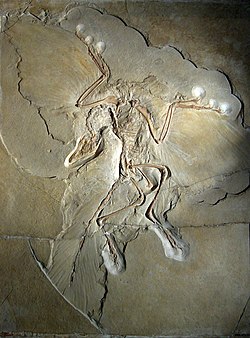
Archaeopteryx is Still a Transitional Fossil

A research article published in this week's Nature describes a fossil, named Xiaotingia, that comes from the boundaries of birds and (non-bird) dinosaurs. As part of their work the researchers performed a statistical analysis designed to give the best picture of who is related to whom, and the result has led to talk in the press of a fall from grace for the iconic fossil Archaeopteryx.

Archaeopteryx was discovered in 1861 and quickly attracted attention. Darwin's theory, published two years prior, held that new species formed by branching off existing ones, which when viewed backward in time meant that taxonomic divisions of organisms would gradually merge. And if that was the case, it meant that there should be transitional fossils--fossils that show characteristics intermediate between otherwise distinct lineages. Archaeopteryx fit the bill of a transitional fossil as a small dinosaur-like creature that also had feathers and a bird-like opposable toe. It's precise relationship to birds has been controversial over the decades, but it has widely been viewed as an early representative of the lineage connecting dinosaurs to modern birds.

Paleontologists don't generally think of fossil organisms as being direct ancestors or descendants from one another, since such relationships are very difficult, or impossible, to prove. Rather, they group them according to relatedness and as more specimens are collected, the relationships can shift around and be refined. Over the past couple of decades a number of fossils of feathered dinosaurs have been discovered, which has complicated the picture of how different lineages relate to one another. With this new fossil thrown into the mix, it now appears that Archaeopteryx was a sister lineage to the lineage that led to birds.

Whether these results hold up under further scrutiny and as more fossils are found remains to be seen. However, none of this changes the broader meaning for Archaeopteryx. It is still a transitional fossil.

For more authoritative information, see here.


Continue reading...

Saturday, July 23, 2011

Now THAT's Hot! Proof of Global Warming

I have to give my wife credit for this one. Yesterday she was watching an MSNBC online video and saw the following ticker-tape message:

Exreme heat in the eastern region of the U.S. becomes worse as temperatures go above boiling point in some areas

Um, OK.

[Update: The Associated Press screwed up too.]


Here's the video clip.

Visit msnbc.com for breaking news, world news, and news about the economy


Continue reading...

Thursday, July 21, 2011

The Ensign Avoids (What Should Be) the Obvious

The August issue of the Ensign has a seven page story about the Church in the Galápagos (link). [In my best Church Lady voice]: Now let's see. Who do the Galápagos islands remind me of? What person is famously and intimately connected with them. Oh, I don't know. Could it be DARWIN?! [a.k.a. SATAN?!]

Before reading the story, I said to my wife, "I bet you that there isn't a single mention of Darwin." Then I started reading. In the second paragraph we get this:

Here, on the Galápagos, islands born of fire, life takes on precious meaning. It is a land where science and faith intermingle, where we come to understand that we are all part of a common humanity.
Then the article talks about the experience of individual members of the Church. OK, no mention of Darwin but the article is firmly focused on Church members, so I guess those sentences will do.

But then in a section titled, "What the Galápagos Teach Us," the article starts talking about ecology and my ears perk up.
As a tour guide and naturalist, André explains, "The Galápagos teach us that an ecosystem is like a living being. It's like a body. It has pressure, fluids, and organs. If one of those things goes wrong, then everything suffers."
Interesting. Ecology in the Ensign? Cool.
The Galápagos Islands also teach us about the vast grandeur of God's creations. Nothing is indigenous to the Galápagos. All life, plants, animals, and people are imports.
Yes!
"If you think about it," André explains, "the chances of life beginning here on the Galápagos are incredible. First, the lava rock had to decompose to the point where it would support life. Then freshwater sources had to develop. Then seeds had to arrive in a condition that would allow them to germinate. And they had to be able to pollinate each other.

"Then creatures had to arrive, whether floating on the water or flying or whatever. And members of each sex had to arrive at the same time and place and condition so that they could reproduce and find food and water. There are thousands of species of animals in the Galápagos.
Yes! Yes! We're almost there! (Except a pregnant female would do as well as an opposite sex pair.) Go on!
"Remember, the nearest land mass is 600 miles [1,000 km] away. For all of these conditions to be met is something of a miracle."
Yes! You've got it! Bring it home!
And yet that is exactly what the Lord, in His infinite wisdom, caused to happen.


Oh, Ensign. You're supposed to be feeding my faith, not my cynicism.

I guess I should congratulate the author for his skill at dancing within a Book of Mormon's width of Darwin and evolution without touching them. And nice use of the word 'grandeur,' which Darwin used in his famous closing of Origin of Species. I think it's best if it serves as the end of this post, too.
There is grandeur in this view of life, with its several powers, having been originally breathed by the Creator into a few forms or into one; and that, whilst this planet has gone cycling on according to the fixed law of gravity, from so simple a beginning endless forms most beautiful and most wonderful have been, and are being, evolved.

Update: The Church magazines deserve credit for an online photo gallery, as I explain in this post.


Continue reading...

  © Blogger templates The Professional Template by Ourblogtemplates.com 2008

Back to TOP