Monday, November 29, 2010

Hockey Stick History: Past and Present

The public and political controversy over the science of global warming has become so tangled and has so many parts to it, that it is difficult to sort the whole thing out. I can't say that I have it all sorted out myself. This post is to help organize some information for myself, as well as to provide background to some new developments.

In the Beginning

Once upon a time (1990, to be specific), the IPCC issued their first climate report, which contained a figure representing the global average temperature over the last millennium. The figure looked like this, with the dotted line representing conditions at the beginning of the twentieth century:
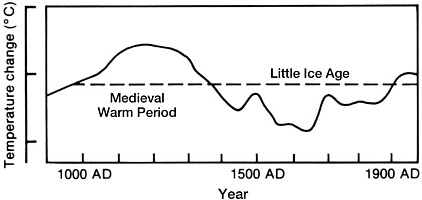

We should note here that there are three problems with this figure that are often overlooked. First, in the IPCC report it is called a "schematic." Second, it is based on data from mostly central England, and cannot, by itself, be considered representative of the whole globe, or even the whole Northern Hemisphere. Third, although it appears to be current up to the end of the twentieth century, the data it is based on do not include the last few decades of the twentieth century which is when much of the current warming has taken place. (See Common graphical tricks and the Medieval Warm Period.)

Then in 1998 a young climatologist named Michael Mann did a study of tree rings, corals, and other indicators in order to reconstruct the average temperature of the Northern Hemisphere and compared it to the recent record taken by instruments. The results were published in 1998 and 1999, and looked like this:


This image was the basis for a figure featured prominently in the 2001 IPCC report, which looked like this:


Thus the 'hockey stick' was born and the conditions for controversy were set. The last figure suggests that the current warming of the planet is unprecedented in the last 1,000 years and helps to bolster the case that humans are warming the planet. In contrast, in the first figure the current warming (which actually is not shown, as noted above) appears insignificant compared to the so-called medieval warming period (MWP). Skeptics of global warming have seized upon this difference. They claim that the first figure (along with other data) shows that global warming is not significant and charge that bias, if not outright fraud, led the IPCC to embrace the later figure and discount the MWP.

Retired mining statistician Stephen McIntyre and economist Ross McKitrick became interested in Mann's figures and published criticisms of the statistical analysis behind them. Their basic claim was that the shape of Mann's graphs were an artifact of incorrect application of statistical analysis, and that the analysis relied too heavily on certain data sets which bias the early points toward the low side. Their 'corrected' version, published in 2003, looked like this (note that the instrumental record is not shown):


These criticisms touched off a number of papers with claims and counter claims, and here those of us without statistical training see everything blur into a nerd-fight over statistical methods. Added into this mix is a spat over data and whether Mann shared enough of his data and code with McIntyre and McKitrick, and whether he was even obligated to. To hear McIntyre and McKitrick tell it, they were able to uncover flaws in Mann's work through heroic efforts in overcoming Mann's stonewalling. To hear Mann tell it, McIntyre and McKitrick made ill-founded criticisms and were demanding data and computer code that they were not entitled to. You can get a sense for this in the Wall Street Journal article, In Climate Debate, The 'Hockey Stick' Leads to a Face-Off.

What I have outlined thus far accounts for a significant portion of the public controversy. Meanwhile, in 2005 a group of scientists in Sweden and Russia published their own reconstruction of Northern Hemisphere temperatures over the last 2000 years, which looked like this:


Investigation

Eventually Congress got involved. It asked the National Research Council (NRC) of the National Academy of Sciences (NAS) to look into Mann's methodology and conclusions. The report, Surface Temperature Reconstructions for the Last 2,000 Years, was released in 2006. Although it did contain some criticism of Mann's statistical analysis and conclusions, it was basically supportive. In 2008 Mann published a new reconstruction that took into account the NRC criticisms. The result looked like this (note that the figure also shows other published reconstructions for comparison, such as the Swedish one above (Moberg et al.)):


So, we end up with a picture that is a little more wavy on long time scales than Mann's original reconstruction, but with current warming still elevated relative to the last two millennia.

Meanwhile, back in 2006, the House Committee on Energy and Commerce, chaired by Rep. Joe Barton (R-TX), held its own hearing (here, here, and here). The committee asked George Mason University statistician Edward Wegman to assemble a panel and to essentially referee the running dispute between Mann verses McIntyre and McKitrick. While not denying the reality of global warming (something sometimes glossed over by skeptics), the report, dubbed the Wegman report, basically upheld all of McIntyre and McKitrick's criticisms of Mann's early work. It also went on to suggest that the principle researchers within the niche of paleoclimatology were too cozy with one another, which compromised the peer-review process (something Mann denies since, among other reasons, most of his scientific relationships were formed after the publication of the papers in question).

Because they were released in the same year, and because Wegman has been a chair of the NRC's Committee on Applied and Theoretical Statistics, the NRC report and the Wegman report are sometimes conflated. They are not the same. As mentioned above, the NRC report was produced under the auspices of the NAS with a panel of at least 12 scientists and an additional 13 reviewers. It focused less on Mann's early papers than the current state and reliability of the science. In contrast, other than Wegman and one other respected statistician (David Scott), the other contributors to the Wegman report were then-current or former graduate students of Wegman, including Yasmin Said, the third co-author. The Wegman report was ostensibly limited to the question of McIntyre and McKitrick's criticisms of Mann's early papers and gave little consideration to later developments in the field. It specifically disclaimed any position on whether global warming was caused by humans. There is some overlap in the basic findings in these two reports. However, the Wegman report is more negative and is naturally more popular with climate skeptics.

Back to the Future

All of this might be water under the bridge were it not for the Climategate hoopla of a year ago. The content of the private emails, made public, re-ignited the old disputes. For the six months following the release of the emails, climate scientists took a public beating, often for passages taken out of context. The controversy has died down as official investigations have cleared the climate scientists of wrongdoing, but based on the emails the Attorney General of Virginia is seeking to investigate Mann for fraud and his brief relies in part on the Wegman report. (I didn't see any references to the NRC report.) Despite its limited scope, the Wegman report remains a touchstone of climate skepticism.

While the climate scientists were being pilloried in the press, a Canadian blogger who goes by the name of "Deep Climate" was taking a closer look at the Wegman report. He found that some of the background material on paleoclimatology was plagiarized from a textbook that was authored, ironically, by one of the co-authors of the very papers being criticized, and that other portions were taken from Wikipedia. These findings inspired computer scientist John Mashey to take a detailed look at the Wegman report and the circumstances around it. He found additional examples of plagiarism and other alleged forms of poor scholarship. His report is lengthy and overwhelmingly detailed, but his bottom-line conclusion is that the Wegman report was designed to provide a scientific facade for the PR campaign of Washington D.C. think tanks.

Deep Climate is continuing to digest the Wegman report and has recently posted analysis (here and here) suggesting that the Wegman report simply re-capitulated the analysis of McIntyre and McKitrick without any real attempt at understanding the underlying details. And in another twist of irony, Stanford emeritus physics professor David Ritson has been trying to get details on Wegman's analysis for four years, but to no avail. Wegman has thus far exempted himself from following principles of openness that his report lectured Mann about.

Ravings of partisans? Perhaps. However, the plagiarism charge has gained traction. As reported by USA Today (here and here) Wegman is under investigation by his university and outside experts agree that there are clear examples of unattributed quoting or nominal re-wording of text. (As if experts were needed; it's pretty obvious when you look at the comparison.)

According to Mashey's analysis, the plagiarism extends into the dissertations of Wegman's graduate students, one of which was a co-author of the Wegman report. It seems plausible to me that Wegman farmed out the basic composition of the report to his student and that she wrote most of the text and is responsible for the plagiarism. Nevertheless, aside from being an academic sin in and of itself, the plagiarism raises questions about the level of scholarship of the report as a whole. Whether further criticisms by Mashey and Deep Climate will stick remains to be seen.

Over a decade since its initial publication, the hockey stick controversy lives on.


Continue reading...

Friday, November 26, 2010

More Viruses in Your Genes

For over a decade we've known that a certain family of viruses--retroviruses--has left remnants in our genome. However, a recent survey has found that this phenomenon extends to a much broader collection of viral families. Although new in its extent, this is not all that surprising when you consider what a jumble of chemical reactions occur in the cell.

For more, see the summaries by these Discover Magazine bloggers:

Carl Zimmer - Your inner viruses: the trickle becomes the flood

Ed Yong - I am virus – animal genomes contain more fossil viruses than ever expected


Continue reading...

Thursday, November 18, 2010

Steve's Primordial Soup: Odds and Ends

[This post is a continuation of a discussion (begun here) of Crawling Out of the Primordial Soup: A Step toward the Emergence of an LDS Theology Compatible with Organic Evolution" (PDF), by BYU biologist Steven Peck.]

It's time to wrap up this series. Here I will briefly touch on some odds and ends, and then conclude.

Gender

Toward the end of his paper Steve touches briefly on the issue of gender. He notes that the "The Family: A Proclamation to the World" defends gender as part of pre-mortal existence. Exactly what that entails, however, is not clear. The degree of conflict between evolution and pre-mortal gender is likely to turn on how closely mortal and pre-mortal gender are claimed to correspond with one another. Evolution aside, one need not look any farther than the natural world in the present to find at least some conflict with this teaching. (See, for example, Duane Jeffery's Dialogue article, "Intersexes in Humans: An Introductory Exploration.")

Although there are many exceptions, sexual reproduction is pervasive throughout the biosphere. The exact reasons for this are unknown, but one popular hypothesis is that the mixing of genes facilitates the genetic flexibility needed to adapt to new environments and to battle parasites. Given its popularity as a reproductive mechanism, it seems that sexual reproduction provides a strong selective advantage over asexual reproduction, and is the type of thing we might expect to repeatedly arise on planets with life.

Selfish Genes

In his discussion of gender, Steve invokes arguments by biologist Joan Roughgarden regarding the role of the sexes in nature.

Recently [Roughgarden] has argued for a new model of evolution, based not on selfish genetic forces (Richard Dawkins’s selfish gene model), but on models of cooperation among creatures in a gendered and sexual context.
I am at a disadvantage here because I have not read Roughgarden. However, the contrast between selfish genes and cooperating creatures represents a common misunderstanding of Dawkins, which Steve unfortunately perpetuates. Dawkins used the term 'selfish gene' as a metaphor for understanding how the the effects of genes play out in the world, and how those effects promote the continued survival of those genes in a population. It was simply a metaphor and was not meant to imply that the creatures built by those genes are, or should be, selfish (which is also a common misunderstanding of natural selection), nor was it meant to imply, as some others have thought, that genes actually have conscious motivations. To the contrary, genes only survive in relationships with other genes. As Dawkins later wrote (The Ancestor's Tale, p.187 ),
My first book, The Selfish Gene, could equally have been called The Co-operative Gene without a word of the book itself needing to be changed. Indeed, this might have saved some misunderstanding (some of the book's most vocal critics are content to read the book by title only). Selfishness and co-operation are two sides of a Darwinian coin. Each gene promotes its own selfish welfare, by co-operating with the other genes in the sexually stirred gene pool which is that gene's environment, to build shared bodies.
There is no necessary conceptual conflict between selfish genes and cooperating creatures. Indeed, if cooperating with other creatures represents a successful strategy of survival and reproduction, then genes that encourage cooperation will be selected for. Metaphorically speaking, we could say that those genes ensure their own survival (a selfish goal) by encouraging cooperation between their host organism and others--a sort of selfless selfishness, if you will.

William Chamberlin

The year 1911 saw the culmination of a controversy over evolution (and other topics) at BYU when several of the faculty where forced to leave. Evolution was banished from the campus and would not formally return until the early 1970s. Although he hung around for a few additional years, William Chamberlin was among the casualties. Naturally, I tend to view this as unfortunate, although it is easy to sit in judgment a century after the fact. However, after reading Steve's discussion of Chamberlin's ideas, and reviewing the history again, I find the decision less objectionable. The reason is, I have no idea what William Chamberlin was talking about.

I don't mean to by catty, nor do I think that the ideas expressed at a university should be limited to the horizons of my own understanding. Joseph F. Smith and others were worried that these faculty (and their students) were getting too caught up in philosophical and theological speculation. From what I can tell, Chamberlin's ideas (as described by Steve) were a kind of mystical mishmash of science and theology. If this was what he was teaching then his (and his cohort's) downfall is more understandable because he was not a martyr for science as such, but for his own speculative theology. In fact, apparently theology, not science, was William's main teaching responsibility. This is not to say that the science teachers were safe (e.g. his brother, Ralph), but strictly speaking, most of the trouble seems to have come from philosophy and theology, not science.

I am not saying that I agree with what happened, but at a minimum I think we can say that, like Galileo, these men contributed to their own problems. The desire to harmonize science and religion is almost irresistible, but any attempt to do so must necessarily remain largely speculative. It seems to me that these men may have put too much stock in their ideas. To publicly teach and defend them at a Church-owned school was courting trouble.

It seems appropriate, then, that Steve's article repeatedly reminds us that the ideas expressed in it are speculative and hypothetical. Evolution now has a firm and successful presence at BYU, and this can certainly be partially attributed to the care with which the faculty have performed their balancing act. As a BYU biologist, Steve is not only smart enough to recognize when his ideas are speculative, but he's also savvy enough to advertise them as such. Whether Chamberlin deserved what happened or not, a century later his example remains relevant.

Conclusion

The Drake equation is an attempt to organize all of the known parameters that determine the probability of us finding communication from an alien civilization into a single mathematical equation. It is not an equation that can give a reliable answer because the values of many of the variables simply are not known and the outcome is wildly dependent on whatever values one assigns to these unknowns. If it has any use, it is in helping to make assumptions explicit and laying out a framework for thinking about the issue.

I view attempts to bring science and religion together in a similar light. There is a lot that we do not know, and there are many assumptions guiding our thinking that we are barely aware of. We may not get a definitive answer from these exercises, but hopefully our thinking will be clearer and more informed. I appreciate Steve's contribution to the discussion of the relationship between evolution and Mormon theology, and thank him for being a good sport about my criticisms.


Continue reading...

Thursday, November 11, 2010

The Buoyant Jaredites

I was recently reading the account of the Jaredites and their preparation to cross the sea, and came upon a passage that seems like a nice little case study in the intersection of scriptural interpretation and science. Most people probably pass right over it in their reading, and it doesn't have the mountain of commentary associated with other passages, so perhaps we can approach it with a little more objectivity.

The Jaredites were commanded to build barges which are described as "tight like unto a dish" and "light upon the water, even like unto the lightness of a fowl upon the water." From further description, they don't seem to be the kinds of barges we think of; they seem more like contained boats, similar to submarines. Later, during the discussion about how to light them, God says (Ether 2:24),

For behold, ye shall be as a whale in the midst of the sea; for the mountain waves shall dash upon you. Nevertheless, I will bring you up again out of the depths of the sea; for the winds have gone forth out of my mouth, and also the rains and the floods have I sent forth.
Archimedes is given credit for having first articulated the principles of buoyancy, and today we would say it is just a result of density and gravity. If the weight of the volume of water displaced by an object is greater than the weight of the object, then the object will float. Or, more simply, if something is less dense than water, it will float--no divine intervention needed. Further, the barges were already described as light on the water, which suggests that they floated, plain and simple. Yet, here we have God speaking as though his direct intervention is needed to bring the barges back to the surface. So is this literal or figurative? On what basis should we decide?

If they notice the sentence at all, most people probably just consider it a figure of speech. Floating is an ordinary phenomenon that we observe on a regular basis, and the idea of submarines coming to the surface is familiar to us. Also, the second part of the sentence speaks of wind coming out of God's mouth, which is also taken to be figurative because (i) we understand the cause of wind and (ii) the picture of God blowing on the earth like a birthday cake just strikes us as silly. But we might imagine some zealous defender of scripture assuring us that God chooses his words carefully, says what he means, and that therefore his intervention really was needed to bring the barges back up. This defender might concede that the wind coming out of God's mouth is an obvious metaphor, but still insist that the first part is literal and challenge us to explain why God would take credit for something he didn't actually do.

The non-literal nature of the sentence might be explained by one or more of the following:
  • God sometimes uses metaphors and figures of speech. He expects us to be smart enough to understand that. Get over it.

  • God adapted his explanation to the level of Jaredite understanding. In ancient Near Eastern culture the sea was associated with chaos and monsters, and both the sea and the wind were ruled by gods. God adopted their cultural background in his communication with them.

  • God didn't really say what is attributed to him. Ancient writers embellished the dialogue in a way that reflects ancient conceptions of the sea and wind. Revealed texts are not necessarily precise transcriptions of God's words.

  • God simply meant that he would protect them and intervene if necessary.

The approach one takes to this verse is influenced by culture, experience, assumptions about God, prophets, and scripture, and some quick mental calculus to determine how the answer affects the integrity of these. Most of the decision probably occurs unconsciously and reflexively.

How one interprets this verse is probably inconsequential. However, if I am right in my guess that most people don't think that God literally had to pull those barges out of the water, then maybe this verse can be useful in discussions of scriptural literalism and science.


Continue reading...

Wednesday, November 03, 2010

Steve's Primordial Soup: Teleology

[This post is a continuation of a discussion (begun here) of Crawling Out of the Primordial Soup: A Step toward the Emergence of an LDS Theology Compatible with Organic Evolution" (PDF), by BYU biologist Steven Peck.]

That God created some features of the earth and life upon it through acts of direct intervention cannot be disproved. We have such limited information relative to the size and age of the planet that we cannot definitively exclude God's intervention. However, as scientists have come to understand the composition of this earth, life upon it, and the processes that occur in both, the apparent need for God's intervention has diminished, and positive evidence for such has not been forthcoming (Intelligent Design notwithstanding). Further, the picture we get from natural history differs markedly from the picture painted by Genesis. These considerations have led many to conclude that God's direct influence on the character of this planet has been minor, if such influence exists at all. However, if God's direct intervention has been minimal, how is he able to achieve his purposes?

Steve speculatively suggests that God acts in the physical world by communicating with the minds of conscious beings, who carry out the physical work.

When I read the scriptures, I see a God who makes arrangements for irreplaceable records to be kept, preserved, and maintained through conscious effort. He implies that, if they are not, this knowledge will be lost and not brought back through His intervention. I see the Lamanites languishing in unbelief until the sons of Mosiah are inspired to go among them. Angels bear messages to other consciousnesses but do not seem to manipulate the world in interventionist ways. Almost all of the scriptures can be reinterpreted as acts of consciousness acting in the world.
This view of God's actions seems consistent with President Spencer W. Kimball's statement that, "God does notice us, and he watches over us. But it is usually through another person that he meets our needs." It also complements the view expressed by Hugh Nibley that most miracles are simply a matter of timing. In this view, God anticipates natural events and directs his prophets in a way that capitalizes on the circumstances. It is a view of miracles that appeals to the rational part of me.

However, although Steve acknowledges that the miracles of Jesus seem to be an exception, when I read the scriptures I also see disciples who cannot be kept in prison, prophets who can initiate and end drought, people who are healed from disease, and men who stand in a furnace but remain unharmed. It may be true that God generally acts through consciousness-mediated action (in order, I suppose, to maximize the use of personal agency), and I am not suggesting that every miracle should be taken at face value, but the apparent exceptions keep the underlying questions alive. And surely God has access to technology at least as advanced as ours!

Some of the difficulty may yet again lie in our own narrow perspective of what God's purposes are, and our limited understanding of the possibilities inherent in the universe. God may simply find it generally unnecessary to intervene, and here we again return to the issue of efficiency and Nibley's reminder that God can have multiple purposes. After all, who can look at the way the plan of salvation has been implemented in this world and claim to see a model of efficiency? It may be that processes are just as much a part of God's purposes as final goals--the journey as much as the destination. Or perhaps God values different efficiencies than we do.

My criticism of Steve's idea should not be taken to mean that I think it is false or worthless. On the contrary, I think that in many cases it is probably correct and is worth further consideration. However, although I am willing to believe that God has limitations, I am skeptical of attempts to pinpoint what they are. Rather than serving as an absolute explanation, I view Steve's proposal as one line of reasoning that is potentially useful in grappling with these kinds of questions.


Continue reading...

Monday, November 01, 2010

Amber Fossils, T. Rex, and YECs


A collection of 50 million-year-old amber fossils from India were in the news last week (see here). Resin secreted by certain plants can trap and preserve insects, microorganisms, plants, and even (rarely) small vertebrates. Some of these amber fossils have survived hundreds of millions of years.

Seeing these amber fossils reminded me of something I had been thinking about regarding how young earth creationists view science. For them, the earth is about 6,000 years old and everything must be interpreted in that light. They claim that they and scientists share the same facts, but simply differ in interpretation. This strategy is especially effective for scientific findings that superficially support their view.

A perfect example of such a finding was published in 2005 in the journal Science. Paleontologist Mary Schweitzer described the recovery of soft tissue from the femur of a fossilized Tyranosaurus rex. This was a surprising finding that the atheist conspiracy failed to suppress, since the fossil was 65 million years old. Moreover, they were later able to recover and sequence some fragments of collagen protein (not DNA). Nobody knew that such preservation was possible, which is why YECs have had a field day with it. They argue that such preservation isn't possible, which is why this finding supports a young earth. They emphasize how delicate biological molecules are and how quick and pervasive decay processes are. Any other interpretation is just evidence of an unwillingness to face the plain facts. In contrast, mainstream scientists consider the age of T. rex to be pretty solid, supported by an array of evidence. To them, the remarkable preservation of the tissue represents nature teaching us that such preservation is possible under the right conditions, even if unexpected.

Same facts, different interpretation, right?

If Schweitzer had simply cracked open the bone and found soft tissue, we might have a legitimate problem. However, putting it in such simple terms distorts reality. There is a whole discipline of science that studies how fossils are formed, called taphonomy, and there are several types of preservation. Some of these involve replacement of minerals or the infusion of minerals into empty spaces. In the case of T. rex, although the precise mechanism of the preservation is not yet known, minerals obviously played an important role in preventing decay because the tissues had to go through an extensive demineralization process in the laboratory. So although the preservation was unexpected and is not fully understood, it isn't totally detached from prior understanding, either [1]. When considered in the context of all of the supporting evidence for the ancient age of the fossil, it is more parsimonious to conclude that such preservation can occur, rather than that it can't and that all of the supporting evidence is wrong too.

This brings me back to the amber fossils. YECs certainly do not believe that such fossils are millions of years old, but as far as I have seen they don't argue their case on the basis of preservation--that it is impossible--like they have done with T. rex. There seems to be an implied admission that if amber fossils actually were ancient, the degree of preservation would still be believable. It seems, then, that their objection is not to preservation per se. Further, they argue that fossilization can take place rapidly, which undercuts their argument that the T. rex preservation is impossible.

So what about DNA--can it be recovered from amber fossils? It depends on the age. A 2005 review article I found does a nice job of explaining the difficulties of working with ancient DNA [2]. Over the last couple of decades there have been a handful of studies that have claimed to recover DNA from samples tens of million years old, some of them from amber fossils. However, according to the authors there is a theoretical/empirical limit of DNA survival on Earth of about one million years, and in each of these cases the results either could not be replicated or were found to be from contaminants. Their Figure 2 summarizes many of the ancient DNA publications over the last couple of decades. (Click to enlarge. Note that the Y axis is actually log scale.)


The YEC view of the earth is compressed enough to fit well within the theoretical limits of DNA preservation. If scientists can get DNA from a mammoth and Neanderthal, they should also be able to get it from a dinosaur--or certainly a comparably aged amber fossil--without much more trouble. We wouldn't want to say that scientists will never recover such DNA because, just as in the case with T. rex, the possibilities in nature can surprise us. Indeed, subsequent to this review article there have been additional claims of DNA recovery from amber fossils older than the theoretical limit, though the reliability of these reports remains to be determined. However, given that deep time inversely correlates with the technical feasibility of recovering ancient DNA, YECs need to explain the disparity in DNA recovery if deep time is actually an illusion.

They have creative minds. I'm sure they will think of something.


Notes:
(Both articles are freely available.)

1. Mary Schweitzer et al., Soft tissue and cellular preservation in vertebrate skeletal elements from the Cretaceous to the present, Proc. R. Soc. B 22 January 2007 vol. 274 no. 1607 183-197.

2. Eske Willerslev and Alan Cooper, Ancient DNA, Proc. R. Soc. B 7 January 2005 vol. 272 no. 1558 3-16.


Continue reading...

Wednesday, October 27, 2010

An Agent of Misery Dies a Quiet Death

In case you missed it--and you probably did--Rinderpest virus has been eradicated. Rinderpest is a disease of cattle that is extremely deadly--killing upwards of 90% of infected animals. It is closely related to--and thought to be the origin of--Measles virus. If it wasn't one of biblical plagues, it certainly could have been. As explained by the New York Times (Virus Deadly in Livestock Is No More, U.N. Declares),

Rinderpest is thought to have originated in Asia and spread through prehistoric cattle trading; it was in Egypt 5,000 years ago. It never became established in the Americas (though there was a small outbreak in Brazil 90 years ago), nor in Australia or New Zealand. Cattle infected with it would have started dying aboard ship and the herd would be slaughtered or quarantined on arrival.

But it reached Africa in the late 19th century, with devastating consequences. The near total destruction of herds meant widespread famines; in one of those, a third of the population of Ethiopia died, according to the Food and Agricultural Organization.

It was apparently introduced to Abyssinia, which is now Ethiopia, in cattle from India imported by the Italians during their campaign to conquer Abyssinia, said Dr. Jeffrey M.B. Musser, a rinderpest expert at Texas A&M’s veterinary school. Some experts believe it was deliberate, as a form of biological warfare, he said, while others contend that it was accidental.
As a result of a sustained international vaccination campaign, rinderpest has not been detected in the field since 2001. Field surveillance will now cease and the eradication officially declared complete later this spring. This is only the second virus to be eradicated from the earth--aside from remaining frozen laboratory stocks--the first being smallpox.

Thank you, science!


Continue reading...

Tuesday, October 19, 2010

Steve's Primordial Soup: Natural Evil

[This post is a continuation of a discussion (begun here) of Crawling Out of the Primordial Soup: A Step toward the Emergence of an LDS Theology Compatible with Organic Evolution" (PDF), by BYU biologist Steven Peck.]

If God used evolution as a method of creation, then we are faced with questions of natural evil. Why would a kind and loving God use such an inefficient and wasteful process, with all of the attendant pain and suffering, in order to produce humans? Why wouldn't he use a more direct method? Drawing on an essay by David Paulsen (Joseph Smith and the Problem of Evil), Steve suggests that for some unknown reason, natural selection is a necessary natural law. He then proposes that a spirit is required for conscious thought and that the Fall of Adam and Eve marked the embodiment of spirits. Life forms before the Fall were not conscious beings, and therefore did not experience pain.

Perhaps they cannot be fully divorced, but I think it would be useful to consider pain and inefficiency separately. First, I will focus on pain. I do not wish to minimize the pain experienced by the Earth's inhabitants, but I also do not think it should be inflated, either. As far as we can determine, physical pain requires a nervous system and brain of a certain level of complexity. I doubt that we can draw distinct lines, and the ability to feel pain may come in degrees, but I think we can safely rule out the perception of pain in plants and simple animals, for example.

The same kind of issues apply to emotional pain. And, in fact, there is feedback between our emotions and our perception of physical pain. So if we are going to ask how a loving God could use a process involving so much pain, we should recognize that many life forms apparently do not feel physical and/or emotional pain. Further, it should be made clear that natural selection is not a process that adds pain to mortal life. It is simply the outcome of differential survival and reproduction of offspring. It is a result of mortal conditions, not an additional cause.

Whatever the merits of the above, does rejecting evolution solve the problem? For the sake of argument, let's suppose that evolution is all wrong and that pain and death entered the world through the Fall about 6,000 years ago. In his book, River Out of Eden, Richard Dawkins wrote this memorable passage:

The total amount of suffering per year in the natural world is beyond all decent contemplation. During the minute it takes me to compose this sentence, thousands of animals are being eaten alive; others are running for their lives, whimpering with fear; others are being slowly devoured from within by rasping parasites; thousands of all kinds are dying of starvation, thirst and disease.
All of that in a minute. Multiply that by the 6,000 years of the Ussher time line, and then multiply that by whatever number of mortal inhabited worlds exist in this universe. If mortal conditions are a necessary part of God's plan in "one eternal round," then we are still faced with vast amounts of pain and suffering (if such things can be quantified). Can we suppose that the creatures of this (or any) earth suffer the absolute minimum amount needed to fulfill God's plan, and no more? Further, under this scenario God is the creator of the many methods animals have for inflicting pain, and for the sensory systems needed to feel it in the first place. It is hard for me to see how evolution poses any significant problems for the nature of evil that are not already contained, and sometimes magnified, in traditional creationism viewed through a Mormon lens.

All of this forms part of the reason why I am not a fan of Steve's proposal that pain did not exist in the world until the Fall brought consciousness to Earth's life forms, though I appreciate his creative thinking. Not only does it seem to me like a theological just-so story invented to explain away the uncomfortable, it ultimately leaves the problem of suffering in place since the process is presumably endlessly repeated. As Steve notes, it also deprives any pre-existing humans, such as Neanderthals (or even other Homo sapiens), of consciousness in spite of the fact that they "had religious practices, created art, and made intricate tools." It just isn't clear to me that this idea gains us much, never mind the question of whether it's true.

At the same time, Steve's thoughts about a participatory fall are similar to my own. Whatever the historical truth behind Adam, Eve, and the Fall, the rest of us apparently fall simply by being born, which, we are taught, is the means by which our spirit leaves the presence of God and is joined to this mortal existence. We are also taught that we agreed to this. I don't know why suffering must be such an integral part of this world, but I take some comfort that for any individual organism, suffering is temporary and finite, and will ultimately be recompensed.

Finally, let's briefly return to the issue of inefficiency. Why use such a long process to produce humans when humans are the goal? On the one hand, we can posit that such long periods are nothing to God, and anyway this is a slippery slope because we can always imagine how things could be more efficient and wonder why God would let it be otherwise. On the other hand, perhaps it is fallacious to assume that the existence of humans is the only important goal. This sentiment was expressed by Hugh Nibley ("The Geological Problem" in Ancient Documents and the Pearl of Great Price):
John Chrysostom said that the sole purpose of the stars was to guide sailors at sea. There's no other purpose; therefore, why should there be life on other worlds? The stars have fulfilled their purpose if they just guide sailors at sea. Well, they do guide sailors at sea, but is that their only purpose? This is the thing we have to keep in mind here. So never forget this pluralism, this multiple use of the earth. It's not made for us alone. We are allowed to share it with God's other creatures, and we are told in the seventy-seventh chapter of the Doctrine and Covenants that other creatures have just as much right to the earth as we have. Not only that, but they have spirits and will be resurrected in their own world in their own time. We mustn't interfere with them in their proper places.
None of this really solves the basic question as to why God would use evolution. We may never be able to give a fully satisfactory answer, but the evidence is that he did, and I think it is important that we continue to engage with the question. I appreciate Steve's attempt to do so, even if I'm not convinced that he has uncovered the answer.


Continue reading...

  © Blogger templates The Professional Template by Ourblogtemplates.com 2008

Back to TOP