Tuesday, June 05, 2012

The Transit of Venus (Life Sucks Edition)

Today is a transit of Venus. Venus's transits across the sun occur in pairs eight years apart. The last one was in 2004 and there will not be another one until 2117. They played an important role in helping astronomers to figure out the size of the solar system. In his book, Coming of Age in the Milky Way (you really should read it if you haven't), Timothy Ferris recounts the trials early astronomers went through in order to push the boundaries of knowledge. My favorite story is as follows:

Guillaume le Gentil...sailed from France on March 26, 1760, planning to observe the transit [of Venus] the following year from the east coast of India. Monsoons blew his ship off course, and transit day found him becalmed in the middle of the Indian Ocean, unable to make any useful observations. Determined to redeem the expedition by observing the second transit, Le Gentil booked passage to India, built an observatory atop an obsolete powder magazine in Pondicherry, and waited. The sky remained marvelously clear throughout May, only to cloud over on June 4, the morning of the transit, then clear again as soon as the transit was over. ...

Worse lay ahead. Stricken with dysentery, Le Gentil remained in India for another nine months, bedridden. He then booked passage home aboard a Spanish warship that was demasted in a hurricane off the Cape of Good Hope and blown off course north of the Azores before finally limping into port at Cadiz. Le Gentil crossed the Pyrenees and at last set foot on French soil, after eleven years, six months, and thirteen days of absence. Upon his return to Paris he learned that he had been declared dead, his estate looted, and its remains divided up among his heirs and creditors.
That story makes me laugh every time I read it.


Continue reading...

Saturday, June 02, 2012

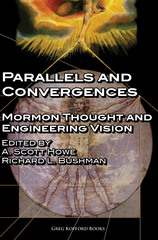
Review of Parallels and Convergences

In March of 2009 a group of LDS engineers (mostly) gathered for a conference at Claremont Graduate University focusing on Mormon perspectives on engineering. Videos of the talks were made available online, and now Kofford Books has published the talks as a collection of essays. It is edited by A. Scott Howe and Richard L. Bushman (yes, the), the principle conference organizers.

Overview

What does Mormonism have to do with engineering? Is there something about the gospel that improves bridges, batteries, or automobiles? Terryl Givens' introduction, "No Small and Cramped Eternities: Parley Pratt and the Foundations of Mormon Cosmology," which was the keynote address at the conference, provides the basic orientation. He describes Pratt's role in systematizing and popularizing Joseph Smith's teachings, particularly with respect to the eternal nature of element and the physical corporeal nature of God. The result can perhaps be summarized with the following sentence.
What this means is that, by naturalizing Deity, the entire universe of God and humankind, heaven and hell, body and spirit, the eternal and the mundane—all are collapsed into one sphere.
With this idea in place it becomes easier to see God as a master engineer, who possesses and uses technologies that seem miraculous to us. Thus the interest of LDS engineers. The rest of the book follows in this vein with speculative excursions into the nature of spirit matter and how human advances in technology may fulfill prophecy and God's purposes. Essays cover the concept of Gaia, how Mormonism dovetails with transhumanism, a novel argument for the existence of God, and more. The book wraps up with a survey of technological advances by David Bailey. It is a credit to the organizers that they were able to attract the involvement of Richard Bushman, Terryl Givens, and David Bailey.

The introduction to the first section of chapters opens with this arresting idea, which also serves as an additional overarching theme:
In the same way that each person should have the privilege of hearing the gospel in his or her own language, it might be important to consider that technical language is another mode of expression into which we ought to translate our most important concepts.
Although the scientific revolution began with figures like Galileo and Newton, most of what is taught in college courses on any scientific topic dates from the late 19th century onward. With two minor exceptions, none of our canonized scripture was written after 1847. Is it any wonder, then, that scripture and science often do not speak the same 'language'? In fact, Givens goes so far as to suggest that the "humanizing and temporalizing" of God by Joseph Smith's King Follett discourse,
does have one virtue, however—one that we will have the boldness perhaps to someday plumb, in that it lends itself to the world’s best hope for a naturalistic theology. Stripped of all invocations of transcendent entities and transcendent eternities, such a universe should be at least potentially appealing to the hardcore materialists currently working the anti-God/anti-religion circuit [1].
After quoting Richard Dawkins--a prominent scientist and atheist--to the effect that god-like extraterrestrials probably exist, a later essay asserts:
“Eternal progression” is what Mormons call that perhaps unfamiliar version of Darwinian evolution. “God” is what Mormons call those god-like extraterrestrials that didn’t start that way. Whether we ever get to know them or not, there are very probably gods. So says Richard Dawkins. So said Joseph Smith.
Translation indeed!

The book has many interesting ideas--sometimes old ideas presented in new ways. For example, chapter 11, "Spiritual Underpinnings for a Space Program," makes an impassioned defense of space exploration, and the authors envision a future day of planet colonization as fulfilling God's purposes.
It should be apparent that the peopling of other worlds will occur according to natural laws and that the recent outpouring of inspiration regarding space technology might be for the purpose of building a foundation of necessary technologies that will allow us to participate in this great work.
In this essay, planetary colonists become futuristic Jaredites.

This is all heady stuff that's fun to think about. Given the speculative nature of the topics discussed, I suppose it was inevitable that I would find some things to object to. Some of the towers of logic are constructed quickly, but perhaps not durably. I am not an engineer; my background is in the biological sciences. Nevertheless, a few problems stood out to me that I would like to briefly tackle.

Criticisms

One essay claimed that:
Inside each cell, ribosomes are a form of enzyme that are highly interconnected with microtubules. They read RNA strands and manufacture proteins that are building blocks for various cell structures. Microtubules function as both scaffolding and as microprocessors for the cell. From an engineer’s perspective, the microtubules (controller) and ribosomes (factory) would be exactly the sorts of functions where we would want to have a capacity for remote control.
Anybody who has taken a cell biology course will be familiar with the scaffolding role of microtubules. But the notion that they are microprocessors that participate in neural networks, and might even be involved in consciousness, was new to me. Granted, I am not a neuroscientist; but my brief look into the scientific literature suggests that these ideas are being promoted by a small handful of theorists who admit that they don't have solid evidence of these functions yet. Thus I believe that any functional role of microtubules in brain function, apart from their structural role in cells, remains hypothetical at best. As to the broader point, I am not aware of a significant interaction between ribosomes and microtubules under normal circumstances, and I don't know that I've ever heard of microtubules playing a role in the regulation of gene expression--they certainly are not among the chief mechanisms.

You might expect me to bring this up, but in the essay arguing for space exploration the authors write:
The Creation story mentions several points at which God and those involved in the preparation of the new world initiate new phases in the Creation sequence. We can imagine advanced celestial engineers periodically visiting the new world to take samples of the atmosphere, water, soil, and variety of organisms and determining that the planet is ready for the next step. We can see in our mind’s eye advanced celestial biologists selectively engineering certain organisms and releasing them into the environment where they take over the older generations, and slowly bring the biosphere up to a new level of readiness.
Indeed, I think this kind of scenario is envisioned by many Mormons. However, the paragraph immediately preceding the one just quoted says:
Perhaps the evidence shows a kinship of all life because the advanced engineers used the same highly adaptive set of programmable building blocks to construct the bodies of each species. Whether the organisms appeared strictly through emergence from a single ancestor or were physically brought and placed in turn as an already developed species, that kinship would be apparent.
This is an argument that is popular with young-earth creationists and intelligent design proponents alike. It seems quite reasonable because it appeals to common sense and experience, but unfortunately it is not well supported by the evidence. Now is not the time to get into the details, but generally speaking, the sequence divergence for the same gene in different species is proportional to their evolutionary separation. Furthermore, our genomes bear the marks of history; approximately half is made up of broken viruses and other self-replicating (or formerly so) DNA elements, much of which we share with other species in patterns that are easy to understand from the perspective of common descent but difficult to justify from a design perspective. With respect to patterns, the same could be said for the fossil record.

The same essay employs quotations from several Church leaders in support of the idea that life on our planet was brought from a previous one, and this is used as implicit support for the idea that we might reach out and colonize other planets. One of the leaders quoted is Joseph Fielding Smith, who said that the universe is peopled with God's children. Although strictly speaking this quote is not misused, it is misleading in the larger context. President Smith is often said to have predicted that man would not go to the moon, with the Apollo landings as an obvious refutation. But this obscures his larger point which, ironically, was that Earth was created as the dwelling place for humans, and that we have no business trying to colonize the moon or any other planet. He might turn out to be wrong on that too, but he clearly would not have agreed with the thesis of the essay.

Chapter 7, "Quantified Morality," sketches out an idea of how morality can be quantified. The basic principle is that moral decisions maintain the greatest number of future possibilities. This interesting idea is then converted into the concept of entropy, which theoretically could be quantified. To put it simply, destructive behaviors are said to increase disorder (entropy) and righteous behaviors minimize disorder, or even create order (i.e. decreasing entropy). The problem with this that any local decrease in entropy is always more than offset by an increase in entropy elsewhere. Yes, your room is more ordered after you clean it, but any drop in entropy is offset by the energy you use and the heat you produce while doing so. Living organisms are great at increasing entropy. So if changes in entropy are the measure of morality, a desolate planet is morally superior to one filled with life. Yet, even though I think this essay is fundamentally flawed, there are gems of interest. Consider this:
As we contemplate the eternal principle of self-replication as a way to combat entropy at all levels [which I dispute], we can speculate that self-replication also applies to planets—that the inhabitants of one world grow and progress until they eventually achieve the ability to replicate their biosphere on another world: “And as one earth shall pass away, and the heavens thereof even so shall another come; and there is no end to my works, neither to my words. For behold, this is my work and my glory—to bring to pass the immortality and eternal life of man” (Moses 1:38–39).
I never thought of that scripture like that before.

Chapter 8 contains a more mundane error.
We have evidence that our ancestors used spears 5 million years ago, but did not fire-harden the points until 500,000 years ago. Over 100,000 years later, we began making complex blades. Roughly 65,000 years after that, we began using the bow and arrow; 14,000 years after that, we began using gunpowder. Less than a thousand years later, we used a nuclear weapon in war.
This appears to assume that spear use by chimpanzees can be extrapolated to the common ancestor of humans and chimpanzees 5-6 million years ago. Be that as it may, the subsequent chronology puts the first nuclear weapon at roughly 320,000 years ago.

Conclusion

The value of this book is not in its explication of science, which I have noted is suspect at times. To me, the value of the book is the new perspectives that it brings to the scriptures and words of Church leaders, emphasizing the exciting and forward-looking side of our theology. I think it would make a nice gift for your scientifically inclined LDS friend or relative. My personal opinion is that if you want this for yourself, a cheaper electronic copy is a better choice, but I may be biased by the fact that I was already broadly familiar with the contents of the book. Then again, there are several engineers in my ward who might enjoy the book and it's too bad I can't easily lend it to them. In my opinion, more Mormons should be thinking along the lines of this book.

Notes:
This review is based on a complementary Kindle copy that I received.

1. Givens elaborated on this somewhat in the Q&A at the conference.


Continue reading...

Friday, May 18, 2012

Stewardship and the Creation

I just finished reading Stewardship and the Creation: LDS Perspectives on the Environment, and the more I think about it the more remarkable the book seems. It's a compilation of essays and articles by LDS authors reflecting on environmental attitudes and issues. It levels some criticism at our western culture, and it even includes some soft criticism of creationism. What makes it remarkable is that it was published in 2006 by the Religious Studies Center of BYU, a research and publishing arm of the BYU religion department. You can read it for free at their website.

Environmental issues tend to be contentious, particularly in the current U.S. political climate. Skepticism--or even disdain--of environmental causes tends to emanate from the same political party that LDS members tend to belong to. As the bloggernacle's own Steven Peck (BYU professor and co-editor) writes:

While on a recent fishing trip with some good Latter-day Saint men who otherwise would never swear, they could not say the word environmentalist without putting the word damn in front of it.
He further notes:
From my experience with members of the Church, I see that they have a profound love for nature. They love camping, hunting, and spending time in the wilderness. ... Many of those who express outrage at the mention of environmentalism are Scouters who profess a strong conservation ethic. They have profound memories of being in wilderness areas, which they speak about with love and passion. But talk to these same people about environmental protection, and they vehemently denounce it and claim such legislation is supported only by extremists and malcontents. When I suggest to my good Latter-day Saint family and friends about global warming, the worldwide loss of species, or the protection of our wild areas, they scoff not only at the idea that we should be concerned about these things but that there is even such a problem that needs attention.
Yet, as Elder Neal A. Maxwell wrote,
This restored work not only involves the things of eternity but is also drenched in daily significance. True disciples, for instance, would be consistent environmentalists—caring both about maintaining the spiritual health of a marriage and preserving a rain forest; caring about preserving the nurturing capacity of a family as well as providing a healthy supply of air and water...Adam and Eve were to "dress the garden," not exploit it. Like them, we are to keep the commandments, so that we can enjoy all the resources God has given us, resources described as "enough and to spare" (D&C 104:17), if we use and husband them wisely. [A Wonderful Flood of Light, p. 103.]
Cultural and political leanings notwithstanding, this book repeatedly points out that environmental concern has strong foundations in our scripture and the teachings of the prophets. If you don't like the word environmentalism, call it conservation, self-reliance, stewardship, or provident living. It ultimately amounts to much the same thing.

In light of the knee-jerk polarization that can occur on this topic, it is unfortunate that the book didn't open with Peck's essay, "An Ecologist’s View of Latter-day Saint Culture and the Environment," because he explores how Latter-day Saints approach several environmental issues and compares it to the broader environmental movement. In spite of a few high-profile disagreements (e.g. population control) and different starting premises, he finds substantial overlap. I think this essay best lays the groundwork for understanding the rest of the book, and I would recommend readers start with it.

A number of the essays are excellent and overlap somewhat in their presentation. I will warn you that some of the chapters are a bit dry, so if they don't interest you, move on to others. Some essays focus more on Utah itself-- especially the late 1800s--while others are more general. I found chapter 11, "A House Divided: Utah and the Return of the Wolf," particularly interesting. Wolves have an image problem that they apparently do not deserve, and I did not realize what central players they were/are in western ecology. (I couldn't help but wonder if their re-introduction to Utah might reduce the number of automobile-deer accidents).

There is always difficulty getting people to accept cause-and-effect relationships. Chapter 8, "The Hope for Extraordinary Ecological Improvement," describes damage that was done in Utah by overlogging and overgrazing. The result was a loss of mountain watersheds and consequent catastrophic floods. Yet some opposed projects to restore and protect the watersheds, attributing the floods to acts of God. There is certainly a basis in scripture for attributing natural disasters to God, but the scriptures and prophets have also been clear about our subjection to the laws of nature.

Chapter 13, "Rattlesnakes and Beehives: Why Latter-day Saints Should Support Ecologically Sustainable Development," makes the interesting suggestion that the latter portion of Doctrine and Covenants 59 can be read as a prophetic forewarning of our environmental problems. In that vein, we might think of it as the Word of Wisdom for the planet.

Chapter 12, "How Can Church Members Increase Their Environmental Awareness?" has a handy little chart of Ensign articles that treat environmental topics. It's not very large, but it's not nothing, either.

For the rest of this post, I'll just quote parts that stood out to me. Maybe they'll pique your interest enough to go read the book.

Chapter 1:
The dilemma we face in organizing our economic activities is that financial capital that Brigham Young identifies as being the least important is also the easiest to measure. Consequently, conventional thinking about economic activity is focused almost exclusively on financial capital with very little attention given to those aspects of human and natural capital that do not have an easily measured financial value.

Humans are free to choose wisely to partner with nature in mutually effective ways, but we are also free to ignore or even interfere with or destroy the work of nature. However, humans are not free to choose the consequences of our actions, the one being sweet and the other being bitter. The penalties for violating natural laws are real and irrevocable, and we as a culture will surely bear the consequences.

There are many who confuse prosperity with the power to waste. An oft-spoken rationale for waste is that if people own something, they are entitled to do with it as they please. This rationale is based on an assumption of the primacy of financial capital while deemphasizing human and natural capital. Brigham Young offers a different perspective by reminding us that one can never have enough to be wasteful, that everything that was created was created for a purpose, and that we interfere with God’s plan when we waste something that He created for a purpose.

Most people realize that for democracy to succeed, it must have a responsible and informed electorate. What is not as obvious is that for free markets to succeed in bringing forth a just and lasting prosperity, the market must have a responsible and informed “consumerate” and “investorate.” For those of us who are fortunate to live in a free market democracy, it is an important part of our sacred stewardship to be part of the responsible and informed electorate, consumerate, and investorate.

Chapter 7:
The scriptures indicate that this arrangement [humans as dominant] has been in place since the creation of Adam, and anyone who takes them seriously has to concede a certain utilitarianism behind the Creation, with man as the designated utilizer. To view the earth, her creatures, and her products strictly in utilitarian terms, however, or to assign them values on the basis of their temporal, immediate, man-centered utility, does not seem justified—especially when it was God himself who started pronouncing his creations “good” long before Adam was on the scene.

Chapter 11:
None of our modern prophets were trained in the complexities of conservation biology. Nevertheless, because they recognize environmental stewardship as a commandment, they advocate the same fundamental ideals as conservationists, namely, that humans are responsible for all life on earth.

Chapter 13:
Of course, wherever human judgment is required, opposing and impassioned social argument is inevitable. Judgment surrounding questions of environmental protection is no exception, and naturally many Latter-day Saints prefer to avoid what could be contentious issues. However, the fact that decisions are difficult or politically loaded and that definitive or detailed instruction has not proceeded from Church leadership does not excuse Latter-day Saints from the obligation to apply wise judgment in the use of “all things which come of the earth” (D&C 59:18). Disciples of Christ cannot choose the do-nothing option simply because there are competing and politically sensitive arguments. The duty to obey supersedes the detail.

Though the natural environment is in a state of perpetual flux and there is in real terms no ideal environment, the past three to four decades have witnessed a global awakening to the fact that humanity, in its rush for the golden egg of economic prosperity, is threatening the very existence of the goose on which it is dependent; namely, this incredibly unpredictable and majestically beautiful natural environment.


Continue reading...

Friday, May 04, 2012

Making Allowance for Prophetic Hyperbole

Over at Juvenile Instructor, Christopher Smith has a post on Mormon folklore about the lost ten tribes living at the north pole. He relates that when explorers reached the pole and it became clear that it was uninhabited, critics of the Church merrily pointed out the falsity of the semi-popular belief. Elder B. H. Roberts responded to the criticism in a speech, "The Things of God Greater Than Man's Conception of Them," given in the Salt Lake Tabernacle on September 12, 1909. (Note that the date given at that link is incorrect; it's apparently a typo.)

Roberts denied that the scriptures dictate such a belief, and then said the following. I think it's worth highlighting because it has broader application than the topic at hand.

You must remember that seers and prophets do not speak the cold, calculating language of philosophy, where every word is weighed in the exact scales of thought. Prophets do not follow the precision in their language that is required of the scientists. These men, prophets and seers, commune with God. Their finite life touches, for a moment, the infinite life of God. Their limited wisdom touches for a moment the supreme wisdom of the infinite. For an instant they see things large; and infused and inspired with the fire they have received from this contact with the divine, lo! they come with their message and speak it in the words of spiritual passion. Of course, to them, in this mood, the mountains will sink; the valleys will rise. Of course, the prophets, if in the north, will hear the voice of God, and the mountains of ice will flow down at their presence; the hills will rejoice and the mountains shout for joy! When men come with this inspiration upon them they see and feel things large, and they speak of them in that spirit; and when we come to reduce what they thus bring to us, from the heart of God, to our petty conceptions, we of course must be prepared to take into account the figurative language they speak. It is possible that if we fail to do this, we shall misapprehend, in part, some material fact of their message. Especially should one be on his guard in such highly picturesque matters as the return of the lost tribes from their long dispersion—from the lands of the north. In such an event not only will "mountains of ice flow down" at the presence of their prophets, but highways will be cast up in the midst of the great deep—their enemies will become a prey unto them—in barren deserts shall come forth pools of living water—the parched ground shall no longer be a thirsty land—the "boundaries of the everlasting hills shall tremble at their presence!" (Doc. and Cov., sec. 133.)

We must make some allowance, I repeat, for the hyperbole of that language in which the message of these prophets is delivered—remember, it is vibrant with the great things of God; and it makes some effort to encompass these great things.


Continue reading...

Wednesday, May 02, 2012

Why Good People Do Bad Things

NPR did a story yesterday, Psychology Of Fraud: Why Good People Do Bad Things. Go read or listen to it; I think it's very interesting. Here are a couple of money quotes.

Over the past couple of decades, psychologists have documented many different ways that our minds fail to see what is directly in front of us. They've come up with a concept called "bounded ethicality": That's the notion that cognitively, our ability to behave ethically is seriously limited, because we don't always see the ethical big picture.
We like to help each other, especially people we identify with. And when we are helping people, we really don't see what we are doing as unethical.
This doesn't really surprise me. Perhaps it explains something that occurred to me a while ago, which is this: Depending on how a story opens (especially a movie) otherwise moral people root for criminals. You know the kind of story I'm talking about--the bank robbing bandits who elude police, the prisoner trying to escape, the scammers who take on a casino, etc. If the story can get us to identify with the main characters, we root for their success even if it happens to be in conflict with the law and with our own moral principles.

Is there a practical application to all of this?
Now if these psychologists and economists are right, if we are all capable of behaving profoundly unethically without realizing it, then our workplaces and regulations are poorly organized. They're not designed to take into account the cognitively flawed human beings that we are. They don't attempt to structure things around our weaknesses.
Something to think about. It makes me glad that Mormons are often reminded of the need for honesty. (Some occasional spectacular failures notwithstanding.)


Continue reading...

Monday, April 23, 2012

Abinadi and Resurrection Contraries

Joseph Smith once wrote that "by proving contraries, truth is made manifest" (History of the Church, 6:428). I noticed something incongruous in the Book of Mormon, and Joseph's statement seems apt for it. I don't imagine I am the first person to notice it, but I don't recall ever having seen it discussed before. First, let's lay the groundwork.

The Book of Mormon prophet Abinadi taught the following about the resurrection (Mosiah 15:21 - 25):

21 And there cometh a resurrection, even a first resurrection; yea, even a resurrection of those that have been, and who are, and who shall be, even until the resurrection of Christ—for so shall he be called.
22 And now, the resurrection of all the prophets, and all those that have believed in their words, or all those that have kept the commandments of God, shall come forth in the first resurrection; therefore, they are the first resurrection.
23 They are raised to dwell with God who has redeemed them; thus they have eternal life through Christ, who has broken the bands of death.
24 And these are those who have part in the first resurrection; and these are they that have died before Christ came, in their ignorance, not having salvation declared unto them. And thus the Lord bringeth about the restoration of these; and they have a part in the first resurrection, or have eternal life, being redeemed by the Lord.
25 And little children also have eternal life.

A straightforward reading of this passage has been summarized by Robert J. Matthews (I have re-numbered his points for the purposes of this post).
[1.] There is a first resurrection, consisting of those who have been, who are, and who shall be from the beginning down to the time of Christ. This means "all the prophets, and all those that have believed in their words, or all those that have kept the commandments"—they are the first resurrection (15:21-23).

[2.] Those who died in ignorance, before Christ came, to whom the plan of salvation was never declared, shall have part in the first resurrection (15:24).

[3.] "Little children [who die as little children] also have eternal life," which in the context of Abinadi's discourse means that they will be in the first resurrection (15:25).

Presumably, this 'first resurrection' is a reference to those who are said--in both the New Testament and the Book of Mormon--to have risen following the resurrection of Jesus. Matthews again:
The first resurrection that Abinadi spoke of consists of the righteous who lived from the time of Adam to the time of Christ. We who live after the time of Christ know of a "second session" of the first resurrection, one stretching from Jesus' time to his second coming and then on through the Millennium. Abinadi spoke from his perspective; we speak from ours.

With this in place, let's consider the resurrection in connection with archaeology. I've seen one LDS commentator speculate that empty tombs and graves discovered by archaeologists may be evidence that the person was resurrected, rather than that grave robbers and/or animals removed and destroyed the remains, or that they simply decayed. Of course there is no way to test such an idea since, as far as we know, resurrected bodies leave no identifying traces. Further, we have no idea whether any particular person would be judged worthy of inclusion in the first resurrection. And although Abinadi said that the ignorant would also be included, which would presumably include the vast majority of people, Matthews points out that modern revelation gives the caveat that "all who have died without a knowledge of this gospel, who would have received it if they had been permitted to tarry, shall be heirs of the celestial kingdom of God" (D&C 137:7).

So when archaeologists find human remains that pre-date ~30 B.C., can we infer that the person was either not righteous, or would not have received the gospel if they had access to it? The vast geographical and temporal range of discovered remains makes this a difficult proposition to accept, but we simply don't know what these people were like or how God would judge them.

But what about little children? If little children (who died as little children) up until the resurrection of Jesus were included in the first resurrection, as Abinadi seemed to say, then we can make a simple prediction: archaeologists should not find their bodily remains. How does this prediction hold up? Not well.

This child of 6-12 months, decorated with beads, lived and died over 8000 years ago. Click picture for more information.

And so we have a contradiction: Abinadi seems to be saying that little children are included in the first resurrection, which took place at the resurrection of Jesus. But archaeologists have found the remains of little children dating from before Jesus. We're missing something; there are several ways the contradiction might be resolved. Here are a few possibilities I can think of.

1. Matthews' interpretation of Abinadi is incorrect. Little children will have eternal life, but are not included in the (first) first resurrection. Abinadi's statement about children was really more of an afterthought.

2. Abinadi made an unjustified inference, or Alma (who wrote the original account) or Mormon (the editor) misunderstood Abinadi.

3. Alma (son of Alma) was a little unsure about the timing of the (first) first resurrection. "I do not say that their resurrection cometh at the resurrection of Christ; but behold, I give it as my opinion, that the souls and the bodies are reunited, of the righteous, at the resurrection of Christ, and his ascension into heaven [Alma 40:20]." Thus, although some people were resurrected at the time of Jesus' resurrection, Alma gives us some leeway to think that the (first) first resurrection has actually not been completed for some reason.

4. The (first) first resurrection was limited in scope and served more as a sign, both of Jesus' resurrection and of things to come, rather than a comprehensive event.

5. The resurrection does not necessarily incorporate surviving physical remains.

6. (For fun)--Just as (according to some) dinosaur fossils aren't really millions of years old, all discovered remains of little children really post-date ~30 B.C.

Some of these explanations are more likely than others. Arguments can be made against each of them. With respect to #5, statements by Joseph Smith and Joseph F. Smith (and probably others) indicate that the body you lay down is the one you take up. That a few bone fragments might be left out seems reasonable, but whole skeletons or mummified flesh?

So where does this leave us? There are several lessons we might draw out of this. We could talk about how we don't believe that prophets are infallible, or that canonized scripture can contain mistakes (see the title page of the Book of Mormon), or that our understanding can change as new facts and revelation come to light. It seems to me that this is a case where science clearly informs (or should inform) interpretation of scripture. Sometimes people draw a contrast between science and revelation--that whereas science is tentative and open to revision, the revelations are not because God only speaks the truth. However, I reject that division because the revelations must be interpreted, and those interpretations may be wrong, and because there is always a possibility that new revelation will dramatically revise the old.

In my view both science and scripture are tentative and open to revision.


Continue reading...

Friday, April 06, 2012

What the Big Bang Means for Mormons

Since we're on the topic of the Big Bang, I want to highlight an article from the FARMS Review (now Mormon Studies Review) in 2004: The Big Bang: What Does It Mean for Us? by Hollis R. Johnson, an emeritus professor of astronomy at Indiana University. The essay is a response to an evangelical critique of LDS doctrine, but it serves as a nice accessible introduction to cosmology. You should read the whole thing, but I'll give you the nickel version.

To understand the evangelical critique, you have to know that the original formulation of the Big Big bang envisioned the initial state of the universe as infinitely dense and infinitely small, known as a singularity. This fit nicely with creation ex nihilo, and also implied that if God exists in space and time, then he was a product of the Big Bang.

This notion of singularity has had a lot of staying power in the popular understanding of the Big Bang, but Johnson points out that science has moved on and the singularity has been discarded. For one thing, the notion of a singularity is at odds with quantum mechanics because it would violate the Heisenberg uncertainty principle. (I presume that this holds for black holes as well?) This and other questions gave rise to inflationary cosmology, and the concept of the multiverse.

So what does the multiverse mean for our theology? Well it supports the teaching that matter (i.e. energy) is eternal. It's less clear to me what it means for God or our future in this universe, but Johnson thinks it's premature to take a strong stand on these things anyway. He chastises critics for assuming any particular scientific model as the final truth, especially when dealing with a topic as large and mysterious as cosmology. His frustration with theologians comes through in these two gems:

Creation from nothing is clearly a fantasy devised by certain theologians, perhaps in a misguided attempt to glorify God by making of him a fantastic magician.
How long is eternity? Theologians can speculate forever, while scientists continue to provide a factual time line.
The straightforward and unapologetic explanation of cosmology makes this essay one of my favorite FARMS Review essays.

Note:

I found a minor mistake that is hardly worth bringing up, but I'm going to anyway. Footnote 7 says: "Note that numbers in an exponent simply show the number of zeros after (+) or before (-) the given digits. For example, 105 means 1 followed by 5 zeros (100,000), and 10—9 means 1 preceded by a period and 9 zeros (.0000000001)." The first part is correct, but the second is not. 10—9 = .000000001; one preceded by eight zeros.


Continue reading...

Wednesday, April 04, 2012

The Big Bang: Let's Get Some Things Straight

In the wake of General Conference, I thought we might briefly review the science (which Elder Richard G. Scott has told us, is one of two ways to find truth) of the Big Bang.

What is the Big Bang?

In the mid-twentieth century, astronomers made some observations indicating that distant galaxies are moving away from each other, and that the universe is expanding. This implies that in the past they were much closer together. Astronomers reasoned that at some point in the past (~13.7 billion years ago) the universe was compressed into an extremely hot and dense state--so hot that atoms could not yet form because the high energies would rip them apart. The term Big Bang (initially coined as a term of mockery) refers to the rapid expansion of this compressed universe.

One prediction made based on the theory was that as the universe expanded and cooled, and atoms began to form, electromagnetic radiation should have begun escaping and might still be observable, but at much lower energy. The discovery of the cosmic microwave background in 1965 fulfilled this prediction and gave empirical support to the theory. Although the original Big Bang theory has been modified and added upon, these core features remain.

Was the Big Bang an explosion?

As mentioned above, the universe began in an extremely hot and dense state and rapidly expanded. In this sense, the Big Bang was like an explosion. However, the result of the Big Bang was not like that of explosions. One way of looking at entropy is as a measure of disorder in the universe. When we think of explosions, we think of ordered material being scattered into unordered pieces. From an energy perspective, concentrated energy in the fuel is released and converted into heat and kinetic energy. We end up with scattered pieces of matter, and energy converted into forms that aren't useful. In other words, explosions increase entropy. However, counter to intuition, the result of the Big Bang was a universe of low entropy. As the universe expanded and cooled, matter was able to condense into atoms--especially hydrogen. Hydrogen atoms were attracted to each other by gravity until they reached such density that they began to fuse together, forming stars. Stars have made the heavier elements of which we are composed.

The main point here is that the Big Bang did not use up fuel to scatter material throughout the universe. Rather, it created the raw fuel (hydrogen) from which all else would be made. In other words, the universe created by the Big Bang was one of low entropy and pregnant with potential.

Did the Big Bang create life?

Not directly, no. The Big Bang occurred about 13.7 billion years ago. Earth is only about 4.5 billion years old, so all life on Earth is obviously younger than that. All elements on Earth were created through the birth and death of stars.

Does order require intelligence?

There are many examples of order in the natural world that do not require intelligence. Many of the features of our universe (stars, galaxies, orbits, etc) are the result of simple laws like gravity. Intuition is not a good guide on these matters because nature is cleverer than we are. I covered this topic in a previous post, Order from Chaos. (It includes a couple of neat videos.) Similarly, there does not appear to be any natural law that would preclude the origin and evolution of life on Earth over billions of years by natural processes.

Whether divine intervention occurred in the formation of the universe or life on Earth is a historical question that cannot be ruled out by science, but neither does there seem to be any great need or evidence for it, scientifically speaking.


Further Reading:

Cosmology Primer


Continue reading...

  © Blogger templates The Professional Template by Ourblogtemplates.com 2008

Back to TOP