Wednesday, August 20, 2008

Another Nail in Lamarck's Coffin

Last month I did a post on the role of E. coli in defeating the notion of Lamarckian evolution. I mentioned that there have been attempts to revive Lamarckism, specifically for bacteria. Essentially, there was experimental evidence that suggested that when bacteria are under stressful conditions, they can increase their mutation rate in order to increase their chance of hitting on a helpful mutation.

This week's Proceedings of the National Academies of Sciences has a paper dealing with this topic. Here is the abstract (but the full article is free to read):

Several bacterial systems show behavior interpreted as evidence for stress-induced mutagenesis (adaptive mutation), a postulated process by which nongrowing cells temporarily increase their general mutation rate. Theoretical considerations suggest that periodic stress-induced general mutagenesis would not be advantageous in the long term, due to the high cost of deleterious mutations. Alternative explanations have been tested for very few of the systems used as evidence for stress-induced mutation. In one prominent system, mutants resistant to rifampicin (RifR; rpoB; RNA polymerase) accumulate in cell populations that “age” on solid medium with little net growth. Mutant accumulation was initially attributed to stress-induced general mutagenesis in nongrowing cells. Evidence is presented that these RifR mutants accumulate because they grow faster than parent cells during the aging period. Direct tests revealed no increase in the frequency of other mutant types during the aging period.

Marie Wrande, John R. Roth, and Diarmaid Hughes. Accumulation of mutants in “aging” bacterial colonies is due to growth under selection, not stress-induced mutagenesis. PNAS 2008 105:11863-11868


Continue reading...

Monday, August 11, 2008

Facts and Presidential Politics

I've avoided partisan politics on this blog and will continue to do so. However, with the presidential election approaching, debate over the candidates and their proposals is increasing--and as rhetoric increases, truth is often a casualty.

My favorite resource for separating fact from fiction is FactCheck.org. I have added their RSS feed to the sidebar, and I anticipate keeping it there until the election. At the very least, I hope to stay above the sleazy smear tactics, lies, and plain stupidity that seem to circulate at election time.

Happy voting.


Continue reading...

Wednesday, August 06, 2008

BYU Studies on The God Delusion

The latest BYU Studies (Vol. 47 No. 1) contains a review of The God Delusion by Richard Dawkins. The article is "The God Delusion: Selling the Soul of Science for a Pot of Message," by Steven C. Walker.

Let's start with my favorite part of the review.

I do not suppose Dawkins could ever agree that I have seen what I have seen, even though I am perfectly willing to agree he has not seen what he has not. Even as agenda-driven a thinker as this deliberately blindered scientist might be, I would hope he might agree that negative evidence can be less persuasive than positive evidence. Even a scientist might admit, were he willing to think about it beyond his usual dismissive range, that the experience of a person who claims to have experience with another Person does more to establish the existence of that Person than the lack of experience of another person does to deny it.
It does seem that some critics of religion don't have the capacity to even imagine why intelligent people believe in God. For many that belief is ultimately rooted in some kind of religious experience that is in turn rooted deep in the heart, and I think it is unfair and unrealistic to expect such people to betray that experience based on a few arguments, however compelling they may seem. After all, we don't know what we don't know.

Having said that, overall I am not wild about this review for several reasons.

1. There is much lamenting about how little Dawkins knows about theology. However, what bearing theology has on the issue or how it refutes Dawkins is not made clear. It seems to me that the best theology can do for you is to put a particular belief into a context of surrounding beliefs that make it seem more reasonable and respectable. You may be able to paint a pretty picture with theology, but that does nothing to establish whether such beliefs are grounded in reality. You may explain to Dawkins all the theological reasons for the death and resurrection of Jesus, but that does nothing to establish his existence or the many miraculous things attributed to him.

2. I don't think that Walker is entirely fair with his quotations of Dawkins. Having returned the book to the library, I can't thoroughly check the quotes, but let's take one example that I dug up. Walker wrote:
When we hint that it appears to us sometimes that scientists could be the worst group in the world to look to for ethical, let alone moral, insight, he assures us that sufficiently moral for his purposes, purpose enough for his life, is—I kid you not—“a good lunch” (100).
Now here is the passage from The God Delusion:
In my interview with [James] Watson at Clare, I conscientiously put it to him that, unlike him and Crick, some people see no conflict between science and religion, because they claim science is about how things work and religion is about what it is all for. Watson retorted: 'Well I don't think we're for anything. We're just products of evolution. You can say, "Gee, your life must be pretty bleak if you don't think there's a purpose." But I'm anticipating having a good lunch.' We did have a good lunch, too.
So first of all it's James Watson, not Dawkins, who made the comment about lunch. But more to the point, isn't it obvious that Watson is saying--in a dry understated way--that life has the quality you give it? I don't see any pronouncements on ethics or morality here, and I don't take either of them to be as shallow as Walker implies.

3. Walker seems almost to approach postmodernism in his criticism of science. Science, you see, is based on human observation and interpretation and is fallible. Therefore, it should not necessarily be privileged over other ways of seeing the world.
...though there are better and worse ways of thinking, there is no infallible way of thinking—even if it thinks itself divinely sanctioned, and even, heaven help us, if it thinks itself scientifically self-evident. Most ways of thinking—whether scientific or religious, idealistic or pragmatic, legal or logical, psychological or philosophical, mathematical or metaphorical, hyperbolic or hallucinogenic or however otherwise demented—have weaknesses as well as strengths, with limitations that allow concentration in particular areas.
Alright, but if we are trying to understand how the universe works, isn't science the best way of thinking?
Science is superbly focused on the world of physical fact. That need not be a problem unless a scientist somehow convinces himself physical fact is all there is. The crippling limitation of materialistic focus is manifest in how many scientists have persuaded themselves that the world of physical fact is the total extent of reality.
I'm not arguing for strict scientism, and I'm not trying to carry Dawkins's water for him, but what does that mean and where does it take us? And this may be a matter of semantics, but if there is no such thing as immaterial matter, and all spirit is matter, where does the domain of science actually end?

I think that Walker's main point is something like the following: "I have experienced God in a way that validates my commitment to my religion and its sacred texts and teachings. One of those teachings is that life is a test, and as part of that test, God has purposefully removed himself from our scientific inquiry." I can accept such a statement and still agree with Dawkins that the existence of God is a scientific question in principle, though perhaps not in practice.

Coincidentally or not, Walker's review is very similar to evolutionary biologist Allen Orr's review in the Feb 2007 New York Review of Books, which resulted in some back-and-forth with Daniel Dennett (the page is laid out in reverse chronological order).

So now The God Delusion has been reviewed in BYU Studies and The FARMS Review. Do you think they are effective reviews? I am particularly interested to hear from people who have read the book, though others are welcome too.


Continue reading...

Saturday, August 02, 2008

The Best Bookstore in Utah?

On my recent trip to Utah, I stopped by a few bookstores to look at LDS books. Based on this and previous experience, my impressions are as follows:

Deseret Book: Great if you want something published by Deseret Book (or Bookcraft, which is now owned by DB) or other Church-owned publishers (e.g. FARMS, BYU Religious Studies). You may or may not find books from other publishers.

Barnes and Noble: A small selection that occasionally has some variety.

Sam Weller's: Has a decent selection of older and out of print titles (I did not look at the higher-end rare books); pretty skimpy on newer ones, but it does have a few.

Benchmark Books: Pretty good overall selection; books from multiple publishers, and a decent selection of used books. Not many of the newer Deseret Books titles.

BYU Bookstore: At first glance, it's a mini Deseret Book. However, on closer inspection they do carry a few books from other LDS publishers, including ones that some might not consider "faith promoting."

So what bookstores do you recommend? I'm especially interested in stores that carry LDS books from publishers other than Deseret Book.


Continue reading...

Thursday, July 31, 2008

Utah Geology Show and Tell

Attention Geologists! I have a question; see below.

One of the things I like about Utah is how its natural history is constantly exposed for viewing. Recently my family and I were in Utah for vacation and I took some pictures for blog show-and-tell (see previous installments here and here). Click on images for larger viewing.

First up was our hike to Timpanogos Cave. Timp cave actually consists of three caves that were discovered at separate times (as late as the 1920s) and then connected by the National Park Service. One of the first things they show you when you get into the cave is fossil coral, which looks like a bunch of white speckles.


Then, of course, there are the stalactites, stalagmites, and other formations.


And here is a view of Utah Valley from near the cave.


We also took a trip down to Arches National Park, by Moab, UT. The hike to the famous Delicate Arch is about 3 miles, which we decided was too long. So instead we took a shorter route to a viewing point. (Delicate Arch is in the upper left of the picture).


Alright, now we come to my question. At the viewpoint for Delicate Arch I noticed lines running through the rock (next three pictures). These were not just color lines; they were slightly raised relative to the surrounding rock, presumably because of slower erosion. The third picture shows one of the lines running down the rock (you may need to click for a bigger view). So my question is, what are those lines?


This next picture is not the Grand Canyon. It is Deadhorse Point, which is close to both Arches and Canyonlands. Here you see the Colorado River winding its way through to where it will join the Green River a few miles to the south. It may not be the Grand Canyon, but it is beautiful and impressive nonetheless.


Some of the natural rock is used as a safety fence at the lookout. This one caught my attention because of its many layers. I couldn't help but wonder how many years were represented in each layer--each a few thumbnails in thickness.


Here is one of several lizards we saw in Arches and Deadhorse Point.


It was a great trip, and I look forward to returning.


Continue reading...

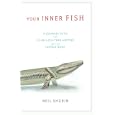
Book Review: Your Inner Fish


Although I intended to make a few comments here about Your Inner Fish, by Neil Shubin, I was invited to participate in a discussion/review of the book with Dave over at Times and Seasons. It has now been posted and you may read it there.

Thanks to Dave for including my two cents.


Continue reading...

Tuesday, July 22, 2008

How E. coli Killed Lamarck

Carl Zimmer's Microcosm: E. coli and the New Science of Life gives an overview of the kinds of questions that the favorite laboratory bacterium, Escherichia coli, has been used to answer, and how those lessons apply to life in general. It's a pretty easy read and I recommend it--especially if you've never been exposed to bacterial genetics before.

In the book Zimmer reviews some classic bacterial genetics experiments--experiments that I learned about in the course of my education but had not thought of in a while. Here I will briefly review two that Zimmer included.

By the middle of the twentieth century, evolution by random mutation and natural selection (Darwinian evolution) generally reigned supreme except among bacteriologists, who believed that bacteria followed Lamarckian principles. That is, new environments somehow induced bacteria to adapt in a directed manner, which adaptation was then passed on to the bacterial progeny.

1943: Salvador Luria and Max Delbrück took a mathematical approach to the question [original paper]. They grew up a large liquid culture of E. coli and then spread the culture on a series of agar plates that contained a virus that would kill the bacteria. They then counted the number of colonies that grew on each plate. These colonies of bacteria were mutants that were resistant to the virus, and each plate had roughly the same number (say, 13-26). Then they did the same thing again, except instead of using a large initial liquid culture they used smaller individual liquid cultures that all received the same innoculum. When those cultures were plated out, the number of resistant colonies on each plate varied dramatically. Many had zero or just a few colonies, while a few plates had many more--e.g. one plate had 107.

If bacteria mutated and became resistant in response to being exposed to the virus, then you would not expect any difference in the variation of colony numbers between the large single culture and the small individual cultures. However, if the resistance mutation occurred randomly before exposure to the virus, then the larger variation in the small culture experiment makes sense. In fact, their observations fit their theoretical calculations quite well. This work helped earn Luria and Delbrück a Nobel Prize in 1969.

1952: Joshua and Esther Lederberg finished off Lamarck by using a technique called replica plating [original paper]. This was done by pushing a piece of velvet onto a plate of bacteria, and then lifting the velvet and pushing it onto a fresh plate. When the bacteria on the new plate grew, the colonies would be located in the same place relative to one another as the first plate, thus providing a replica plate.

The Lederbergs plated bacteria sensitive to an antibiotic (they also used a virus, with the same result) onto a regular agar plate. They then did replica plating onto an agar plate that contained the antibiotic. By comparing the two plates, they could determine which colonies on the regular plate gave rise to the resistant colonies on the plate with antibiotic. They then used the original colonies on the regular plate to start new cultures and do the procedure over again. Eventually, all of the colonies were resistant when replica plated onto the agar containing antibiotic.

The key here is that the pure culture of resistant bacteria came from colonies on the regular plates; they had never been exposed to the antibiotic! How could a pure culture of resistant bacteria be derived from sensitive bacteria, when none of the bacteria in the lineage had ever touched the antibiotic? Again, this makes no sense under a Lamarckian scenario of induced directed mutation, but it makes perfect sense if mutations are random. The Lederbergs had simply identified random mutants and enriched for them until they had a pure culture of clonal mutants. (Joshua Lederberg received a Nobel Prize in 1958 for other work.)

Lamarck may just be unconscious--there have been several attempts to revive him, and occasionally someone thinks they hear a heartbeat. However, most consider him to have died by 1952, and it was E. coli that killed him.


Continue reading...

Monday, July 07, 2008

Y Chromosomes and The Book of Mormon: Let's Get Something Straight

There has been a flare-up over DNA and the Book of Mormon--this time among believing members. I've had a hard time figuring out exactly what Rod Meldrum's scientific claims are. The best I've found so far is apparently the latest essay by Simon Southerton, "How DNA Divides LDS Apologists." Meldrum appears to be making claims about mtDNA haplogroup X. However, I want to discuss the Y chromosome for a moment.

I freely admit that I am not a geneticist, and I'll be happy to be schooled if I'm getting something wrong. Also, my specific criticism should not be construed as general criticism of those making the claims I criticize below. Now let's get down to business.

Some apologists seem to be making the basic following claim: Certain Y chromosome groups are found among Native Americans, people around Siberia, and among some Jewish groups. Although this chromosome grouping may come from Siberia (which is congruent with mtDNA and archaeology), it could come from the Jewish groups instead, and uncertainty in dating increases the plausibility of this interpretation.

I will try to explain why I think this is wrongheaded. Of course it should be obvious that if scientists thought there were good grounds to connect Native Americans with Jewish groups, we would not be having this discussion. And multiple lines of evidence point to Asia over 10,000 years ago, so why should we try to interpret the Y chromosome data in a way that runs counter to the other lines of evidence? But aside from these more philosophical objections, I think that the progressing science is casting additional doubt on the above claim.

The nomenclature of the Y chromosome groupings is quite a hurdle in itself, which is not helped by the fact that it has undergone several revisions. Originally, several researchers were using their own designations and things became a mess. In 2002 the Y Chromsome Consortium established a nomenclature for everyone to use. (It has recently been updated, but I'll get to that in a minute.)

Jeff Lindsay pointed out that haplogroup 1C is found in both Native Americans and some Jews. However, as of 2002 the designation 1C does not exist anymore. This figure shows the Y chromosome haplogroups and how they relate to each other. On the right are colored columns that show the different designations used by different researchers. If you look at the pink column toward the bottom, you will find two labels of 1C. By comparing that to what is on the left, it looks to me that in retrospect, 1C was not very well defined and even included groups not actually closely related. In other words, as additional details and groupings were filled in, it became apparent that the 1C designation was not helpful any more. So much for 1C.

Others make the same claims for M242 or P-36 (which is roughly equivalent to 1C), however similar issues are at play. Below are the latest haplogroup Q designations and relationships (click for bigger image) [1]. You can compare it with the Wikipedia Haplogroup Q page, which is helpful.


Everything to the right of M3 is known exclusively in Native Americans. If you work your way left to P36.2 (formerly P36) and then M242, you will see that the M3 grouping constitutes only a part of what is now included under P36.2 and M242. So to say that P36.2 is also found in Jews is not very informative. If I read this correctly, the closest relative to the M3 group is Q1a3*, which is found in Pakistan and India. If you look at the Wikipedia page, you'll see that if you move up another level you'll find that Yemeni Jews are related, but so are people of Asia and Siberia. The relationship to Jews is at best ambiguous here.

But it looks like we can go a step further. Some apologists point out the uncertainty in dating distinguishing mutations and hint that if we simply adjust time frames, then it all makes sense. Unfortunately for that argument, human remains from On Your Knees cave in Alaska, that radiocarbon dated to 10,300 years ago, yielded Y chromosome DNA falling in the M3 group. This independent dating puts a minimum time on the entrance (or origination) of M3 into North America.

Your head, like mine, is probably spinning by now. In summary, I think apologists should stop trying to link Native American Y chromosomes with that of Jews. Haplogroups represent somewhat arbitrary groupings. The question is not whether Native American genes are related to Jews (of course they are), but how close is the relationship and what time frames are we dealing with? So far it looks like the answers to those questions continue to be that most Native American DNA originated in Asia over 10,000 years ago.


Notes:
1. Tatiana M. Karafet, Fernando L. Mendez, Monica B. Meilerman, Peter A. Underhill, Stephen L. Zegura, and Michael F. Hammer. New binary polymorphisms reshape and increase resolution of the human Y chromosomal haplogroup tree. Genome Res., May 2008; 18: 830 - 838.

Unfortunately I cannot access this paper, but it will become freely available in November. However, the haplogroup chart from which I made the image above is available for download (28MB pdf).


Continue reading...

  © Blogger templates The Professional Template by Ourblogtemplates.com 2008

Back to TOP