Friday, August 12, 2005

The Religion of Charles Darwin

[Update: Whoops--I forgot the link. It is fixed.]

Carl Zimmer has posted a discussion of Charles Darwin's views on religion. I recognized much of the material from his book, Evolution: The Triumph of an Idea. (See the sidebar for a link to my review of the book.) It is worth reading--Zimmer beautifully tells a tale of pain and heartbreak which, perhaps, will make some view Darwin in a more human, and understandable, light.

"It is a disservice to Darwin, and to history, to turn his tortured, complex life into a talking point in a culture war."

Bonus: Zimmer briefly responds to Sen. Buttars' op-ed.

Continue reading...

Creationist Distortion: A Case Report, Part 2

In the last post, I described the misleading use of a Science article, "New Ages for the Last Australian Megafauna: Continent-Wide Extinction About 46,000 Years Ago," by a creationist museum. Here I want to highlight some redemptive value: learning in spite of distortion.

Continue Reading


As I scanned over the article my attention focused on this paragraph.

A review of 91 radiocarbon (14C) ages obtained for Australian megafauna before 1995 rejected the vast majority of ages as being unreliable, including all those younger than 28 ka before the present (B.P.). The remaining 14C ages were close to or beyond the practical limits of the technique, or were on materials that had ambiguous associations with the megafaunal remains. Radiocarbon dating of bone and charcoal older than 35 ka is problematic using conventional sample pretreatments. Consequently, 14C ages were used in this study only for comparison with ages of <50 [thousand years ago] obtained from optical dating of megafauna-bearing sediments and 230Th/234U dating of flowstones formed above and below megafaunal remains. Optical dating is a luminescence-based method that indicates the time elapsed since the sediment grains were last exposed to sunlight. The optical age corresponds to the burial age of megafaunal remains in primary deposition, whereas 230Th/234U dating gives the crystallization age of the flowstone, and thus a constraining age for remains above or below the flowstone. Support for the optical ages reported here is provided by their consistency with the 14C and 230Th/234U ages obtained at megafaunal sites where comparisons have been made. All three methods yield concordant ages within the time range of 14C dating, and beyond this limit the optical and 230Th/234U ages are in good agreement and correct stratigraphic order.


I want to note two things. First, there is discussion about some carbon-14-derived dates as being unreliable. I don't know what the basis of the rejection was, but some creationists cultivate the idea that scientists engage in broad conspiracies to cover up their errors. But who is it that discovers the errors? Any technique has subtlties associated with it and here is a prominent example of a discussion of them.

Second, I had not heard of optical dating before, so I looked around on the internet for an explanation. The basic idea is that electrons in crystals such as quartz get displaced when exposed to ionizing radiation. Light and heat can knock the electrons back into place, which results in a small amount of light being emitted from the crystal. When the crystal is buried, the electrons are not put back in place and the phenomenon accumulates. Under controlled conditions, scientists can expose recovered crystals to light and measure the amount of light emitted, which is proportional to the amount of radiation the crystal has been exposed to. (We all live in an unnoticed sea of background radiation.) By measuring the background radiation at the site the crystal was taken from and determining how much cumulative radiation the crystal was exposed to since burial, the age since its burial can be determined.

This is cross-checked with other radiometric methods, and I'm sure there are subtlties involved. What is beautiful to me is how these kinds of dating methods are derived from basic chemistry and physics and are able to support each other.

So The Museum of Earth History sought to convince me that humans killed of dinosaurs. Instead, they showed me that they abuse the scientific literature and introduced me to a new dating method. I guess thanks are in order.

Continue reading...

Thursday, August 11, 2005

Creationist Distortion: A Case Report, Part 1

I was recently reading another blog which provided a link to a creationist museum. Out of curiosity I followed the link and entered the world according to The Museum of Earth History. This is a small museum in Arkansas where the basic idea is to display fossils in a setting consistent with a certain interpretation of the Bible. It gives the appearance of being "scientific"--it is a museum and there are fossils on display, after all. (Other similar museums already exist or are being planned--a trend that I find a little bit disturbing.) There is a webpage that provides information about some of the dinosaur fossils they have. Remarkably, each of them has a "Biblical History Dating" of 10,000 BCE.

Continue Reading


Anyway, I was poking around and was learning about why the dinosaurs became extinct. Of course they claim that the global flood played a role, but according to this museum, Noah saved some young dinosaurs on the ark. What really caught my eye was this passage:

The post-flood effects on all the animals were tremendous: the climate, habitat and continental form were all impacted greatly, making it difficult for animals to survive with the same ease as they did before the flood. Moreover, within 110 years after the flood, the human population began to disperse around the world. Most scientists today believe that human pressure was the most significant factor in animal extinction, including dinosaurs (Science, June 8, 2001, p n1819, 1888-1896). (Emphasis added.)

Oh really? I found that last sentence remarkable in several ways. First, it states that scientists believe that humans were responsible for the extinction of the dinosaurs. Second, this of course means that scientists believe that dinosaurs and humans were contemporaneous. Third, it attributes most animal extinction to human involvement. (There have been many extinctions in the earth's history, most of them before humans were on the scene. Anyway, I would have thought that they would say the flood was most important.) Finally, an actual reference to a respected scientific journal was provided. Well, I knew that the first three propositions were utterly false (at least if we are talking about mainstream scientists, which the statement implies) but I just had to check out that reference. Would you like to guess what I found?

The pages referenced actually encompass two articles. (Unfortunately you have to have a subscription to access them on the internet. However, you should be able to find Science at your local library.) The second of the two articles reports the results of computer modeling that attempts to determine whether humans could be responsible for the extinction of certain large mammals in North America by over-killing them over 10,000 years ago. (Answer: It is seems that way.) There is no mention of dinosaurs.

The main article of interest here is "New Ages for the Last Australian Megafauna: Continent-Wide Extinction About 46,000 Years Ago," by Richard Roberts, et al. Here is the abstract:
All Australian land mammals, reptiles, and birds weighing more than 100 kilograms, and six of the seven genera with a body mass of 45 to 100 kilograms, perished in the late Quaternary. The timing and causes of these extinctions remain uncertain. We report burial ages for megafauna from 28 sites and infer extinction across the continent around 46,400 years ago (95% confidence interval, 51,200 to 39,800 years ago). Our results rule out extreme aridity at the Last Glacial Maximum as the cause of extinction, but not other climatic impacts; a "blitzkrieg" model of human-induced extinction; or an extended period of anthropogenic ecosystem disruption.

Translation: All of the native animals in Australia weighing more than 220 pounds (and many of the ones weighing more than 100 pounds) went extinct around 46,400 years ago. One climatic event (Last Glacial Maximum) can be ruled out as the cause, but not other climatic or human impacts.

There is no mention of dinosaurs in the article. The closest thing to a dinosaur is Megalania prisca. There is also a turtle, a snake, and something related to crocodiles--but no dinosaurs. Also of interest is the fact that this paper relies on radiometric dating and determines that the extinction was 46,000 years ago. So in order to buttress their claim that scientists believe that humans are responsible for the extinction of dinosaurs, a paper is referenced that:

1. Makes no mention of dinosaurs.
2. Uses radiometric dating (which these creationists reject) to arrive at its conclusions.
3. Places the date of the extinction at 46,000 years ago, thus ruling out the Last Glacial Maximum (~20,000 years ago) as the cause of extinction. (Apparently these creationists believe that the earth did not exist 46,000 years ago. Certainly they don't believe dinosaurs or humans did.)

In other words, these creationists reject the foundation of the paper while trying to enlist a distortion of its conclusion (and its status as actual science) in support of their views. I think this is called "dishonesty." At the very least it is duplicity, and from what I understand it is not uncommon in creationist literature.


(Note: Actual scientists put the extinction of dinosaurs around 65 million years ago. Anatomically modern humans don't show up until about 200,000 years ago.)

Continue reading...

Sen. Buttars in USA Today

Sen. Chris Buttars recently had an editorial published in USA Today. (I've blogged on Buttars before here, here and here. If I have to cover him any more, I'm going to put a link to all my posts on him on the sidebar.)

Here is the meat of the editorial:

Continue Reading


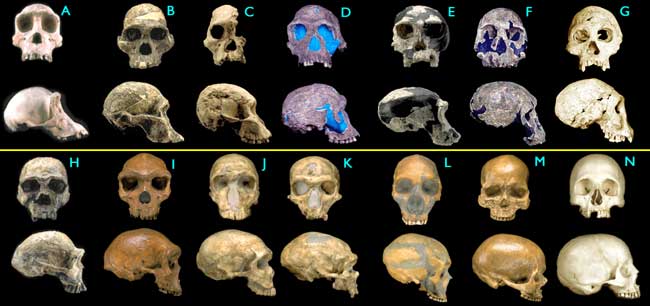
These vehement critics claim that there are mountains of scientific proof that man evolved from some lower species also related to apes. But in this tremendous effort to support Charles Darwin's theory of evolution, in all these "mountains of information," there has not been any scientific fossil evidence linking apes to man.

The trouble with the "missing link" is that it is still missing! In fact, the whole fossil chain that could link apes to man is also missing! The theory of evolution, which states that man evolved from some other species, has more holes in it than a crocheted bathtub.

I realize that is a dramatic statement, so to be clear, let me restate: There is zero scientific fossil evidence that demonstrates organic evolutionary linkage between primates and man.


Well, fossil evidence is only one component to the issue. Nevertheless, I'm no paleontologist, but I wonder how Buttars would respond to something like this?


Continue reading...

Sunday, August 07, 2005

Pretty Much My Favorite Animal

From National Geographic News:

It's half lion, half tiger, and completely real. Now thanks to a cameo in the 2004 cult movie Napoleon Dynamite, the liger has leaped into the limelight, prompting fans to ask, What are they really like?

Continue reading...

Thursday, August 04, 2005

Where are the Conservatives?

Recently, in response to a question, President Bush made some remarks that seem to support teaching intelligent design in public schools. This has resulted in fertilizer hitting the fan, so to speak. I don't have hard numbers, but I think it would be safe to say that the majority of scientists are Democrats--certainly it seems that the blogging ones are. As a result, I think their politics are exacerbating their anger in this case.

Continue Reading


John Hawkes analyzes the situation with a cool head. I think he makes some excellent points. His post is a bit long, so he provided an abstract.

ABSTRACT: Here, I argue that Bush's comments, while damaging to the cause of evolution education, are representative of most Americans' opinions. They reflect our public discourse, which emphasizes fairness. Being (or appearing) fair is much more important to the vast majority of Americans than knowing about the scientific method. Intelligent design creationism violates the scientific method in many ways, but most people neither understand nor care about this: this objection is perceived as "a technicality" rather than a fair division of content. For many years, science and religion have operated in "separate spheres" as a compromise, but the boundary between these has been greatly weakened. The best argument against including intelligent design in schools is that it simply doesn't work: it has led to no new insights, no discoveries, and no scientific results. Creationists continue to argue that this is because of widespread bias among the scientific community. I suggest the establishment of a monetary prize to find solid evidence of intelligent design, along the lines of the "X Prize" in aeronautics, or the "Millennium Prizes" in mathematics. If, as I expect, no evidence of intelligent design comes forward, it would be a solid step toward raising public awareness that ID has no place in the science classroom.


On the other hand, PZ Myers feels that, if anything, he has not been passionate enough.
I am a biologist. Like it or not, the Republican party is being led by religious zealots who are anti-biology, who publicly and vigorously oppose reason and knowledge and evidence in my field of study. This hasn't always been true, and it may not always be true (I hope), but right now and right here, it is inarguably the case. I will not throttle my criticisms of the despicable gang of anti-intellectuals who run this country because it might irritate all those millions of people who voted for George W. Bush; they were wrong and he is wrong and it is my responsibility as a scientist to oppose ignorance, especially ignorance that has power and influence. Let them find comfort and forgiveness for stupid mistakes in their religion, because I sure as hell am not going to give it to them.


I don't know what the answer is. Just as there are professional anti-Mormons who persist in spreading falsehoods no matter what contrary evidence is provided, there are professional creationists who will never stop doing the same to legitimate science. There is no winning over these people. What might help, however, is for religious conservatives who support science to speak up in greater numbers. They might be able to reach people in a way that many scientists cannot. This would give more opportunity for the average church-goer to say, "Well, I don't know about all that science stuff, but Mr. Jones is a great guy and he opposes teaching creationism and ID as alternatives to evolution. Maybe science isn't so bad after all."

Is there such a thing as a Repulican pro-science organization? (And I don't mean pro-science to the extent that the science supports the party platform.) I'm not aware of one. Maybe one should be created.

Continue reading...

Tuesday, August 02, 2005

It's Not Just the Liberals

Conservative columnist Charles Krauthammer has written a piece in Time arguing that faith, including intellignet design, should be kept out of science classes because it undermines the progress of bringing religion back into the public arena. Here are the first and last paragraphs:

Continue Reading


The half-century campaign to eradicate any vestige of religion from public life has run its course. The backlash from a nation fed up with the A.C.L.U. kicking crèches out of municipal Christmas displays has created a new balance. State-supported universities may subsidize the activities of student religious groups. Monuments inscribed with the Ten Commandments are permitted on government grounds. The Federal Government is engaged in a major antipoverty initiative that gives money to churches. Religion is back out of the closet.


To teach faith as science is to undermine the very idea of science, which is the acquisition of new knowledge through hypothesis, experimentation and evidence. To teach it as science is to encourage the supercilious caricature of America as a nation in the thrall of religious authority. To teach it as science is to discredit the welcome recent advances in permitting the public expression of religion. Faith can and should be proclaimed from every mountaintop and city square. But it has no place in science class. To impose it on the teaching of evolution is not just to invite ridicule but to earn it. (Emphasis added.)

It seems to me that the popular culture war is being fought with winner-takes-all mentality, which I think is a mistake--for both sides.

(I try to keep LDS-SR free from politics. I will just note that in spite of what some readers may think, I do lean politically conservative and I am glad to see that there are other conservatives who share my lack of enthusiasm for the religious assault on science.)

Continue reading...

Gene Regulation and Morphology

There is an essay in the July issue of PLoS Biology by Sean Carroll discussing evolution of morphology by changes in gene regulation, as opposed to changes to the gene sequence itself. (Dr. Carroll has written a book, Endless Forms Most Beautiful: The New Science of Evo Devo, which I plan to read.)

Although changes in genes get a lot of attention, some scientists think that the changes are not great enough to explain major morphological differences. Instead, Carroll argues that it is they way the genes are used that makes the difference. This may especially be true for genes that are used in a variety of tissues. It is one thing to mutate a gene that will be used in different ways in a number of tissues, and it is another to simply turn the gene on or off in a subset of those tissues.

Continue Reading


I think the main point of the essay is captured in this paragraph:

While we are often able to infer coding sequence function from primary sequences, we are generally unable to decipher functional properties from mere inspection of non-coding sequences. This has led to a bias in comparative genomics and evolutionary genetics toward the analysis and reporting of readily detectable events in coding regions, such as gene duplications and protein sequence evolution, while non-coding, regulatory sequences are often ignored. However, approximately two-thirds of all sequences under purifying selection in our genome are non-coding. One consequence of the underconsideration of non-coding, regulatory sequences is unrealistic expectations about what can currently be learned about the genetic basis of morphological diversity from comparisons of genome sequences alone. The visible diversity of any group is not reflected by the most visible components of gene diversity—that is, the diversity of gene number or of coding sequences. In order to understand the evolution of anatomy, we have to study and understand regulatory sequences, as well as the proteins that connect them into the regulatory circuits that govern development. (Emphasis added.)


The essay cites several examples in support of his argument, and those examples are captured in several figures. We'll look at two of them here.

Figure 1


The top line in this figure is a generic schematic of a stretch of DNA containing a gene. The black boxes represent portions of a gene. Our genes are usually broken up into several segments ("exons"). When the DNA is copied into RNA, the extra junk in between ("introns") is spliced out. The arrow indicates where the gene starts, and the red circle represents a section of DNA that helps regulate whether the gene is expressed or not. (A) shows what can happen when a gene is duplicated--the normal gene and regulation are retained while either the duplicated gene or its regulation can change due to mutaitons. This is thought to preserve the normal function of the gene while allowing nature to experiment with the duplicate. (B) shows only the regulatory region being duplicated and changed so that the original function is maintained, but with additional regulatory potential. Finally, (C) shows the development of a new exon which allows the gene to be spliced in different ways, thus increasing the functional capability of the gene.

Figure 2


(A) shows that differences in regulation of the gene, yellow, are responsible for differences in pigment pattern between two species of Drosophila (fruit fly). (B) shows that "the expression of the Pitx1 gene of vertebrates is inferred to be controlled by multiple elements (red circles). In pelvic-reduced stickleback fish, Pitx1 expression is absent from the pelvic region. This is proposed to occur through a selective loss of activity of the hindlimb regulatory element (cross through the red circle)."

The same gene, Pitx1, also plays a role in mouse hindlimb development (and presumably all vertebrates) as well as other critical aspects of development. (Deletion of the gene is lethal.) The scenario represented by Figure 2B makes it easier to imagine how snakes and whales lost (or mostly lost) their legs and pelvis. It wasn't (just) mutation of genes--it was a change in they way the genes were deployed. (Note: I don't think that it is yet known whether Pitx1 was involved in snakes or whales losing their legs, but that is beside the point.) I hope the book has more of these kinds of examples.

For more learned commentary, see here and here.

Continue reading...

  © Blogger templates The Professional Template by Ourblogtemplates.com 2008

Back to TOP