Thursday, December 30, 2010

Evolution on Church Radio

Mormon Channel, the Church's official radio station, has a new program called Insights that takes education as its theme. The second episode is an interview with BYU biology professor Dennis Shiozawa. The discussion includes matter-of-fact references to geological timescales, as well as some discussion of evolution (especially at minutes 19 and 47). Here is part of the episode description:

Learn how biologists track species and map DNA to better understand gene pools, evolution, the our effect on our environment.
It's nice to to see mainstream biology and geology represented in Church media. Kudos to Insights and the Mormon Channel!


Continue reading...

Wednesday, December 22, 2010

If I Had a Side Blog

What to do with things I come across that don't seem to warrant a dedicated post? Some blogs have side blogs, but that doesn't seem to be an option in Blogger. Yeah, maybe there's a third-party gadget out there, but I don't feel like messing with it. So until I decide on something I like better, I'll collect items of interest and occasionally post them under this title. So let's kick it off.


1. Rumors of the demise of the incandescent light bulb have been greatly exaggerated.

2. Creationists often deny the existence of vestigial structures, but they can be found within creationist-defined "kinds."

3. Speaking of creationism, an analysis of fruit fly genes delivers another smack to Intelligent Design.

4. The Eternal Universe explains why funding basic research into things of no practical application is important for getting practical applications.

5. FOX News slanting coverage of climate science? Say it ain't so!

6. Send this lady on a mission!

7. If you've seen one temperature data set, you've pretty much seen them all (here, too).


Continue reading...

Thursday, December 16, 2010

One Long Argument from Authority

Argument from authority: "Appeal to authority is a fallacy of defective induction, where it is argued that a statement is correct because the statement is made by a person or source that is commonly regarded as authoritative."

One long argument: Phrase used by Darwin in the final chapter of The Origin of Species to describe the whole book.


A couple of months ago I highlighted a harsh review of Rod Meldrum's publications and talks that was published in the FARMS Review. Although the main focus was the Book of Mormon, evolution was dragged into the discussion.

Meldrum's website has a number of free downloads, including a handy little compilation of many of the bad things past prophets have said about evolution. In some cases (e.g. Joseph Smith) the statements are not directly about evolution, but are nevertheless used as ammunition. In other cases (esp. Joseph Fielding Smith), statements and writings before their becoming president of the Church are grandfathered in. Also, someone has helpfully underlined and bolded all of the important parts, in order to assist hitting you over the head.

The document is said to have been compiled by one James Stoddard, who is the president of ZionVison. In case you need further bludgeoning, check out their video, Creation and Evolution: A Witness of Prophets. You can get a taste of it by looking at these trailers. You can also read a transcript of the video here.

In addition to argument from authority, the video is long on another logical fallacy: appeal to consequences. In classic form, the video blames evolution for various evils in society, such as Hitler and the Columbine massacre. There is also a little bit of traditional quote-mining--more likely recycled quote-mining (example).

I think my favorite part is where it refers to BYU zoologist Duane Jeffery as "one modern biologist, who rejects the miracles of the scriptures," and who "has spent much of his life promoting the theories of Darwinism while belittling the words of latter-day Prophets of God." One wonders how he hung on to his job all those years! Of course the movie doesn't mention his career at BYU. More on that in a minute. The movie charges,
He has given this rationale for his rejection of the miracle of the flood: “Can one really fit ten million species onto a single ocean-going vessel, feed and care for them all with their often very restrictive diets or living conditions (many of which we are helpless to duplicate even with modern systems), and keep it all going with just eight people for an entire year? The answer, plainly, is no.”
I'll bet that's the least of the reasons Jeffery rejects a universal flood. (For more on the flood, see here.)

Toward the end, the movie starts to really lay it on thick. We are told that there are only two forces in this world (presumably good and evil). Then the law of witnesses is invoked along with woe pronounced against those who reject such witnesses. Speaking of witnesses, it's interesting to note how the power of General Authority quotes can be shaped by how they are introduced. "Elder so-and-so stated his opinion that..." doesn't quite pack the same puch as, "Elder so-and-so testified..." or "Elder so-and-so gave his witness..." So naturally, the movie describes the quotes with these terms.

There is no mention of more moderate sentiments expressed by Church leaders like David O. McKay, Heber J. Grant, Stephen L. Richards, James E. Talmage, or John A. Widtsoe, or even some of the allegedly hostile leaders, nor of the views expressed by such prominent Mormons as Henry Eyring. You also won't learn from the video that evolution is taught at BYU. Not only taught, but researched as well. These factors may or may not weigh heavily in how a person views evolution, and given the polemical agenda of the movie their absence is understandable. However, they do tend to undercut the implied message of the movie that the fate of your soul hangs in the balance based on your view of the science.

There is obviously some kind of affiliation between ZionVision and Brigham Young Academy.org (which, in case you are curious, is a sister to the Joseph Smith Academy.org, both of which are divisions of the Joseph Smith Foundation. None are affiliated with the Church.) They have compiled an impressive polemic of an FAQ on evolution, some of which contains exact passages from the movie. It's NDBF on steroids! (No relationship; I checked.) These folks are hard-core; they even call out FAIR (arguably the best LDS apologetic organization out there) and accuse it of mocking, ridiculing, and fighting against "the clear scriptural teachings and witnesses of the Prophets of God." Other honorees include Michael Ash, Steve Peck, and David Bailey. If they wanted to be thorough, they really should have included Hugh Nibley, too. (Yours truly somehow didn't make the list, in spite of almost six years of blogging. Do I have that little influence? I guess I can take some consolation that Mormons and Evolution, a group blog that I participated in for a while, is listed.)

Dealing With General Authority Statements

Although pronouncements by authorities do not determine the truth or falsity of a proposition (hence the logical fallacy), we look to the prophets and apostles as a source of truth, and their thoughts deserve consideration. This style of argumentation, where one is made to feel like s/he is rejecting the prophets, can therefore be quite difficult and frustrating to grapple with because, in its strongest form, there can be no counter-argument. Attempting to do so only validates the perception that you reject the prophets. And yet, we who defend science cannot remain silent or else the authoritarian bullies will be the only ones heard. So what can we do when confronted with such material? Here are a few suggestions to consider.

1. Recognize that these lists of General Authority statements are not merely intended to be informative. They are compiled in such a way as to give rhetorical advantage, and they are often embedded within an implied overarching narrative. Different statements could be strung together for a different effect (example). Consideration should be given to the full range of views expressed along with historical and cultural context. Resist efforts to reduce everything down to a simple black-and-white, good-and-evil story.

2. The cover letter to the BYU evolution packet, prepared in 1992 by the Board of Trustees (which includes the First Presidency), states: "Various views have been expressed by other Church leaders on this subject over many decades; however, formal statements by the First Presidency are the definitive source of official Church positions." Don't feel a need to reconcile every statement--even those by prophets.

3. When you dig below the surface of General Authority statements critical of evolution (or other science), it often turns out that they are actually defending some deeper principle such as the existence of God, morality, inspiration of scripture, etc. Be clear that you agree with the deeper principle.

4. Recognize that the zeal of the anti-evolution crusader is not reflected in the broader Church program. Many people who accept evolution serve as bishops and stake presidents, evolution is taught without apology in the science classes at Church schools, and Church-owned Deseret Book occasionally publishes books that are friendly--or at least moderate--toward evolution (eg. Mormon Scientist, Of Heaven and Earth, and Lenthen Your Stride: The Presidency of Spencer W. Kimball).

5. Study and use the example of Henry Eyring. During his life he successfully navigated these waters and is still held in high esteem in LDS culture.


Continue reading...

Monday, December 13, 2010

Bickmore Takes On Senator Hatch

BYU geologist Barry Bickmore has recently directed his ire toward Senator Orrin Hatch. First there's his post, Orrin Hatch and the Open Mind, then there are his op-eds in the Salt Lake Tribune and Deseret News from a couple of weeks ago.

DN: Global warming consensus matters

SLT: Separating truth and fiction in climate debate

Here's a taste from the Tribune:

Lately, opposition to mainstream climate science has become something of a litmus test for Republican politicians. As a Utah Republican myself, and an Earth scientist, I have been disappointed with how many of our politicians have gone beyond the usual wishy-washy dodge of saying they support “developing all sources of energy” to actively promoting anti-science....

Instead of wallowing in anti-scientific doubt-mongering, why can’t Republicans start garnering support for solutions to the climate change problem that don’t involve massive increases in government revenue and control?


Continue reading...

Monday, December 06, 2010

The Flood and the Baptism of Fire

Brigham Young is often cited as the origin of the teaching that Noah's Flood was the earth's baptism. However, although he did draw the comparison, he did so without much elaboration.

We are of the earth, earthy, and not only will the portion of mother earth which composes these bodies get a resurrection, but the earth itself. It has already had a baptism. You who have read the Bible must know that that is Bible doctrine. What does it matter if it is not stated in the same words that I use, it is one the less true that it was baptized for the remission of sins. The Lord said, "I will deluge (or immerse) the earth in water for the remission of the sins of the people;" or if you will allow me to express myself in a familiar style, to kill all the vermin that were nitting, and breeding, and polluting its body; it was cleansed of its filthiness; and soaked in the water, as long as some of our people ought to soak. The Lord baptized the earth for the remission of sins, and it has been once cleansed from the filthiness that has gone out of it, which was in the inhabitants who dwelt upon its face. [Journal of Discourses 1:274]
Orson Pratt took this idea to the next level and his logic seems to have become lodged in Mormon consciousness.
The first ordinance instituted for the cleansing of the earth, was that of immersion in water; it was buried in the liquid element, and all things sinful upon the face of it were washed away.... The second ordinance instituted for the sanctification of the earth, is that of fire and the Holy Ghost. The day will come when it shall burn as an oven, and all the proud, and all that do wickedly shall be as stubble; after which, the glory of God shall cover the earth, as the waters cover the deep. Here then is a baptism of fire first, then of the Holy Spirit. As man receives the baptism of fire and the Holy Spirit through the laying on of the hands of a legal administrator, so the earth receives the same, not through its own agency, but through the agencies ordained of God.... As man becomes a righteous man by the new birth, so the earth becomes a righteous earth through the same process. [Journal of Discourses 1:331 - 332, emphasis added]
A couple of months ago it occurred to me that there is a fundamental asymmetry here. The Flood was necessary and had to cover the whole earth, the logic goes, because it was a baptism, and we all know that baptism must be by immersion. But this pickiness for literalism in correspondence suddenly disappears when it comes to the baptism of fire. The problem is summarized with the following table:

Baptism:----Water----Fire

People-----Literal-----Metaphorical

Earth------Literal------Literal


I see two ways to salvage Pratt's logic. The first is to say that the burning of the earth at the second coming is metaphorical. The second:


Of course we could dispense with Pratt's logic and chalk the whole thing up to pioneer speculation, but that would remove one of the claimed imperatives for a literal global flood. What to do? Well, I'm definitely not going along with one of these options. I'll let you guess which one.


Continue reading...

Monday, November 29, 2010

Hockey Stick History: Past and Present

The public and political controversy over the science of global warming has become so tangled and has so many parts to it, that it is difficult to sort the whole thing out. I can't say that I have it all sorted out myself. This post is to help organize some information for myself, as well as to provide background to some new developments.

In the Beginning

Once upon a time (1990, to be specific), the IPCC issued their first climate report, which contained a figure representing the global average temperature over the last millennium. The figure looked like this, with the dotted line representing conditions at the beginning of the twentieth century:
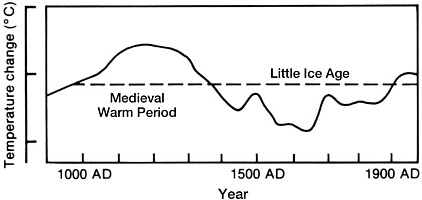

We should note here that there are three problems with this figure that are often overlooked. First, in the IPCC report it is called a "schematic." Second, it is based on data from mostly central England, and cannot, by itself, be considered representative of the whole globe, or even the whole Northern Hemisphere. Third, although it appears to be current up to the end of the twentieth century, the data it is based on do not include the last few decades of the twentieth century which is when much of the current warming has taken place. (See Common graphical tricks and the Medieval Warm Period.)

Then in 1998 a young climatologist named Michael Mann did a study of tree rings, corals, and other indicators in order to reconstruct the average temperature of the Northern Hemisphere and compared it to the recent record taken by instruments. The results were published in 1998 and 1999, and looked like this:


This image was the basis for a figure featured prominently in the 2001 IPCC report, which looked like this:


Thus the 'hockey stick' was born and the conditions for controversy were set. The last figure suggests that the current warming of the planet is unprecedented in the last 1,000 years and helps to bolster the case that humans are warming the planet. In contrast, in the first figure the current warming (which actually is not shown, as noted above) appears insignificant compared to the so-called medieval warming period (MWP). Skeptics of global warming have seized upon this difference. They claim that the first figure (along with other data) shows that global warming is not significant and charge that bias, if not outright fraud, led the IPCC to embrace the later figure and discount the MWP.

Retired mining statistician Stephen McIntyre and economist Ross McKitrick became interested in Mann's figures and published criticisms of the statistical analysis behind them. Their basic claim was that the shape of Mann's graphs were an artifact of incorrect application of statistical analysis, and that the analysis relied too heavily on certain data sets which bias the early points toward the low side. Their 'corrected' version, published in 2003, looked like this (note that the instrumental record is not shown):


These criticisms touched off a number of papers with claims and counter claims, and here those of us without statistical training see everything blur into a nerd-fight over statistical methods. Added into this mix is a spat over data and whether Mann shared enough of his data and code with McIntyre and McKitrick, and whether he was even obligated to. To hear McIntyre and McKitrick tell it, they were able to uncover flaws in Mann's work through heroic efforts in overcoming Mann's stonewalling. To hear Mann tell it, McIntyre and McKitrick made ill-founded criticisms and were demanding data and computer code that they were not entitled to. You can get a sense for this in the Wall Street Journal article, In Climate Debate, The 'Hockey Stick' Leads to a Face-Off.

What I have outlined thus far accounts for a significant portion of the public controversy. Meanwhile, in 2005 a group of scientists in Sweden and Russia published their own reconstruction of Northern Hemisphere temperatures over the last 2000 years, which looked like this:


Investigation

Eventually Congress got involved. It asked the National Research Council (NRC) of the National Academy of Sciences (NAS) to look into Mann's methodology and conclusions. The report, Surface Temperature Reconstructions for the Last 2,000 Years, was released in 2006. Although it did contain some criticism of Mann's statistical analysis and conclusions, it was basically supportive. In 2008 Mann published a new reconstruction that took into account the NRC criticisms. The result looked like this (note that the figure also shows other published reconstructions for comparison, such as the Swedish one above (Moberg et al.)):


So, we end up with a picture that is a little more wavy on long time scales than Mann's original reconstruction, but with current warming still elevated relative to the last two millennia.

Meanwhile, back in 2006, the House Committee on Energy and Commerce, chaired by Rep. Joe Barton (R-TX), held its own hearing (here, here, and here). The committee asked George Mason University statistician Edward Wegman to assemble a panel and to essentially referee the running dispute between Mann verses McIntyre and McKitrick. While not denying the reality of global warming (something sometimes glossed over by skeptics), the report, dubbed the Wegman report, basically upheld all of McIntyre and McKitrick's criticisms of Mann's early work. It also went on to suggest that the principle researchers within the niche of paleoclimatology were too cozy with one another, which compromised the peer-review process (something Mann denies since, among other reasons, most of his scientific relationships were formed after the publication of the papers in question).

Because they were released in the same year, and because Wegman has been a chair of the NRC's Committee on Applied and Theoretical Statistics, the NRC report and the Wegman report are sometimes conflated. They are not the same. As mentioned above, the NRC report was produced under the auspices of the NAS with a panel of at least 12 scientists and an additional 13 reviewers. It focused less on Mann's early papers than the current state and reliability of the science. In contrast, other than Wegman and one other respected statistician (David Scott), the other contributors to the Wegman report were then-current or former graduate students of Wegman, including Yasmin Said, the third co-author. The Wegman report was ostensibly limited to the question of McIntyre and McKitrick's criticisms of Mann's early papers and gave little consideration to later developments in the field. It specifically disclaimed any position on whether global warming was caused by humans. There is some overlap in the basic findings in these two reports. However, the Wegman report is more negative and is naturally more popular with climate skeptics.

Back to the Future

All of this might be water under the bridge were it not for the Climategate hoopla of a year ago. The content of the private emails, made public, re-ignited the old disputes. For the six months following the release of the emails, climate scientists took a public beating, often for passages taken out of context. The controversy has died down as official investigations have cleared the climate scientists of wrongdoing, but based on the emails the Attorney General of Virginia is seeking to investigate Mann for fraud and his brief relies in part on the Wegman report. (I didn't see any references to the NRC report.) Despite its limited scope, the Wegman report remains a touchstone of climate skepticism.

While the climate scientists were being pilloried in the press, a Canadian blogger who goes by the name of "Deep Climate" was taking a closer look at the Wegman report. He found that some of the background material on paleoclimatology was plagiarized from a textbook that was authored, ironically, by one of the co-authors of the very papers being criticized, and that other portions were taken from Wikipedia. These findings inspired computer scientist John Mashey to take a detailed look at the Wegman report and the circumstances around it. He found additional examples of plagiarism and other alleged forms of poor scholarship. His report is lengthy and overwhelmingly detailed, but his bottom-line conclusion is that the Wegman report was designed to provide a scientific facade for the PR campaign of Washington D.C. think tanks.

Deep Climate is continuing to digest the Wegman report and has recently posted analysis (here and here) suggesting that the Wegman report simply re-capitulated the analysis of McIntyre and McKitrick without any real attempt at understanding the underlying details. And in another twist of irony, Stanford emeritus physics professor David Ritson has been trying to get details on Wegman's analysis for four years, but to no avail. Wegman has thus far exempted himself from following principles of openness that his report lectured Mann about.

Ravings of partisans? Perhaps. However, the plagiarism charge has gained traction. As reported by USA Today (here and here) Wegman is under investigation by his university and outside experts agree that there are clear examples of unattributed quoting or nominal re-wording of text. (As if experts were needed; it's pretty obvious when you look at the comparison.)

According to Mashey's analysis, the plagiarism extends into the dissertations of Wegman's graduate students, one of which was a co-author of the Wegman report. It seems plausible to me that Wegman farmed out the basic composition of the report to his student and that she wrote most of the text and is responsible for the plagiarism. Nevertheless, aside from being an academic sin in and of itself, the plagiarism raises questions about the level of scholarship of the report as a whole. Whether further criticisms by Mashey and Deep Climate will stick remains to be seen.

Over a decade since its initial publication, the hockey stick controversy lives on.


Continue reading...

Friday, November 26, 2010

More Viruses in Your Genes

For over a decade we've known that a certain family of viruses--retroviruses--has left remnants in our genome. However, a recent survey has found that this phenomenon extends to a much broader collection of viral families. Although new in its extent, this is not all that surprising when you consider what a jumble of chemical reactions occur in the cell.

For more, see the summaries by these Discover Magazine bloggers:

Carl Zimmer - Your inner viruses: the trickle becomes the flood

Ed Yong - I am virus – animal genomes contain more fossil viruses than ever expected


Continue reading...

Thursday, November 18, 2010

Steve's Primordial Soup: Odds and Ends

[This post is a continuation of a discussion (begun here) of Crawling Out of the Primordial Soup: A Step toward the Emergence of an LDS Theology Compatible with Organic Evolution" (PDF), by BYU biologist Steven Peck.]

It's time to wrap up this series. Here I will briefly touch on some odds and ends, and then conclude.

Gender

Toward the end of his paper Steve touches briefly on the issue of gender. He notes that the "The Family: A Proclamation to the World" defends gender as part of pre-mortal existence. Exactly what that entails, however, is not clear. The degree of conflict between evolution and pre-mortal gender is likely to turn on how closely mortal and pre-mortal gender are claimed to correspond with one another. Evolution aside, one need not look any farther than the natural world in the present to find at least some conflict with this teaching. (See, for example, Duane Jeffery's Dialogue article, "Intersexes in Humans: An Introductory Exploration.")

Although there are many exceptions, sexual reproduction is pervasive throughout the biosphere. The exact reasons for this are unknown, but one popular hypothesis is that the mixing of genes facilitates the genetic flexibility needed to adapt to new environments and to battle parasites. Given its popularity as a reproductive mechanism, it seems that sexual reproduction provides a strong selective advantage over asexual reproduction, and is the type of thing we might expect to repeatedly arise on planets with life.

Selfish Genes

In his discussion of gender, Steve invokes arguments by biologist Joan Roughgarden regarding the role of the sexes in nature.

Recently [Roughgarden] has argued for a new model of evolution, based not on selfish genetic forces (Richard Dawkins’s selfish gene model), but on models of cooperation among creatures in a gendered and sexual context.
I am at a disadvantage here because I have not read Roughgarden. However, the contrast between selfish genes and cooperating creatures represents a common misunderstanding of Dawkins, which Steve unfortunately perpetuates. Dawkins used the term 'selfish gene' as a metaphor for understanding how the the effects of genes play out in the world, and how those effects promote the continued survival of those genes in a population. It was simply a metaphor and was not meant to imply that the creatures built by those genes are, or should be, selfish (which is also a common misunderstanding of natural selection), nor was it meant to imply, as some others have thought, that genes actually have conscious motivations. To the contrary, genes only survive in relationships with other genes. As Dawkins later wrote (The Ancestor's Tale, p.187 ),
My first book, The Selfish Gene, could equally have been called The Co-operative Gene without a word of the book itself needing to be changed. Indeed, this might have saved some misunderstanding (some of the book's most vocal critics are content to read the book by title only). Selfishness and co-operation are two sides of a Darwinian coin. Each gene promotes its own selfish welfare, by co-operating with the other genes in the sexually stirred gene pool which is that gene's environment, to build shared bodies.
There is no necessary conceptual conflict between selfish genes and cooperating creatures. Indeed, if cooperating with other creatures represents a successful strategy of survival and reproduction, then genes that encourage cooperation will be selected for. Metaphorically speaking, we could say that those genes ensure their own survival (a selfish goal) by encouraging cooperation between their host organism and others--a sort of selfless selfishness, if you will.

William Chamberlin

The year 1911 saw the culmination of a controversy over evolution (and other topics) at BYU when several of the faculty where forced to leave. Evolution was banished from the campus and would not formally return until the early 1970s. Although he hung around for a few additional years, William Chamberlin was among the casualties. Naturally, I tend to view this as unfortunate, although it is easy to sit in judgment a century after the fact. However, after reading Steve's discussion of Chamberlin's ideas, and reviewing the history again, I find the decision less objectionable. The reason is, I have no idea what William Chamberlin was talking about.

I don't mean to by catty, nor do I think that the ideas expressed at a university should be limited to the horizons of my own understanding. Joseph F. Smith and others were worried that these faculty (and their students) were getting too caught up in philosophical and theological speculation. From what I can tell, Chamberlin's ideas (as described by Steve) were a kind of mystical mishmash of science and theology. If this was what he was teaching then his (and his cohort's) downfall is more understandable because he was not a martyr for science as such, but for his own speculative theology. In fact, apparently theology, not science, was William's main teaching responsibility. This is not to say that the science teachers were safe (e.g. his brother, Ralph), but strictly speaking, most of the trouble seems to have come from philosophy and theology, not science.

I am not saying that I agree with what happened, but at a minimum I think we can say that, like Galileo, these men contributed to their own problems. The desire to harmonize science and religion is almost irresistible, but any attempt to do so must necessarily remain largely speculative. It seems to me that these men may have put too much stock in their ideas. To publicly teach and defend them at a Church-owned school was courting trouble.

It seems appropriate, then, that Steve's article repeatedly reminds us that the ideas expressed in it are speculative and hypothetical. Evolution now has a firm and successful presence at BYU, and this can certainly be partially attributed to the care with which the faculty have performed their balancing act. As a BYU biologist, Steve is not only smart enough to recognize when his ideas are speculative, but he's also savvy enough to advertise them as such. Whether Chamberlin deserved what happened or not, a century later his example remains relevant.

Conclusion

The Drake equation is an attempt to organize all of the known parameters that determine the probability of us finding communication from an alien civilization into a single mathematical equation. It is not an equation that can give a reliable answer because the values of many of the variables simply are not known and the outcome is wildly dependent on whatever values one assigns to these unknowns. If it has any use, it is in helping to make assumptions explicit and laying out a framework for thinking about the issue.

I view attempts to bring science and religion together in a similar light. There is a lot that we do not know, and there are many assumptions guiding our thinking that we are barely aware of. We may not get a definitive answer from these exercises, but hopefully our thinking will be clearer and more informed. I appreciate Steve's contribution to the discussion of the relationship between evolution and Mormon theology, and thank him for being a good sport about my criticisms.


Continue reading...

  © Blogger templates The Professional Template by Ourblogtemplates.com 2008

Back to TOP