Saturday, February 27, 2010

Moses as Dr. McCoy

Over at Times and Seasons, Dave has a nice post, Genesis and Genre, that reviews several perspectives on what kind of writing Genesis is. It fits with some of my posts here regarding concordism, but that's not what I want to discuss at the moment.

Down in the comments, R. Gary expressed the probably common opinion that Moses witnessed the creation in detail, something he has done on this blog before. The scriptural support for this is Moses 1:27:

And it came to pass, as the voice was still speaking, Moses cast his eyes and beheld the earth, yea, even all of it; and there was not a particle of it which he did not behold, discerning it by the spirit of God.
I think it is unclear whether Moses saw a panoramic view of the history of the earth, or just a cross-section at that time. Sometimes I imagine Moses stepping into a large command-and-control center for a few minutes, with all kinds of real-time information flowing in. But for the sake of argument, let's assume that Moses had a panoramic vision.

I am reminded of an episode of Star Trek that I saw as a kid. Aliens had captured Mr. Spock and removed his brain, and Dr. McCoy was under pressure to surgically replace it before Spock's body died. This was a task beyond McCoy's ability and knowledge, so he used an alien machine to temporarily enhance his knowledge. But he could only do so once and still live. McCoy emerged from the machine marveling, "A child could do it." The surgery began and McCoy worked quickly. However, as time wore on McCoy's enhanced knowledge began to fade, his comprehension became foggy, and the surgery became more difficult. Capt. Kirk tried to spur him on, reminding him that "a child could do it," but eventually McCoy was left to his own abilities. Fortunately Spock was now conscious and with his help, and through trial and error, McCoy was able to finish off the job.

Back to Moses: He was only able to comprehend what he saw "by the spirit of God." Even if he saw and understood everything about the earth, by the time he wrote his account he was back to his normal self. What could his mortal mind remember of his experience? What comprehension would he retain? I think that it would have been as ephemeral as a dream.

Of course, what exactly Moses saw and remembered is a matter of speculation. But if his experience was like Dr. McCoy's, there is reason to think that it isn't relevant to science.


Continue reading...

Sunday, February 14, 2010

Utah's Legislature Goes for Climate Science Denial

Last week Utah's House of Representatives voted 56-17 for a non-binding resolution urging the EPA not to regulate carbon dioxide, ostensibly because they fear it will hurt Utah's agriculture. OK, that's understandable; no problem. It's their job to represent the interests of their constituents and seek the best policies. Unfortunately, this concern for Utah's economy is accompanied by an attempt by several House members to become to climate science what Chris Buttars was to evolution.

This has been brewing since at least last fall, which prompted 18 BYU earth scientists to write the House and urge them not to embrace fringe views. (See Open Letter (PDF).)

You can read the bill here. It includes amendments that changed some of the more inflammatory language, like "conspiracy" and "gravy train." That's right; the person who composed this resolution--Rep. Kerry Gibson, apparently--used the words "gravy train".

Anyway, the bill is nonsense almost from beginning to end. It's also self-contradictory. If I may paraphrase: Scientists have been fudging data to make it look like the earth is warming, but it's not. But if it is, the warming is natural. Or if it isn't natural, it's because of chlorofluorocarbons (CFCs), which are not used anymore. And that explains why the natural, non-existent, artificial warming has leveled off over the last 12 years.

Also of interest are some of the comments reported in the Salt Lake Tribune.

[Rep. Gibson] said there is mounting evidence that humans can't influence their environment...
That's actually a paraphrase, so I have to hope he didn't say that. Because if he did, not only is it asinine, it is contradicted by his own bill where he attributes warming and then cooling to human use (and then non-use) of CFCs.
Rep. Mike Noel, R-Kanab, staged a defense of carbon dioxide, saying it is an odorless gas that is "essentially harmless to human beings" that is unrelated to air pollution and can actually encourage plant growth.
Thank you, Rep. Noel, for the science lesson. But I'm sorry, that is not a serious argument. In the physical world nothing is an unadulterated good in unlimited quantities.

Rep. Noel thinks he knows what is really behind all the fuss about climate change: population control.
But Noel defended the "conspiracy" wording, pointing to an out-of-print textbook, Ecoscience: Population, Resources, Environment, written in the 1970s by biologist Paul Ehrlich, Ehrlich's wife, Anne, and physicist John Holdren about the potential hazards of unchecked population.

The Kanab Republican, referring to Holdren as the Obama administration's "energy czar," read from passages of the 1,000-plus-page tome about population-control alternatives that included abortion and forced sterilization. He did not share the authors' conclusion: that voluntary population-limiting methods are "a far better choice." [I think that means that Noel failed to mention the conclusion, not that he disagrees with it. -- LDSSR]

"Now, if you can't see a connection [of a conspiracy] to that," the legislator said, "you're absolutely blind to what is going on. This is absolutely -- in my mind, this is in fact a conspiracy to limit population not only in this country but across the globe."
Don't forget fluoride! Fluoridation of water has to be somewhere in there too!

The icing on the cake in all of this is the call for an apology from BYU and the 18 scientists who wrote the letter last fall. To their credit, both BYU and its scientists say there will be no apology. I guess those 18 scientists feel free to speak their mind since they aren't dependent on the "gravy train" of state funding for their jobs.

Personally, I think the House owes the citizens of Utah an apology for passing a resolution filled with nonsense, and for indulging in conspiracy thinking to the point that they have latched onto any dissenting views and ignored the expertise coming from one of their state's major universities.


Continue reading...

Wednesday, February 10, 2010

The Spirit as a Homunculus


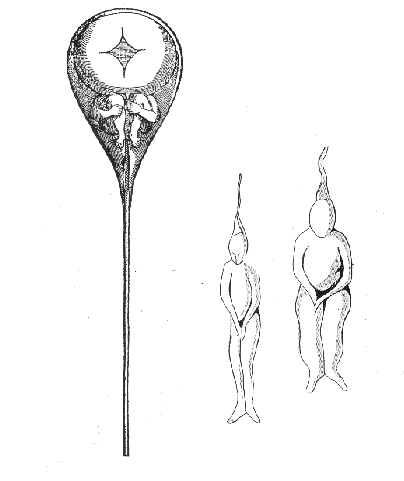
Although we take them for granted, the details of how babies are made have only been discovered over the last 150 years or so. Prior to that not much was known about it--aside from the obvious. Also a mystery was the process of development, about which there were two general schools of thought. Tracing back to Aristotle, epigenesists held that development was a process of emerging formation from formlessness. In contrast, preformists thought that the sperm (or egg) contained a miniature person--a 'homunculus'--and that development consisted of the enlargement of this preformed anatomy.

Preformists had to deal with two outstanding problems: that children had traits of both parents rather than just one, and the absurd implication that all of humanity was contained in the body of Adam (or Eve) like miniature Russian dolls. As science has progressed it has become clear that preformatism is wrong. Each person inherits genetic information from both parents, and development from a single cell occurs through a process of emerging organization, structure, and differentiation as cells alter their gene expression in response to their local environment.

The homunculus may be an outdated scientific idea, but it lives on as the spirit body in Mormonism [1]. While searching for something totally unrelated a while ago, I ran across this passage written by Joseph A. West in the May 1920 Improvement Era.

The gospel teaches, however, that the life-giving, intelligent, and immortal part of man is the spirit, which is in the exact likeness of the body, the growth and development of which are occasioned, according to Orson Pratt [2], one of the former Council of the Twelve, by the elastic force of the spirit in its effort to expand the body to conform to its spirit dimensions, and that, if the body is not stunted or deformed by some abnormal act of nature, it becomes, in every function and feature, an exact counterpart of its spirit life.
Although West was more detailed than most in his explanation, it is not hard to find similar statements using D&C 77:2 and Ether 3:16 as support. For example, in Vitality of Mormonism James E. Talmage wrote (p.243),
The human body, so far as it is normal, undeformed and unimpaired, is a presentment of the spirit itself.
Other Church leaders such as President Joseph F. Smith said similar things in the context of the resurrection of children. These ideas can still be found in the Church, but often there is less emphasis on the degree of correspondence between spirit and body.

The statements referenced above were all made no later than 1920, a time when science had little to say about heredity and development. For comparison, the first two decades of the twentieth century saw the emergence of the field of genetics, followed by molecular genetics in the second half of the century. Embryology and developmental biology have seen great advancements as well. From today's perspective, there doesn't seem to be any role for the spirit to shape the body, which makes the comparison to a homunculus apt in another way.

Homunculus arguments are fallacious arguments in theories of vision or mind that account for a phenomenon by invoking the same phenomenon that they are intended to explain, resulting in an infinite regression. For example, if you explain vision as the result of a little person (so to speak) inside you who views the images gathered by the eyes, you have not really explained vision; you have merely added another viewer.

Thus the spirit can be compared to a homunculus in two ways. First, there is the idea expressed by West that the expansion of the spirit is what shapes the physical body. And second, attributing physical features to the form of the spirit not only clashes with the demonstrated truths of genetics and developmental biology, but it also adds another layer to the mystery without really explaining anything. (What determines the shape of a spirit? And what determines the shape of that? And so on.)

None of this is to deny that we have a spirit, but it does raise questions about doctrinal traditions that developed in a pre-scientific environment. At the very least, I think we should be cautious in interpreting D&C 77:2 and Ether 3:16. It may also be worth re-evaluating what these scriptures mean, or looking at a range of possible meanings (for example, see Kent Condie's article, Pre-Mortal Spirits: Implications for Cloning, Abortion, Evolution, and Extinction).


Notes:
1. I don't know whether any Mormon commentators directly borrowed preformist ideas. As far as I know, the similarities are at best indirectly related.

2. I have not yet found such a discussion by Orson Pratt. If anybody knows of one, please tell me.


Continue reading...

Wednesday, February 03, 2010

Climategate: Michael Mann Cleared of Academic Misconduct (So Far)

Michael Mann is a climatologist at Penn State. Perhaps he is best known for his 'hockey stick' graph--a reconstruction of global temperatures over the last millennium, and he was prominent in the recent controversy over the stolen emails of the British Climatic Research Unit (CRU). Based on the many emails and inquiries received, the University conducted an official inquiry of academic misconduct.

The inquiry committee condensed the various emails down to four questions (allegations):

1. Did you engage in, or participate in, directly or indirectly, any actions with the intent to suppress or falsify data?

2. Did you engage in, or participate in, directly or indirectly, any actions with the intent to delete, conceal or otherwise destroy emails, information and/or data, related to AR4, as suggested by Phil Jones?

3. Did you engage in, or participate in, directly or indirectly, any misuse of privileged or confidential information available to you in your capacity as an academic scholar?

4. Did you engage in, or participate in, directly or indirectly, any actions that seriously deviated from accepted practices within the academic community for proposing, conducting, or reporting research or other scholarly activities?
After reviewing all emails from, to, or about Mann, as well as interviewing him and reviewing some of his own archived emails, the committee found "no substance" to the first three allegations. The inquiry committee judged that the fourth allegation should be investigated by "faculty peers from diverse fields" rather than the administrative committee.

Mann has thus been mostly cleared of academic misconduct, with the remaining allegation awaiting further investigation. More importantly for science, he has been cleared of falsifying data.

The Climategate controversy has generated a lot of heat online and in the media. Some commentators, particularly in the conservative media, speak as though it is established fact that these prominent climatologists not only acted poorly, but also falsified and manipulated data. As I wrote at the time, there seemed to be little evidence that there would be any significant change to the science based on the emails.

Given the prominence of the initial controversy and subsequent commentary, it is important that the public be made aware of this. (Expect cable news to be all over this...not.)

Further links:

Statement by Michael Mann

Inquiry Report (PDF)


Continue reading...

Monday, February 01, 2010

What's With the Ages of the Patriarchs? (Final)

In my first post in this series I brought up reasons why the ages of the ancient patriarchs (and numbers in general) in Genesis should be approached with caution. In my second post I showed how a straightforward reading of the ages results in problems of scriptural consistency. But this still leaves us with D&C 107:41-53, a revelation to Joseph Smith that gives support to the long ages of the patriarchs. I will admit up front that I don't have a tidy solution, but maybe we can nibble around the edges of the problem.

First let's look at these verses more closely. The ages at which the various patriarchs down to Noah were ordained to the Priesthood are given, and range from 10 years old to 496. Two of the ages stand out: Enos was ordained at 134 years and 4 months, and Mahalaleel at 496 years and 7 days(!). Why are we given such specificity for these two obscure prophets? Also notice that Enoch was ordained at 25 and blessed at 65. This blessing cannot refer to Adam's final blessing, as a look at the graphs in my second post shows. Is it coincidence that this blessing by Adam, the birth of Methuselah, and the founding of Zion all occurred when Enoch was 65? The text mentions that "God called upon Cainan...in the fortieth year of his age," and Enoch's ordination and blessing were also 40 years apart. The number 40 plays a prominent role in the Bible. For example Moses: was 40 years old when he first visited the Hebrews, spent 40 years as a shepherd, led Israel in the desert for 40 years, was on the mountain for 40 days, etc. Finally, perhaps it's also worth pointing out that these verses are somewhat in tension with D&C 84:15-16, which gives a different impression as to who ordained whom.

Now let's look at historical context. This portion of D&C 107 was received in March (or maybe April) of 1835. Perhaps it is not coincidence that just 2-3 months before, Joseph was helping to prepare the Lectures on Faith for publication. The Lectures on Faith had been composed the previous November, and they were selected for inclusion in the 1835 edition of the Doctrine and Covenants, which was published in August of that year. Although Sidney Rigdon is thought to have done most, if not all, of the actual composition, it seems clear that Joseph oversaw their contents.

The Lectures on Faith are of interest here because the second lecture dwells at length on the ages of the various patriarchs and their relationships to one another. A passage that seems to foreshadow D&C 107:53 says,

So that Lamech, the father of Noah, Methuselah, Enoch, Jared, Mahalaleel, Cainan, Enos, Seth, and Adam, were all living at the same time, and beyond all controversy, were all preachers of righteousness.

This brings us to the changes to the patriarchal ages made in the JST. The Book of Moses was written in 1830-31, and it followed the Old Testament in the ages it used. Sometime later (apparently after August 1831), Oliver Cowdery marked changes to the ages on one of the source manuscripts of the JST. However, except for the ages for Enoch, these changes were apparently removed by Joseph Smith III during publication, which is why they are also absent from our Book of Moses. As can be seen in my last post, it appears that the most important effect of these changes was to push Lamech's birth to after Adam's death, which fits better with D&C 107:53. Were these changes pure revelation? Were they adjustments made to correct perceived inconsistencies? What is their relationship to D&C 107 (especially the age of Enoch)? And why were they not included in the Lectures on Faith?

Perhaps the key to another way of looking at this scripture is verse 57.
These things were all written in the book of Enoch, and are to be testified of in due time.
Perhaps when the unknown book of Enoch was written these ages had symbolic or numerological significance that is lost to us. Under this hypothesis Joseph revealed contents of an ancient text, the real meaning of which remains cryptic to us.

But what about Adam's meeting with so many generations of his lineal descendants? There are several potential answers:

1. Such a thing would technically be possible even with non-miraculous documented lifespans of up to 120 years.

2. Returning to my first post, it may be that the relationships were not all strictly lineal.

3. It's possible that some of the detail is actually based on assumptions made by Joseph. It might be that the actual revelation was simply that Adam assembled and blessed his posterity, and that Joseph filled in the details of names based on his familiarity with the kinds of details contained in the Lectures on Faith?

Admittedly these ideas are not the most natural way to read D&C 107. However, the point of all of this is not to force a conclusion on whether the patriarchs lived for hundreds of years, or whether D&C 107 is right or wrong--or right in an unexpected way. Rather, my purpose has been simply to think creatively and raise possibilities. Since a straightforward reading of the scriptures dealing with the patriarchal ages leads to contradictions, it seems that creative thinking is required whether you think the ages are real or not.


Continue reading...

Wednesday, January 27, 2010

What's With the Ages of the Patriarchs? (Part 2)

In my last post I touched on alternative explanations for the ages of the ancient patriarchs. However, I also noted that Joseph Smith's revelations embrace those ages, thus seeming to tie his credibility to them. So it would seem that if you want to uphold Joseph, you have to accept the ages at face value. But it turns out not to be so simple.

First there is the question of which ages to use. The numbers in the Masoretic Text (MT) (our Old Testament) are somewhat different from the Septuagint (LXX) (the Old Testament in Jesus' time). The Book of Moses, which comes from the Joseph Smith Translation (JST) of the Bible, follows the MT except that Enoch's age is increased from 365 to 430. Although they were not incorporated into our Book of Moses, apparently Joseph and/or Oliver Cowdery also changed other ages in their work on the JST.

To get an overview of the situation I did what many curious Bible readers have done: I calculated the dates of the various ages [1]. Below are graphs of the ages as described by the MT, the LXX, the Book of Moses from the Pearl of Great Price, and the fuller JST [2]. The year of birth, priesthood ordination (all taken from D&C 107, except Adam, who presumably always had the priesthood), and death are indicated, as is the Flood. To make comparisons easier, the years count up from zero. (Click images to enlarge. Note the slightly different scale for the LXX.)

MT


LXX


PofGP


JST


It turns out that no matter which scenario you choose, there are things that don't make sense. Here is a list of the problems I have identified.

  • D&C 107 says that everyone down to Methuselah was ordained by Adam, and they are specifically named as having attended the gathering three years prior to Adam's death. But in the LXX Adam dies before Jared, Enoch, and Methuselah are born.

  • According to the PofGP, Enoch was translated at age 430. This means that Enoch established the city of Zion, which existed for 365 years, at age 65 (which is also the year Methuselah was born). This timing puts the founding of Zion well before the death of Adam, which doesn't seem to fit with the scriptural context. More specifically, the account of Enoch in the Book of Moses suggests that when Enoch began his preaching Adam had long since died.
    [Moses 6] 45 And death hath come upon our fathers; nevertheless we know them, and cannot deny, and even the first of all we know, even Adam.
    46 For a book of remembrance we have written among us, according to the pattern given by the finger of God; and it is given in our own language.
    But according to the MT, PofGP, and JST, none of Enoch's 'fathers' had died when he said this [3].

  • According to Moses 8:2, Methuselah was not taken up with the city of Zion,
    ...that the covenants of the Lord might be fulfilled, which he made to Enoch; for he truly covenanted with Enoch that Noah should be of the fruit of his loins.
    3 And it came to pass that Methuselah prophesied that from his loins should spring all the kingdoms of the earth (through Noah), and he took glory unto himself.
    But according to the MT, PofGP, and JST, Methuselah's son, Lamech (Noah's father), was born and ordained to the priesthood well before the city of Zion was taken up.

  • Speaking of being left behind, depending on the scenario, between three and five patriarchal ancestors of Enoch died sometime after Zion and Enoch were translated. Why weren't they also translated?

  • D&C 107:53 specifies that Adam called together Seth through Methuselah, "who were all high priests". But in the MT and PofGP Lamech was also alive and had been ordained to the priesthood. Perhaps to correct this, adjustments in the JST have Lamech as having not been born yet.

  • D&C 107:52 says that Noah was ordained to the Priesthood at the age of ten. However, Moses 8:12-14,19 seems to suggest that Noah was ordained after the birth of his sons, the last named of which was born when Noah was 500 years old.

  • The bottom line is this: no matter which scenario you choose (including the two canonized ones), if you take the ages and relationships of the ancient patriarchs at face value you end up with problems of scriptural internal consistency. It seems clear that further adjustments or clarifications are needed.

    In my final post in this series we'll look more closely at D&C 107.


    Notes:

    1. I have checked and double-checked my work, but I can't be certain it is free of mistakes. Please let me know if I've made any. Here is an image of my spreadsheet. (Click to enlarge.) Highlights represent differences from the MT.


    2. These four sources were chosen for convenience. Other ancient sources contain additional variations.

    3. Technically this problem could be resolved by pushing Enoch's statement into the last 50-120 years of his life. But it seems clear from the text that Enoch made this statement at the beginning of his preaching, before the establishment of Zion. Alternatively, Enoch could be referring to death rhetorically. But that does not explain why Enoch appeals to written records as supporting evidence for the existence of Adam.


    Continue reading...

    Saturday, January 23, 2010

    What's With the Ages of the Patriarchs? (Part 1)

    One of the well-known curiosities of Genesis is the long ages of the ancient patriarchs, particularly from Adam to Noah. With the exception of Enoch, who was translated, all of them are said to have lived over 700 years--some of them almost 1,000 years. To say that such long lifespans seem implausible is an understatement. What are we to make of these ages?

    Carol Hill's 2003 article, "Making Sense of the Numbers of Genesis" (PDF) in Perspectives on Science and Christian Faith (a publication of the American Scientific Affiliation) argues that the numbers of Genesis should be understood in terms of numerology rather than arithmetic. She makes the following basic points:

    • In ancient cultures numbers often had symbolic value independent of their numeric value.
    • The ancient civilizations of Mesopotamia and Egypt are known to have exaggerated lifespans of important persons.
    • Mesopotamians used a sexagesimal (base 60) number system, often symbolically. However, the Egyptians--and later the Hebrews--used the decimal (base 10) system. The decreasing lifespans after the flood may reflect a change in the usage of numbers by the Hebrews as a result of their time spent in Egypt.
    • All of the ages given from Adam to Noah can be broken down into favored numbers.
    • There are clear examples of numerical symmetry in scripture.
    • Genealogies in the Bible sometimes omit generations, and "begot" doesn't always mean begot.

    Read the paper for more details. I think she makes a good case for exercising care in taking Biblical numbers (especially in Genesis) at face value. This frees us from having to accommodate such fantastic lifespans as part of real history.

    BUT...

    The Genesis lifespans are repeated in the Book of Moses, which is Joseph Smith's revision of Genesis, and Doctrine and Covenants 107:42-53 gives the ages at which the ancient patriarchs were ordained to the Priesthood. Not only were several of them hundreds of years old at the time of their ordination, but before he died Adam assembled his posterity to bless them. All of the patriarchs down to Methuselah (Adam's great-great-great-great-great grandson) are named as having attended.

    So now we are back where we started. Or are we? In my next post we'll look at the ages of the ancient patriarchs a little more closely and see what we find.

    Part 2
    Part 3


    Continue reading...

    Thursday, January 14, 2010

    Lehi and the Creation of Opposites

    In a recent post I discussed the need to be careful about imposing our own culture and questions upon the scriptures. Specifically, I was discussing the Creation as depicted in Genesis 1 and how it may not have been formulated with our sense of science and history in mind.

    While reading Conrad Hyers's The Meaning of Creation I came across the following passage (p. 89; an almost identical paragraph is here):

    Since cosmologies are concerned with the establishment and maintenance of order in the cosmos, central to the achievement of order is the act of separating things from one another. Without acts of separation, one would have chaos. Thus ancient cosmologies commonly begin with a depiction of a chaotic state, where there are no clear lines of demarcation, and then proceed to indicate ways in which the present world-order (cosmos) with its lines of demarcation, has been organized. In other cultures this was achieved by divine births, wars, etc. Here cosmos is accomplished by separating things out from one another, and by creating other things (e.g., light or firmament) that aid in the separation. Everything is thus assigned its proper region and allowed to have its own identity, place and function in the overall scheme of created things. The key concept, therefore, which is applied to the inanimate as well as the animate, is the cosmological concept of separation to achieve order.
    I have often thought that this universe and life on Earth can be described in terms of separation, gradients, and compartmentalization (and for you physics folks, broken symmetries?). And until I read the above passage, I've always thought of these separations in the context of Lehi's opposites in 2 Nephi 2.
    11 For it must needs be, that there is an opposition in all things. If not so, my first-born in the wilderness, righteousness could not be brought to pass, neither wickedness, neither holiness nor misery, neither good nor bad. Wherefore, all things must needs be a compound in one; wherefore, if it should be one body it must needs remain as dead, having no life neither death, nor corruption nor incorruption, happiness nor misery, neither sense nor insensibility....

    15 And to bring about his eternal purposes in the end of man, after he had created our first parents, and the beasts of the field and the fowls of the air, and in fine, all things which are created, it must needs be that there was an opposition; even the forbidden fruit in opposition to the tree of life; the one being sweet and the other bitter.
    It is clear from the context that Lehi had been reading about the creation and subsequent events in the Garden of Eden. Scholars believe that Genesis 1 and 2 contain separate creation accounts that were merged together, probably after the Babylonian exile--and therefore after Lehi. But let's put that aside for now.

    Although Lehi's discussion of opposites is focused on the fruit of the two trees, it is interesting to me that in our text (if, perhaps, not Lehi's) the opposites of Eden are preceded by the creation of opposites through separation.

    I guess my point is that the suggestion that the creation narratives can be understood in ways other than literal science/history is not mere ivory tower sophistry, nor is it meaningful only in an ancient context. In addition to other symbolic meanings of Genesis 1, Lehi provides us one more: Genesis 1 represents the creation of a universe of opposites and both foreshadows and complements the opposites of Eden.


    Continue reading...

      © Blogger templates The Professional Template by Ourblogtemplates.com 2008

    Back to TOP