The current issue of the journal Science has a policy article discussing the pitfalls of using race in medical and genetic studies (Taking race out of human genetics). It is very easy to conflate race and ancestry, so I was struck by this paragraph that concisely explains the difference:
It is important to distinguish ancestry from a taxonomic notion such as race. Ancestry is a process-based concept, a statement about an individual's relationship to other individuals in their genealogical history; thus, it is a very personal understanding of one's genomic heritage. Race, on the other hand, is a pattern-based concept that has led scientists and laypersons alike to draw conclusions about hierarchical organization of humans, which connect an individual to a larger preconceived geographically circumscribed or socially constructed group.
Maybe that doesn't seem straightforward on a first reading, but it isn't that difficult to unpack. Ancestry is about who your ancestors were and where they came from. Basically it's the process of how you came to be. Race is a categorization that is made based on how you match up to a pattern. Barack Obama, for example, is equally of European and African ancestry. Yet in the United States his divided ancestry is usually collapsed into the racial category of black, based primarily on outward features that match the pattern associated with that race. If he had grown up in northern Minnesota, associated only with white people, and married a woman exclusively of Scandinavian ancestry, he still would never be considered white in the United States because he just doesn't look white (which is to say that his features don't match the pattern associated with being white).
I suppose this is all fairly mundane, but it is very easy to forget the distinction, and perhaps difficult to articulate. If I ever have reason to explain the difference, I'll remember that it boils down to process vs. pattern.
Richard Muller is a University of California, Berkeley physicist who took an interest in climate science. Concerned that the temperature data analysis done by other climate research groups might be flawed, a popular accusation of climate skeptics at the time [1], in 2010 Muller founded Berkeley Earth, an independent non-profit organization, to independently investigate the modern climate record. Climate skeptics were enthusiastic, with Anthony Watts even pledging to accept whatever result Muller found. Unsurprisingly, when Berkeley Earth's results basically confirmed those of NOAA, NASA, etc [2], Watts and other skeptics found reasons to be dissatisfied.
With that as background, last week Berkeley Earth released their analysis of 2015 and found it to be "unambiguously" the warmest year of the modern era.
In their press release, Berkeley Earth highlights the fact that they were conservative in not being willing to declare 2014 as the warmest year, as NASA and NOAA did.
Berkeley Earth has taken a cautious approach to announcing hottest years. A year ago, we announced that 2014 was not a clear record, but only in a statistical tie with 2005 and 2010. Now, however, it is clear that 2015 is the hottest year on record by a significant margin.
As you can see from the figure above, the average global temperature fluctuates from year to year, yet there is clearly an underlying trend. Skeptics have charged that there has been no warming since 1998, which was a strong El Niño year. This 'pause' in warming has been trumpeted as though it is incompatible with warming due to CO2 emissions. Although the timescale was too short to be certain of any particular trend, even some mainstream climate scientists began to treat the pause as a real phenomenon, though usually attributing it to temporary secondary factors (e.g. La Niña). Others thought it might just be statistical noise. In the press release Muller says,
This new high temperature record confirms our previous interpretation that the pause was temporary and that global warming has not slowed.
Now that 2015 is the unambiguously warmest year (NOAA, NASA, and the U.K.'s Met Office Hadley Centre all agree on this), will talk of the pause vanish? It would not be surprising if the next few years--maybe even a decade--are not as warm as 2015 [3]. Is it too cynical of me to think that skeptics will start speaking of 2015 as the beginning of a new pause? Alternatively, they may discount 2015 as a strong El Niño year, ignoring the fact that 1998 was also a strong El Niño year. Or perhaps we will hear a lot more about the virtues of satellite data, which are more amenable to the skeptical view as demonstrated by a recent hearing held by Rep. Lamar Smith and Sen. Ted Cruz?
I'll end this post by including a short video of an interview with Richard Muller from a couple of years ago, where he explains how he came to join the scientific consensus.
Notes:
1. The 'climategate' brouhaha began at the end of 2009. You remember climategate, right? Remember how stolen emails were breathlessly reported to show that the warming was based on a biased and dishonest analysis?
2. It turns out that government grants are so powerful that even an organization not funded by the government is compelled to arrive at the scientific consensus. Government grants are some seriously strong stuff!
Last month the journal Nature published a news article, The science myths that will not die. It lists five myths that, while based on a kernel of truth, are actually false. They are:
1. Screening saves lives for all types of cancer
2. Antioxidants are good and free radicals are bad
3. Humans have exceptionally large brains
4. Individuals learn best when taught in their preferred learning style
5. The human population is growing exponentially (and we're doomed)
Myths can extend into the history of science as well, as a linked article from 2013 illustrates. Most of it revolves around Joseph Meister, the first person saved from rabies by a vaccine made by Louis Pasteur. The story goes that when the Nazis invaded Paris, they asked Meister, who was working as a caretaker at the Pasteur Institute, the location of Pasteur's grave. In an act of loyalty, Meister shot and killed himself rather than give up the location of the tomb.
However, newer research tells a very different and more tragic tale. (Those darn revisionist historians!) As the Nazis approached Paris, Meister sent his wife and children away. Believing that they had been killed in a bombing campaign, he committed suicide by gas a few hours before they returned. Eugene Wollman, a scientist at the Pasteur Institute, wrote of this in his diary, "Life has an extraordinarily refined cruelty."
Anyway, back to the first article: It is accompanied by a box where Nature lists the myths most frustrating to doctors and scientists polled by Nature.
1. Vaccines cause autism
2. Paracetamol (acetaminophen) works through known mechanisms
3. The brain is walled off from the immune system
4. Homeopathy works.
OK, really? The idea that acetaminophen works through known mechanisms frustrates doctors and scientists? I guess I fell for this one in that I assumed the mechanism of acetaminophen's actions were known. But how on earth does this rise to such levels of irritation as to be listed with vaccines/autism and homeopathy? Is this just a thing among pharmacologists? Does anybody out there know?
The post title may be a little clickbaity, but the words aren't mine. Conservative New York Times columnist David Brooks published a column yesterday in which he wrote that on climate change,
the G.O.P. has come to resemble a Soviet dictatorship — a vast majority of Republican politicians can’t publicly say what they know about the truth of climate change because they’re afraid the thought police will knock on their door and drag them off to an AM radio interrogation. [1]
Comparisons to Hitler, the Nazis, Stalin, or other authoritarian regimes of history are a dime a dozen these days. Ordinarily we might expect the charge that Republicans are acting like Soviets to come from someone on the left wing of the U.S. political spectrum, but Brooks comes from the right and seems to be giving voice to a quiet minority (presumably) within his own party [2].
Brooks's column led New York Magazine's Jonathan Chait to muse about the GOP's orientation toward climate change, citing data from the National Oceanic and Atmospheric Administration (NOAA) to rebut a Wall Street Journal columnist's recent assertions. Continuing, Chait wrote,
Of course, refuting climate-science skepticism with NOAA data runs into the problem that Republicans reject NOAA data. House Science Committee chairman Lamar Smith has used his power to accuse federal scientists of falsifying climate data. Smith has no evidence to support his charge, but the accusation is in keeping with the conservative belief that the theory of anthropogenic global warming is the product of a vast conspiracy among thousands of scientists worldwide to enrich themselves. (The chairman of the Senate’s environment committee is a fellow subscriber to this theory.) The theory is just as bonkers as the belief that the government faked the 9/11 attacks or the moon landings, with the main difference being that it informs a first-order public policy question and is also accepted doctrine within one of the two major American political parties.
The current spat between Smith and NOAA is where Brooks's comparison to the Soviets perhaps becomes most relevant. Soviet agriculture and biology were harmed for decades because the ideas of Trofim Lysenko became party doctrine. Thousands of mainstream Russian biologists were disposed of in one way or another and the Russian people suffered the consequences of such wrong-headed biology. It may seem absurd that a political organization would take a stand on the proper way to understand biology, but such is life in the political world, I guess.
This is not to say that the GOP treatment of government scientists in any way rises to that of the Soviets. Nevertheless, the Soviet experience does serve as a historical warning of the foolishness of political parties standing against the scientific mainstream. And it certainly must be demoralizing to many scientists to persistently be held in such contempt by roughly half of the legislative branch of government, and most of their potential executive heads.
It doesn't have to be this way. Just a couple of weeks ago The Atlantic did an article on conservative solutions to climate change. If Republicans would take the issue seriously, they might be able to build a legacy on this issue to be proud of.
Increasingly I have seen political commentators suggest that the GOP is becoming post-truth and post-policy [3]. I hope that they are wrong, but lately my hope finds little encouragement. However, as the saying goes, hope springs eternal.
Notes:
1. Maybe it's just me, but I get the feeling Brooks's statement is true for a number of issues.
2. Senator Lindsay Graham has been outspoken on this, but he seems to be alone among presidential candidates. And anyway he has almost no support in the polls.
3. Post-truth, meaning that party leaders tell blatant lies as a matter of course. Post-policy, meaning that the party has no meaningful policy solutions, but lives only by stoking resentment over current policies and advancing purely symbolic fights.
Recently I became aware that the evolutionary history of whales is based on fraudulent information. At least that seems to be the common belief of creationists. We might expect them to be resistant to the fossil and genetic evidence for whale evolution, but what makes it fraudulent?
Some Background
First we need to step back a few decades to get some historical perspective. Prior to 1979 very little was known about the early evolution of whales. Mammals evolved on land long before whales appeared in the fossil record. Therefore, since whales are mammals, you would expect whales to have their evolutionary roots in land mammals. However, there wasn't much fossil evidence to go on. That started to change when, working in Pakistan, paleontologist Philip Gingerich discovered the skull of a land mammal that was similar in form to a wolf. Gingerich noticed a couple of grape-sized bones of the middle ear that were only known to exist in cetaceans (whales, dolphins, etc). This strongly suggested that the newly discovered animal, Pakicetus, was a relative of whales. Over the next few decades, Gingerich and his former student, Hans Thewissen, discovered a number of other related fossils showing various degrees of adaptation to water, and each with the distinctive cetacean middle ear bones.
Scientists initially believed that whales were most closely related to a group of extinct mammals called Mesonychids, which are related to Artiodactyls (cattle, pigs, hippos, etc). However, most experts now believe that whales are more closely related to Artiodactyls based on two principle lines of evidence [1]. First, in the late 1990s a Japanese group found that whales and hippos share some common genetic markers (LINEs and SINEs) that are not shared by other Artiodactyls, suggesting that they share a common ancient ancestor that is not shared by other Artiodactyls or Mesonychids. Second, some of those fossils discovered by Gingerich and Thewissen turned out to have an ankle bone (double-pulley astragalus) that is a defining feature of Artiodactyls.
Let's pause for a moment to make this clear. We have fossils that have one feature diagnostic for cetaceans, and another feature diagnostic for Artiodactyls. Also, modern whales share some unique genetic markers with hippos (which are Artiodactyls). It's almost as if...whales....evolved from....a group of ancient Artiodactyls [2].
The Fraud
So where does the fraud come in? A creationist named Dr. Carl Werner (apparently a physician by training) interviewed some of the paleontologists that study cetacean evolution, especially Gingerich (2001) and Thewissen (2013). Werner produced an anti-evolution video series and published an accompanying book titled, Evolution: the Grand Experiment, with one chapter devoted to whales. For the 2014 third addition of his book, Werner produced a press release that breathlessly lays out the main charges, even though much of it pertains to information over a decade old. During his filmed interviews, Gingerich and Thewissen spilled the beans on how shaky the whale evolutionary scenario is. These amazing revelations included the following:
1. Although the tail of the ancient cetacean Rodhocetus has not been found, Gingerich initially speculated that it had a fluke at the end of it. Also, initially the limbs were not recovered so he speculated that Rodhocetus had flippers. Limbs were later recovered, leading Gingerich to doubt that they were flippers, and ultimately doubt that it had a tail fluke. However, various museums were still displaying drawings of Rodhocetus with flippers and a fluke. Somehow all of this disqualifies Rodhocetus as a transitional fossil and serves as evidence that evolutionary scientists freely spread misinformation.
2. When Thewissen discovered the skeleton of Ambulocetus, part of the upper jaw was missing, along with the nasal opening. The remaining lower jaw allowed him to judge how long the upper jaw would have been. However, the location of the nasal opening is not known. Thewissen's model placed the nasal opening a few inches back from the end of the snout. Since the actual location of the nasal opening isn't known, Thewissen's model is biased and misleading.
3. In discussing the middle ear of Ambulocetus, Thewissen acknowledged that a part called the sigmoid process, which was previously thought to be diagnostic for cetaceans, was 'questionable'. This admission revealed that there was no basis to consider Ambulocetus a cetacean. When combined with #2 above, it was clear that Ambulocetus as a transitional whale fossil was a figment of wishful thinking.
More to the Story
When I first came across these claims I did some Internet searching to see if there was any response. These charges were clearly popular because all kinds of creationist websites dominated my search results. Eventually I found an anonymous message board where one of the participants claimed to have contacted Dr. Thewissen and received a reply, which he posted. Thewissen confirmed that Werner did interview him.
He had me answer the same question a number of times. Usually journalists do this when the answer that a scientist gives is too technical, so usually the scientist rephrases the answer in a more simple way. When Werner shot in my lab, he would ask the same question multiple times, and I simplified my answers more and more each time he repeated a question. He then put my answers together in a creative way that makes it all look pretty silly....
The written piece that you sent me, I had never seen before. It does not discuss the critical piece of information that shows that Pakicetus and Ambulocetus are whales: the thick inner part of the tympanic bone of the ear, called the involucrum. It is not clear to me why this is not presented, as scientists agree that this is the most critical feature. Instead, the video focusses on another part of the tympanic bone, the outer part, which indeed is different in shape in different whales, and occurs in some whale relatives too (artiodactyls are the closest relatives to whales, no wonder that their ears have similarities). So, that feature needs to be qualified when it is explained. In a simple sound bite such as the ones that Dr. Werner presents, those qualifiers are not present and that causes that particular feature to look pretty inconclusive in the way it is presented there.
Since this comes from some unidentified person on a message board, you might be skeptical that it actually came from Thewissen, as you should be. However, the response also drew attention to a video that Thewissen made to help clarify the issues around Ambulocetus, though without direct reference to the creationists. Indeed, the YouTube video does exist! And it's worth watching.
Let's return to the issue of the sigmoid process and the involucrum for a moment. Werner's website quotes a 1998 publication by another whale expert (Zhe-Xi Luo) as follows.
"Other diagnostic characters, such as the sigmoid process as discussed below, are now open to question in the wake of the new fossil evidence from Pakicetus...[The] sigmoid process [in Pakicetus] is a simple plate [and is] equivocal, [since it is also] present in the artiodactyl Diacodexis...compromising its utility as a "dead ringer" apomorphy [unique trait] for cetaceans."
However, this editing leaves out an important preceding sentence from the original publication (a book, by the way, that was edited by Thewissen) (bolding added).
Cetaceans including pakicetids have only one unambiguous bullar synapomorphy that is absent in all noncetacean mammals--the involucrum, or the pachyosteosclerosis of the medial margin of the bulla. Other diagnostic characters, such as the sigmoid process, as discussed below, are now open to question in the wake of the new fossil evidence from Pakicetus and Ichthyolestes.
Luo's argument is rather technical, but the gist seems to be that the sigmoid process should not be considered a definitive sign that an ancient fossil is a cetacean. However, as stated by Luo, that still leaves the involucrum! I wonder if Werner missed that sentence.
Summary and Conclusion
So let's summarize the answers to the supposedly devastating admissions by Gingerich and Thewissen, numbered as above.
1. So far as I know, Gingerich never responded to Werner. Paleontologists often do not recover all of the bones of a fossil skeleton, so their reconstructions sometimes contain some guesswork based on other information. Carl Zimmer's book, At the Water's Edge, which profiled Gingerich's work, stated that most of the tail of Rodhocetus was missing, "preventing [Gingerich] from knowing whether it had grown flukes at its tip." Zimmer's book was published two or three years before Werner interviewed Gingerich, so Gingerich was hardly making a new admission to Werner. Werner's complaint has some justification as far as accuracy of reconstructions go. However, that does not negate the features that make Rodhocetus a cetacean that could function both on land and in water. Rodhocetus retains its place in the evolutionary transition of cetaceans from land to water.
2. Although Thewissen did not know exactly where the nasal opening of Ambulocetus was, its close relation to another fossil suggested that the opening had migrated a bit from the tip of the snout. The exact location of the opening is not important. When you look at the broad picture of cetacean evolution, you see the nasal opening migrate back from from the tip of the snout toward the eyes, where we know it in modern cetaceans as the blowhole.
3. The sigmoid process is a strong indicator of being a cetacean, but is apparently now considered not entirely definitive. However, the involucrum is considered definitive, and all of the fossils in question have an enlarged involucrum.
There are other issues I have not addressed, on both sides. Werner and other creationists have a few other criticisms that I haven't run down, some of which are rooted in a cartoon version of how evolution or science works. Similarly, there are other evidences derived from both living and ancient cetaceans that yield further evidence of, and insight into, cetacean evolution.
In conclusion, the notion that evolution, both in general and as applied to whales, has fallen like a house of cards remains a creationist fantasy. Nor is there any evidence of actual fraud; only some perhaps ill-advised artistic license. In this case, Werner has employed classic creationist tactics of selective quotation and ignoring important context. The evolutionary history of whales remains in good shape.
1. There are actually a number of other characteristics that support the relationship, but they are more subtle.
2. Either that, or God created whales on the fifth day of creation, some with a distinctive ankle bone they hardly used, if at all. And then, for some reason, He created a bunch of land Artiodactyls on the sixth day of creation with that same ankle bone, and in a few cases threw in the whale-like middle ear for good measure.
If you paid any attention to last week's Republican primary debate and the subsequent commentary, you'll know that there was some controversy over Dr. Ben Carson's answer to a question about his involvement with a dietary supplement company. From the transcript:
CARL: This is a company called Mannatech, a maker of nutritional supplements with which you had a ten-year relationship. They offered claims that they could cure autism, cancer. They paid $7 million to settle a deceptive marketing lawsuit in Texas, and yet your involvement continued. Why?
CARSON: Well, that's easy to answer. I didn't have an involvement with them. That's total propaganda. And this is what happens in our society. Total propaganda. I did a couple of speeches for them. I did speeches for other people. They were paid speeches. It is absolutely absurd to say that I had any kind of relationship with them.
Do I take the product? Yes, I think it's a good product.
CARL: To be fair, you were on the home page of their website with the logo over your shoulder.
CARSON: If somebody put me on their home page, they did it without my permission.
What Carson called 'total propaganda' turned out to be total truth, leading a writer at the conservative National Review to call Carson's answer "bald-faced lies." Further documentation of Carson's history with the company can be found here and here.
My interest here is in two statements he previously made about the product, separated by about 9 years.
The wonderful thing about a company like Mannatech is that they recognize that when God made us, He gave us the right fuel.
-----------
God gave us [in plants] what we need to remain healthy. In today’s world our food chain is depleted of nutrients and our environment has helped destroy what God gave us.
Underlying much of advocacy for alternative health, anti-GMO, and anti-vaccination is the fallacious belief that 'natural' is better. Taking extracts of various plants is better than taking a drug, natural so-called organic foods are better than those that have been altered by genetic technology, and having an infectious disease somehow gives better immunity than a vaccine. Scientifically this is all baloney, at least in the broad strokes, but it sure has marketing appeal.
Carson's statements could be classified as a theological subset of the fallacious appeal to nature. I don't know whether he actually believes what he said, or whether this is religious rhetoric in the service of sales. It is certainly true that many useful drugs are derived from naturally occurring substances, but that doesn't seem to be Carson's point. Taken at face value, he seems to believe that edible plants in the natural world (created by God) contain the solutions to our health problems. Except, I guess, for the ones we already use.
This seems like a rather presentist belief to hold, by which I mean you have to ignore most of human history, during which life expectancy was pretty low compared to today. Many of our foods are the end products of artificial selection, and increased understanding and technology have allowed us to fortify common food items with a variety of dietary necessities (iodine in salt, vitamin D in milk, folic acid in flour, etc). As a result, dietary diseases like scurvy and rickets are practically unheard of in developed countries. To claim that our food is depleted of nutrients seems exactly backwards, except in the sense that many people choose to eat unhealthy foods.
In Carson's case, prostate cancer supposedly sparked his interest in Mannatech. I say supposedly because Carson has claimed that Mannatech's product alleviated his cancer symptoms. However, the documented timeline suggests that Carson had already had his prostate removed by the time he found Mannatech. At any rate, the notion of adding some exotic supplement to your diet as a way to prevent or treat cancer is the way of snake oil. Wrapping snake oil in praise for the providence of God still leaves you with snake oil.
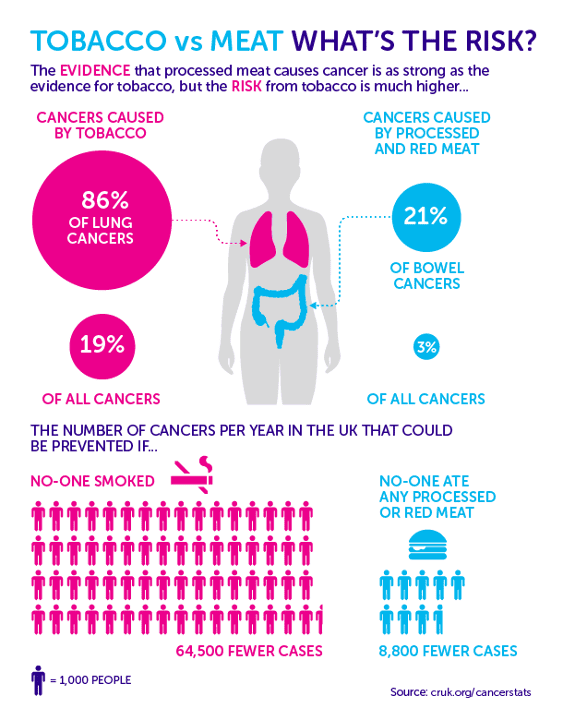
This morning as I was doing my news-browsing rounds, I came across the big news that the WHO has officially declared red and processed meats as carcinogenic [1]. In my case the news was conveyed by the image and associated article on the left, as found on the home page of The Guardian. My first reaction was one of anger and skepticism. How on earth could meat rank with smoking as a cause of cancer? What eggheads came up with this idea? My second reaction was to cool my jets and to investigate a little. After all, the WHO is a pretty respectable organization, and if bacon causes cancer, my being angry about it will have zero bearing on reality. We use science to try to ferret out truths about the universe, after all, not just tell us what we want to hear.
The Guardian article went basically like this: WHO says meat causes cancer, the meat industry is furious, but industry scientists are just in denial. Well, no industry likes its products being called out as harmful (see: tobacco, fossil fuels, etc), so yeah, we wouldn't expect the meat industry to like this. (Disclosure: I am not a meat industry scientist, but my job is impacted by the meat industry.) However...
Vegetarians are probably breathing a sigh of relief today as headlines are warning us that processed and cured meats cause cancer. But the way this message has been framed in the media is extremely misleading.
Comparing meat to tobacco, as most news organisations who’ve chosen to report this have done, makes it seem like a bacon sandwich might be just as harmful as a cigarette. This is absolutely not the case.
Gee, what news organization was misleading?
The article goes on to explain that processed meat is in the same class as tobacco in terms of certainty of cancer causation, NOT risk of cancer. Understanding the difference is important for judging how concerned to be about this. The article includes this handy graphic.
It's important not to go overboard with this. For example, my wife's doctor has her on a low-carb diet, which means that red meat and processed meats make up a larger part of her diet. Freaking out about their cancer potential would be counter-productive because without them she is at much greater risk of developing diabetes and cardiovascular disease.
Presumably governments will issue consumption guidelines sometime in the future, and perhaps methods of meat preparation and cooking will be developed that minimize cancer risk. It seems that the bottom line for now is simply to eat red and processed meats moderately. You can have bacon; just don't go crazy with it.
Notes:
1. According to WHO, "Red meat refers to all mammalian muscle meat, including, beef, veal, pork, lamb, mutton,
horse, and goat....Processed meat refers to meat that has been transformed through salting, curing, fermentation, smoking, or other processes to enhance flavour or improve preservation."
The Church is introducing new 'cornerstone' religion courses for Church universities and Institutes of Religion. One of these courses is titled, Jesus Christ and the Everlasting Gospel, with a manual of the same name. The seventh lesson of the manual is titled, Jesus Christ—God’s Only Begotten Son in the Flesh. After laying some scriptural groundwork, students are encouraged to think of physical traits they inherited from their mother and father. They are then taught to think of Jesus, Mary, and God the Father in the same manner, with support from this passage in Jesus the Christ, written by Elder James E. Talmage.
That Child to be born of Mary was begotten of Elohim, the Eternal Father, not in violation of natural law but in accordance with a higher manifestation thereof; … In His nature would be combined the powers of Godhood with the capacity and possibilities of mortality; and this through the ordinary operation of the fundamental law of heredity, declared of God, demonstrated by science, and admitted by philosophy, that living beings shall propagate—after their kind. The Child Jesus was to inherit the physical, mental, and spiritual traits, tendencies, and powers that characterized His parents—one immortal and glorified—God, the other human—woman” (Jesus the Christ, 3rd ed. [1916], 81).
Terryl Givens has written that,
LDS biblical interpretation has tended more toward fundamentalist literalism than historically nuanced or figurative readings. This is largely a product of Mormonism’s origins in a time when Common Sense theology was dominant....Parley Pratt set the tone for Mormon scriptural exegesis with recurrent attacks on those who would “spiritualize” the Bible, rather than read in the plain, literal sense [1].
Reinforcing this literalism was the attempt of Parley and Orson Pratt, as well as John Widtsoe and James Talmage, to fit Joseph Smith's teachings into a theology "amenable to contemporary standards of scientific understanding [2]." Indeed, elsewhere in Jesus the Christ Elder Talmage explained that miracles are simply higher manifestations of natural law, not violations of it.
When Elder Talmage wrote his book a century ago, heredity was an observed phenomenon about which almost nothing was known. The passage above was a sensible thing for Elder Talmage to write for readers of the time, and its inclusion in the new manual speaks to its persuasive power today--when most people still only have a vague sense of the basis for heredity [3]. However, today the mechanism of heredity is well understood. So if we are to let science into the conversation, as Elder Talmage invites us to, then we need to talk about biological and genetic principles and details. Are these topics that can profitably be brought to bear on Jesus' divine sonship? It may seem vulgar to speak of such things in the context of the atonement, but that is the door the writers of the manual open by highlighting Elder Talmage's optimistic appeal to science and philosophy.
Using the lens of science a variety of questions could be raised. Instead, for now let's confine ourselves to this question: What possible relevance could genetics ("the ordinary operation of the fundamental law of heredity") have to the resurrection or any other of Jesus' abilities? The manual directs as follows (bolding in original):
As students respond, make sure they understand the following truth: As the Only Begotten Son of God in the flesh, Jesus Christ was able to perform the Atoning sacrifice, which required Him to endure more than a mortal person could, and thereby fulfill His role in the Father’s plan. In addition, because Jesus had power over death, He had the capacity to rise from the dead. Make sure students understand that if Jesus Christ had been born of two mortal parents, He could not have overcome death or endured the infinite pain and suffering of the Atonement. If He were born of two immortal parents, He would not have been subject to physical suffering and death.
On what basis should such assertions be made? Several scriptural prophets including Enoch, Moses, Elijah, John, and the three Nephites were each given a kind of "power over death" (D&C 7:2), without heredity playing any role. Lazarus was raised from the dead. Any number of miraculous interventions could have been used to prevent Jesus from dying before his mission was accomplished. Further, it is unclear what inherited property could cause a dead body to rise back to life, and since all people are promised the resurrection (Spencer W. Kimball, echoing Brigham Young, taught that it is an ordinance), I don't see why we would even need to posit one.
Remember that in a gospel context death is the separation of body and spirit, with resurrection being the reuniting of the two. Are we to believe that a physical property of Jesus' decaying body made it possible for his spirit to re-enter it? If the decision to initiate resurrection was made by his spirit, how can inheritance be relevant? You would think that the mere fact that Jesus was "God himself"--the premortal Jehovah, would be a sufficient explanation. (And simply as a matter of internal consistency, if, according to Church teachings, it was possible for Adam and Eve to change from immortality to mortality, why wouldn't it be possible for Jesus to do the same if both parents were immortal?)
The atonement and resurrection are incomprehensible, and fundamentally remain mysteries to us. Is anything gained in multiplying the mystery by asserting the necessity of unknown inherited factors? Is such detail clearly supported by the scriptures? And might we unwittingly put stumbling blocks in the paths of students by invoking the authority of science where it probably doesn't belong?
Let's be careful about claiming science in support of doctrine. Especially those doctrines we know very little about.
Notes:
1. Givens, Wrestling the Angel: The Foundations of Mormon Thought: Cosmos, God, Humanity, p. 18.
2. Givens, Wrestling the Angel: The Foundations of Mormon Thought: Cosmos, God, Humanity, p. 126.
3. I think most people know that heredity involves genes and DNA, but don't really know much more than that. I once had a conversation with a highly intelligent and educated friend in which he told me that he did not understand the difference between a gene and the genome. Based on his career path, there was no particular reason why he should have.


 Posts
Posts