


 Posts
Posts


Meat and Cancer: Let's Not Go Overboard

The Guardian article went basically like this: WHO says meat causes cancer, the meat industry is furious, but industry scientists are just in denial. Well, no industry likes its products being called out as harmful (see: tobacco, fossil fuels, etc), so yeah, we wouldn't expect the meat industry to like this. (Disclosure: I am not a meat industry scientist, but my job is impacted by the meat industry.) However...
I later clicked through to the science section where I found this much more responsible article.

Vegetarians are probably breathing a sigh of relief today as headlines are warning us that processed and cured meats cause cancer. But the way this message has been framed in the media is extremely misleading.Gee, what news organization was misleading?
Comparing meat to tobacco, as most news organisations who’ve chosen to report this have done, makes it seem like a bacon sandwich might be just as harmful as a cigarette. This is absolutely not the case.
The article goes on to explain that processed meat is in the same class as tobacco in terms of certainty of cancer causation, NOT risk of cancer. Understanding the difference is important for judging how concerned to be about this. The article includes this handy graphic.
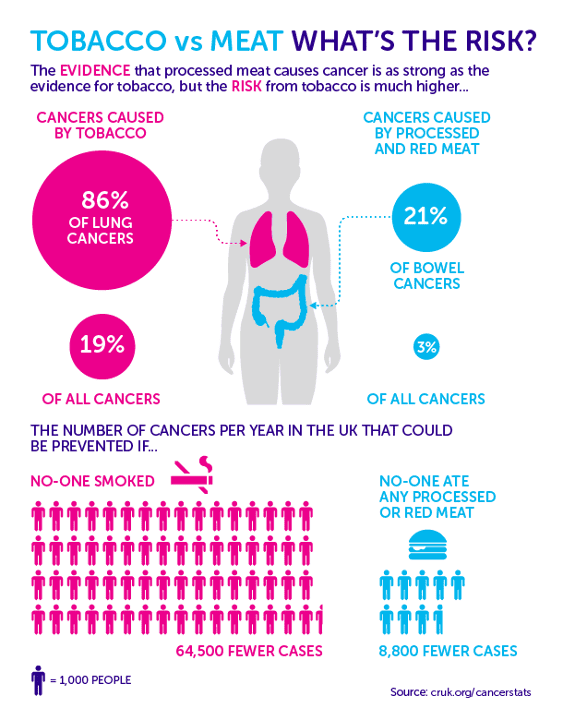
It's important not to go overboard with this. For example, my wife's doctor has her on a low-carb diet, which means that red meat and processed meats make up a larger part of her diet. Freaking out about their cancer potential would be counter-productive because without them she is at much greater risk of developing diabetes and cardiovascular disease.
Presumably governments will issue consumption guidelines sometime in the future, and perhaps methods of meat preparation and cooking will be developed that minimize cancer risk. It seems that the bottom line for now is simply to eat red and processed meats moderately. You can have bacon; just don't go crazy with it.
For more information, see WHO's FAQ.
Notes:
1. According to WHO, "Red meat refers to all mammalian muscle meat, including, beef, veal, pork, lamb, mutton,
horse, and goat....Processed meat refers to meat that has been transformed through salting, curing, fermentation, smoking, or other processes to enhance flavour or improve preservation."


2 comments:
I read a few articles suggesting this around a year ago. At that time, sodium nitrate was being pinpointed as the culprit for the link with processed meats and cancer. The current articles I have read do not make that connection (or any specific cause/effect connection at all). Has this been found to be false?
I don't know. According the the FAQ:
"Q. What makes red meat and processed meat increase the risk of cancer?
A. Meat consists of multiple components, such as haem iron. Meat can also contain chemicals that form during meat processing or cooking. For instance, carcinogenic chemicals that form during meat processing include N-nitroso compounds and polycyclic aromatic hydrocarbons.
Cooking of red meat or processed meat also produces heterocyclic aromatic amines as well as
other chemicals including polycyclic aromatic hydrocarbons, which are also found in other foods and in air pollution. Some of these chemicals are known or suspected carcinogens, but despite this knowledge it is not yet fully understood how cancer risk is increased by red meat or processed meat."
Post a Comment