Friday, May 31, 2013

My Plan for Stopping Tornadoes

What, if anything, should we do about tornadoes? James P. Pinkerton at The American Conservative thinks that the mainstream media are too wrapped up in sentimentalism and green ideology to be interested in practical solutions.

So these are the two dominant media narratives: sweetly sentimental and greenly ideological. And it’s a safe bet that the green agenda will resonate in the MSM long after reporters have lost interested in heartwarming stories from plucky survivors.

It might prove to be the case that climate change is the greatest threat that humanity faces. Maybe the American people can be persuaded that the changing climate is a more urgent problem than terrorism, or poverty, or joblessness. Maybe, also, the Chinese and Indians can be persuaded to forgo economic growth by reducing their carbon footprints. And even poorer peoples, too.

Yet even so, it still couldn’t hurt to give some consideration to shorter-term threats, such as people being killed, and places being wrecked, by tornadoes.

That is, whatever the future of climate-change efforts, we could have a dynamic, science-based discussion about reducing the lethality of tornadoes.
I'm willing to grant that the MSM can be a little ridiculous in the way they cover tragedies. And of course we'll have lots of tornadoes whether or not the globe continues to warm. So what about this science-based discussion?
But if we could pretend for a moment that tornadoes were threatening Washington, DC, and not some place in flyover country, we could then start thinking about next steps, beyond warning and basement-building.

We could, and would, think about actually stopping tornadoes. Ideas for stopping tornadoes are, in fact, abundant. Yet in the wake of this deadly tornado, the media will offer little, if any, discussion of such ideas. Why not? Why this lack of interest?

Perhaps it’s because, as we have seen, media bandwidth has been allocated to narratives of sweet sentimentalizing and green ideologizing. Either the storm proves the moral worth of Sooners, or else it proves the need for action on climate change. But that seems to be all. In other words, new action to stop tornadoes from killing is sort of beside the point; it’s certainly outside of the twin narrative.
The links are in the original piece. The first is a link to an online physics discussion forum and, while I didn't read all 6 pages, in my perusal I didn't find anything much more than arm-chair speculation. The second link is an interview with a tornado scientist where the last question addresses this question, and the answer is extremely vague--probably because of the enormity of such a task. The third link is to some guy's patented idea for shooting a water mist over a city to cool the air. Folks on that physics forum appear to be of the opinion that misting the air would only make things worse. I think it's also fair to ask whether that's a wise use of water in a place already under drought stress.

So in spite of the abundance of ideas, those are the three evidences offered by Pinkerton. He goes on to admit that we don't even know if stopping tornadoes is possible, but who knows what technology will bring?
...new technology will always confound the conventional wisdom. Such confounding is the nature of scientific revolutions, and it would help if the media, the great collective maker of conventional wisdom, could make room for that reality. That is, if the media could add a third narrative idea—the idea that we can apply science to solve deadly problems, even in the short run.
So let me get this straight. Renewable energy sources that reduce our contribution to CO2-mediated warming are the fevered dream of green ideologues, but if we would just put on our thinking caps we might find a way to stop tornadoes and save people now.

This is just silly, and it's pretty thin gruel for MSM bias--to the point that it's almost a parody of such complaints. I know this is crazy, but maybe nobody is chasing this angle because it is as impractical as moving Mt. Everest to Nebraska. I'm all for practical solutions, but stopping something that develops with little warning and has the energy of multiple nuclear bombs is a tall order. Why, at this point, should we expect the MSM to take this seriously?

But not to worry, because a solution is already at hand. We just need to get Pecos Bill better transportation than a horse.


Continue reading...

Friday, May 24, 2013

The Changing Political Climate on Climate

Good Republicans don't worry about climate change--except as a liberal plot to destroy freedom. That's the stereotype you get listening to conservative media outlets--or liberal outlets reporting on conservatives. But a National Journal article suggests that, much like the effects of climate change, quiet but real shifts are beginning to occur within the party.

Mother and daughter Roberta and Michele Combs are pillars of the Religious Right. Roberta, president and CEO of the Christian Coalition America, got her start in Republican politics working with celebrated strategist Lee Atwater. Michele, who was named Young Republican of the Year in 1989 and worked as a planner for events such as George W. Bush’s inauguration, is the coalition’s communications director. With their white-blond bouffant hair, penchant for fuchsia lipstick, soft South Carolina accents, and sterling conservative bona fides, the Combses are familiar presences in the ruby-red heart of the GOP establishment.

That’s why it’s so surprising to many that they are tackling climate change. But both women see global warming, and clean air and environmental protection more broadly, as issues that tie into their core conservative mission of protecting family values.

“This is an important issue for the Republican Party,” Roberta Combs says. “At one point in time, this was a Republican issue, but Democrats took it over.”
Took it over? That's kind of like saying the air took over the land when the tide ran out. Nevertheless, the article paints a picture of increasing concern about the climate among Republican operatives and politicians. They just can't be too vocal about it yet.
Already, deep fissures are emerging between, on one side, a base of ideological voters and lawmakers with strong ties to powerful tea-party groups and super PACs funded by the fossil-fuel industry who see climate change as a false threat concocted by liberals to justify greater government control; and on the other side, a quiet group of moderates, younger voters, and leading conservative intellectuals who fear that if Republicans continue to dismiss or deny climate change, the party will become irrelevant.
One thread I want to pick up on comes from the opening of the article, which introduces climate scientist Kerry Emanuel.
Kerry Emanuel registered as a Republican as soon he turned 18, in 1973. The aspiring scientist was turned off by what he saw as the Left’s blind ideology....Back then, Emanuel saw the Republican Party as the political fit for a data-driven scientist.
Emanuel sees an inversion taking place, at least with respect to the climate, which reminds me of something Kevin Drum wrote a couple of weeks ago.
On the right, both climate change and questions about global limits on oil production have exited the realm of empirical debate and become full-blown fronts in the culture wars. You're required to mock them regardless of whether it makes any sense. And it's weird as hell. I mean, why would you disparage development of renewable energy?

If the National Journal's article is to be believed, things are quietly changing.


Continue reading...

Saturday, May 18, 2013

The Church's Position on Embryonic Stem-cell Research

Embryonic stem cells are back in the news, so I thought it might be worth reminding everyone of the Church's position. It can be found in two places that I know of.

First:

Misstatement: “Mormons, for example, oppose abortion, but find some embryonic stem cell research morally acceptable. According to Mormon belief, life does not begin until a human embryo attaches to the mother's uterus after about 14 days. That is the moment, according to Mormon theology, at which the human spirit joined with human flesh and a resulting full human being is created.”

Fact: The Church of Jesus Christ of Latter-day Saints has no official position on the moment that human life begins. Further, the Church has not taken a position on the issue of embryonic stem-cell research.
Also:
The First Presidency of The Church of Jesus Christ of Latter-day Saints has not taken a position regarding the use of embryonic stem cells for research purposes. The absence of a position should not be interpreted as support for or opposition to any other statement made by Church members, whether they are for or against embryonic stem cell research.


Okay, time for a quiz. True or false?
1. According the the Church, life begins at conception.
2. The Church opposes research using stem cells derived from embryos.
3. According to the Church, embryonic stem-cell research is acceptable because the embryos do not have a spirit.
4. The Church's official position on when life begins and the morality of embryonic stem cells is that it has no position.
5. Any Church member, including priesthood leaders, who makes definitive statements about the Church's position for or against these matters (absent new official communication) is misinformed.


Answers:
1. False
2. False
3. False
4. True
5. True


Continue reading...

Saturday, May 11, 2013

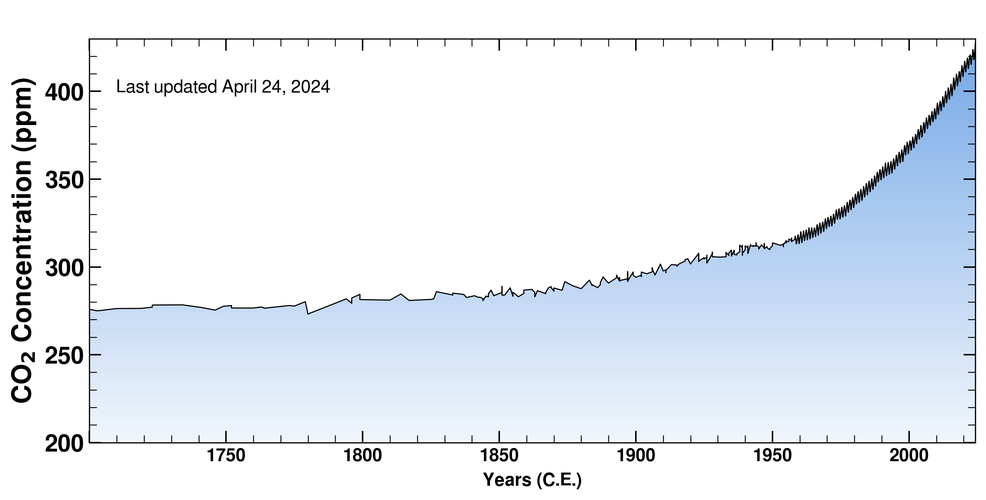
Happy 400 ppm!

Carbon dioxide concentrations have hit 400 parts per million for the first time in human history. Some historical perspective is in order.

Here is the last 300 years:


And here is the last 800,000 years:


Make sure your poison ivy thanks you.


Continue reading...

Thursday, May 09, 2013

And God Created Fowl

If you have 3 minutes to spare, have a look at this video. Science writer Carl Zimmer explains the origin of birds and feathers. I don't think I'm spoiling anything if I tell you that there was more to it than God saying, "Let there be..."


Continue reading...

Saturday, April 27, 2013

Don't Forget that the Universe is Strange

Over at BOAP.org, WVS expresses his doubt that absolute foreknowledge and free will can co-exist (here and here), and I think I agree with him. But it reminds me of one of the irritants I found in Converging Paths to Truth, a book published by Deseret Book and the BYU Religious Studies Center. You may recall that I highlighted the book a couple of months ago, and hinted that I had some gripes. So here's one of them.

J. Ward Moody's essay is "Time in Scripture and Science: A Conciliatory Key?". The title is a bit of a misnomer because there's not really any reconciliation. It's more of a rumination on the concept of time, using both scriptural and scientific perspectives. It has the kind of ideas that any science enthusiast has kicked around at one point or another. Good clean fun.

Not far into his essay Moody takes up relativity, a scientific concept that captures the imagination and perhaps ranks only behind quantum mechanics in its difficulty to comprehend. Moody, of course, knows this.

It is tempting to stop and shout, “Of course there is a difference [between past, present, and future]! The past is behind, the future is ahead and the present is now! Only dimwitted philosophers could get confused about such an obvious thing!” Indeed! But there are some physical, philosophical, and religious facts that challenge such a straightforward interpretation.

When Albert Einstein gave the world the special theory of relativity, he irrefutably established that events which are simultaneous to one person are not simultaneous to another person moving with respect to the first.
Got that? Relativity seems like philosophical nonsense, but is in fact irrefutable. I presume that Moody would say the same for quantum mechanics. So far, so good.

Turning to a little speculation about God's sense of time, Moody says
If every point of time can be called “now” according to some perspective, then the entire extent of time must already be created. You cannot say that, at this instant, a point of time is known to be “now” before it has come into being. Therefore all time—and with it, all past, present, and future—must already exist. If so, it is trivial for God to know the future.
Moody has a couple of criticisms of this idea (also known as block time). Then he says,
Even though block time allows for God to comprehend all time, I am uncomfortable with it from a religious perspective. It seems a bit like predestination with our decisions already made and existing in a future that can only unfold to us as our “now” hyperplane passes through it. I see no purpose in living in such a universe. If I know anything about life from my own experience, it is that we have agency. Our decisions matter and are not made before we make them. Time must allow for this.
Oh, well I guess that settles it then. It's fine with me that Moody is not a fan of block time, and I don't mind that religion adds to his suspicion. What irritates me is that he asserts that block time cannot be correct because it doesn't comport with his personal experience. Well guess what? Relativity and quantum mechanics don't fit with my personal experience either!

Sometimes nature doesn't do things the way we think it should. That's science.


Continue reading...

Wednesday, April 10, 2013

Should Tea Be Allowed in Africa?

The history of Word of Wisdom observance in the Church is more interesting than you might expect. Many members are not aware that the uniformity of observance that is one of our most distinctive practices is a twentieth-century development that occurred primarily during the Joseph F. Smith and Heber J. Grant administrations. The story of this development is told in Thomas Alexander's classic treatment, "The Word of Wisdom: From Principle to Requirement [PDF]." However, the idea that the Word of Wisdom was not viewed as important before then goes too far in the other direction, according Paul Hoskisson's article last year in the Journal of Mormon History, "The Word of Wisdom in Its First Decade" [paywall]. Nevertheless, the strictness of observance did fluctuate within Joseph Smith's lifetime.

As part of his discussion, Hoskisson carves out two main exceptions to the Word of Wisdom: sacrament and medicine. When wine was used as part of the sacrament, it was obviously not viewed as a violation of Word of Wisdom observance. Similarly, medical exceptions were also tolerated, though not specifically recognized in D&C 89.

Even as late as the 1950s and early 1960s, I can remember faithful Latter-day Saints speaking of the medicinal use of tea and coffee. I have also heard anecdotal reports that some members continued to excuse their use of alcohol for medicinal purposes well into the second half of the twentieth century. Certainly statements about the medicinal value of prohibited substances reflect the generally held beliefs of members in Kirtland, Missouri, and Illinois.

Today in the Church the medical justification for breaking the Word of Wisdom has been severely restricted. I have not yet determined just when the medicinal loophole was tightened. Neither am I aware of any official Church prohibition today against legitimate medicines that contain the same active ingredients that are found in coffee, tea, and alcohol....

In short, from the date the Word of Wisdom was received in 1833, until at least the end of the nineteenth century, the Church seems to have implicitly or explicitly recognized two exceptions to strict abstinence—sacramental and medicinal—both of which were eventually eliminated or severely restricted.
(Fun Church history fact: A later example of the medical exception was when James E. Talmage temporarily took up cigar smoking, by order of the First Presidency.)

With this as background, I was interested to read an article on Slate.com a few days ago about wormwood tea as an anti-malarial. Medical authorities are worried that its widespread use could cause more harm than good by generating resistance to a class of anti-malarial drugs, but from a consumer point of view it's a no-brainer because it's cheap and easy.
The fact is that most traditional herbal remedies are probably useless, potentially dangerous, and will only delay a person’s efforts to seek proper medical treatment. But some herbs do have medically active compounds, albeit with varying levels of efficacy, and Africans are choosing to go that route because they know that drug supply won’t be cut off by war or corruption or bureaucratic incompetence. Herbs are not always going to be the right strategy, but the data about these unconventional interventions should be shared and discussed.

Let's put aside the question of what the best public health policy is. Would wormwood tea be prohibited by the Word of Wisdom? I'm not any kind of tea expert, but Wikipedia tells me that regular tea comes from Camellia sinensis, while wormwood is entirely different: Artemisia absinthium. So maybe on that basis it would not be considered prohibited. On the other hand, there's that T word. Maybe someone with more international Church experience than me would know.

Whatever the case, this seems like a worthy exception to the Word of Wisdom. The Word of Wisdom was made for man, not vice versa.


Continue reading...

Thursday, March 21, 2013

Let Us Speak of Bowels, and the Fullness Thereof

A couple of days ago I got to wondering about the scriptural use of the word bowels, as in bowels filled with mercy. So I did a Google search and the first link to pop up was a 1999 BYU Studies article, "Bowels of Mercy," by John Durham Peters. It's a pretty interesting read.

The scriptures often come to us like messages in a bottle, blown from distant times and places. They bring with them modes of expression that can sometimes be mysterious for latter-day readers. One of these mannerisms is the frequent use of concrete bodily language in describing spiritual conditions....That bowels, of all things, should be singled out for special spiritual purposes arouses perplexity, if not aversion, in most of us. Yet if properly understood, the notion that the viscera can be the vehicle of virtue is poetically and morally powerful.
The Hebrew and Greek words translated as bowels have broader meaning than the end of the large intestine. In fact, the word itself used to have a similarly broader meaning. It can refer to the internal organs in general, for example, or may refer to reproductive organs. The ancients did not have a good understanding of how the body worked, so thoughts and emotions were associated with various internal organs, and this is reflected in the scriptures. For example, Jeremiah 20:12 says that God can see your kidneys (reins) and your heart.

I think Peters gets a tad carried away over how wonderful of a metaphor bowels are. Nevertheless, it's a nice quick read, and with Easter coming up you'll be able to display your superior knowledge at church when bowels full of mercy are mentioned.


Continue reading...

  © Blogger templates The Professional Template by Ourblogtemplates.com 2008

Back to TOP