Tuesday, September 09, 2008

Brian Greene on Infinity, the Multiverse, and Other Oddities

WNYC Radiolab (a program/podcast that you should be listening to) has a discussion with theoretical physicist Brian Greene. The first part of the discussion is about the wild idea that out in the universe--somewhere--is a person exactly like you. The reasoning is that there are only so many arrangements of matter, so if the universe is infinite, then any particular arrangement of matter will eventually repeat. In other words, somewhere out there is someone who is just like you down to the last neuron.

Later the discussion turns to the concept of the multiverse. Although interesting in itself, what caught my attention was Greene's repeated emphasis that the multiverse is not just a crazy idea that physicists/cosmologists dreamed up and decided to push. Rather, he claims it falls naturally out of observed realities, such as the cosmic microwave background. Whether that is overreaching or not, I honestly don't know.

The idea of a multiverse is sometimes attacked with Occam's razor--that without direct evidence of a multiverse, it is more parsimonious to hold that there is only one universe. Dr. Greene turns that on its head. Which is more parsimonious, the particular fundamental constants that we have, or all possible values and combinations, only one of which we observe?

Now maybe you don't think that the universe is infinite, so--whew--there's not another you out there. But if, according to a prominent strain of Mormon thought, we are part of an eternal enterprise of people production that extends infinitely into the past and future, then it is hard to escape the logical conclusion that you and I are not really unique in the grand scheme of things. Have fun chewing on that.


Continue reading...

Friday, September 05, 2008

Joseph Fielding Smith and Sterling Talmage on God's Power

In Man, His Origin and Destiny (MHOD) President Joseph Fielding Smith described a conversation that resulted from a speech in which he gave his opinion that the earth literally stood still for Joshua (p. 12).

[The speech] was published and it brought into my office a teacher of science with whom I had gone to school in earlier days. He took me to task for my remarks and said: "Why, do you not know that if the earth slowed up for part of a day that it would create such a terrific wind that everything on the face of the earth would be swept off?" I looked at him and with a smile said: "My goodness! Is it not too bad that the Lord would not know this?" The conversation ended.

Over 20 years previous to the publication of MHOD, Sterling Talmage, the son of Elder James E. Talmage, argued this same point with then Elder Smith. Again, the context was a speech by Elder Smith, published in October 1930, wherein he related someone's incredulity [1] that the earth stopped and then argued that God has all power to do so. Sterling responded with "An Open Letter to Elder Joseph Fielding Smith" [2]. In the letter Sterling detailed some of the catastrophic consequences stopping the earth would have. The portion quoted below specifically addresses God's power.
For the reasons given I cannot believe that the rotation of the earth was stopped in the interests of Joshua's victory. Let me make clear the fact that I am not questioning the power of God to do so. He could have stopped the rotation of the earth, or he could have made the earth cubical instead of spherical, or he could have made water run uphill instead of down, or he could have caused the oceans to hang on the hillsides instead of settle in the basins, or he could have made the sun move around the earth as the moon does.

But he did not!

... I am convinced that the laws of nature are a part of the law of God. It is only another step to say that the law of gravity is as much a part of God's plan as is the law of tithing. And I claim that it is not irreverent to say that God cannot wantonly ignore the law of gravity that he has established to hold the planets in their courses, any more than to say that he cannot make a tithe (defined as a tenth) equal to seven or to seventeen percent. This is only another way of saying that God cannot perpetrate an absurdity. I admit that, in the realm of miracles, I am not wise enough to say in every case what constitutes an absurdity; but some of them are not hard to recognize.

Talmage's argument is certainly an interesting one, and I think there is merit to it, but I also have some sympathy for President Smith's perspective. I think it's best to make as few assumptions about God as possible. The more an argument is based on collected evidence, the better.

Notes:
1. This may be a reference to the same conversation as related in MHOD.
2. Published in Can Science Be Faith Promoting?


Continue reading...

Tuesday, September 02, 2008

A Call for Papers: Mormon Thought and Engineering Vision

I am passing along the following announcement [official site]. My brief comments are below.

The Howard W. Hunter Chair of Mormon Studies in the School of Religion at Claremont Graduate University is pleased to sponsor a conference on:

Parallels and Convergences: Mormon Thought and Engineering Vision

Location:
Claremont Graduate University, 150 E. 10th Street, Claremont, CA 91711

Important Dates:
Abstract deadline: 2008 December 1 (extended abstract)
Conference: 2009 March 7 (Saturday)

Topics:
The Howard W Hunter Chair is interested in expanding the discussion of Latter-day Saint (LDS) perspectives on the attributes of God and the potential of man through a variety of innovative directions. One of the directions to be explored is whether there is a possible resonance between Mormon and engineering thought. The assumption is that according to LDS understanding, God is the architect of the Creation and the engineer of our bodies and spirits. Man, on the other hand, is believed to be capable of growing to become like God. The theological question is: where does engineering fit in the convergence of these two realms?

Papers for Parallels and Convergences: Mormon Thought and Engineering Vision should present scholarly discussions that explore scriptural background and LDS philosophy, set in the context of engineering and technology.
-----------------------
This looks like an interesting conference; I think its best potential lies in exploring connections between Mormonism and advances in technology. However, it could also be a menagerie of naturalistic fallacies--and don't get me started on Intelligent Design. Nevertheless, I'm glad to see these kinds of things happening. Maybe some time they can focus on Mormonism and stochastic processes.


Continue reading...

Friday, August 29, 2008

The Argument from Resurrection

In arguments among Mormons regarding science and religion (or among Christians in general), it is not uncommon to see what I call "the argument from resurrection." It usually takes the following general form:

1. You claim that X is scientifically untenable.
2. However, the resurrection is also scientifically untenable.
3. We believe that the resurrection is (or will be) a reality.
4. Therefore, I am justified in believing X.

Something about how the argument from resurrection is often used bothers me, and I'll try to explain why. (Of course, my comments are based on an acceptance of #3 above.)

I think the fundamental problem lies in the difference between X and the resurrection--a false equivalence. Practically speaking, the resurrection is a future event or state, and it can be framed as a technological problem. Somehow, God can put us back together. It may seem impossible from our perspective, it may raise some tough questions, and perhaps our understanding or mental picture of the resurrection is not very accurate, but who is to say that such a technological achievement cannot be made. After all, God is God.

In contrast, the point of contention in #1 above usually involves a matter of history. The issue then is not what God could or could not do, but what the surviving evidence suggests. If the evidence contradicts X, then God's power, as exemplified by the resurrection, is really irrelevant. The question must turn to whether God would tamper with the evidence, which is not a scientific question.

Sometimes people slip into arguing over technical feasibility, which--with some exceptions--I think is a mistake [1]. So, for example, the issue with a global flood is not where all the water came from, or where it went, or whether Noah and his family could care for all of those animals. Although those are important questions, they are resolvable by appealing to miracles (i.e. God's superior technologies). The real issue is why geology, biogeography, and genetics do not give any support to such a flood.

Another example (if I recall correctly) is a certain book in which the author employed the argument from resurrection to support a literal interpretation of Joseph Smith's statement that

...the effect of the Holy Ghost upon a Gentile is to purge out the old blood and make him actually of the seed of Abraham.
If this is to be taken literally (and I don't think it need be), it is totally disconnected from modern biology. Again, the issue is not what God can do, but what we find if we look into the matter [2].

So when you see the argument from resurrection take a step back and determine what is at issue. Is it God's ability to do something, or is it the nature of the evidence? If it is the latter, then the argument from resurrection has probably been misapplied.


Notes:
1. The general exception to this is when someone makes a specific non-miraculous proposal. You can then follow-up on what the consequences of that proposal would be (i.e. what predictions it makes).

2. Remember that the mechanism of heredity was not known for another hundred years. The notion that blood was involved goes back to the ancient Greeks. Having said that, I doubt if a study has ever been done that compared the genetics of a Gentile pre- and post- reception of the Holy Ghost.


Continue reading...

Wednesday, August 27, 2008

Magicians and Neuroscientists

I love a good magic show. Magicians and neuroscientists have teamed up to write a scientific paper. As described by the New York Times,

In a paper published [July 30] in the journal Nature Reviews Neuroscience, a team of brain scientists and prominent magicians described how magic tricks, both simple and spectacular, take advantage of glitches in how the brain constructs a model of the outside world from moment to moment, or what we think of as objective reality.
The paper, Attention and awareness in stage magic: turning tricks into research, is available to read for free. The paper is an outgrowth of a conference last year, of which some videos are also available for viewing. A few specific tricks are explained, but the discussion is mostly about general principles.

Incidentally, if you spend any time paying attention to the skeptics movement, you'll find the involvement of magicians. James Randi, one of the authors of the paper, is particularly prominent. Their expertise in deception, as part of their craft, gives them insight into evaluating paranormal claims. After all, they do make their living by appearing to do or know impossible things.


Continue reading...

Sunday, August 24, 2008

Scientific Advisors to the Prophet

Discover Magazine has an article, How to Teach Science to the Pope, that highlights a little known organization in the Vatican called the Pontifical Academy of Sciences.

Though it is virtually unknown among laypeople, the Pontifical Academy of Sciences is an independent and remarkably influential body within the Holy See. Over the years its membership roster has read like a who’s who of 20th-century scientists (including Max Planck, Niels Bohr, and Erwin Schrödinger, to name a few), and it currently boasts more than 80 international academicians, many of them Nobel laureates and not all of them Catholic—including the playfully irreligious physicist Stephen Hawking.

The academy serves an advisory role to Catholic leadership, and some scientific work is done under its auspices.
In 1992 John Paul II told the members that “the purpose of your academy is precisely to discern and to make known, in the present state of science and within its proper limits, what can be regarded as an acquired truth or at least as enjoying such a degree of probability that it would be imprudent and unreasonable to reject it.”

I wonder if our Church could use a similar organization--maybe an appendage to Correlation. Given how advancing science touches on Church policies and doctrines, it would be nice to know that the Brethren get good information to inform their decisions. You could make a case that BYU can serve that purpose; I wonder how often anybody in the basic sciences are contacted by Church headquarters for information or advice. (Steve P., got any stories?)

My guess is that when Church leaders feel a need, an ad hoc committee is formed involving GAs with the appropriate background and other prominent trusted professionals. Back in the 1970s James O. Mason--later the head of the CDC, and even later a Seventy--served as the Church Commissioner of Health and advised the First Presidency on certain health issues. I have no idea whether such a position still exists or not.

The Church Scientific Advisory Committee--I won't hold my breath, but I can dream.


Continue reading...

Saturday, August 23, 2008

Measles Up in the U.S.

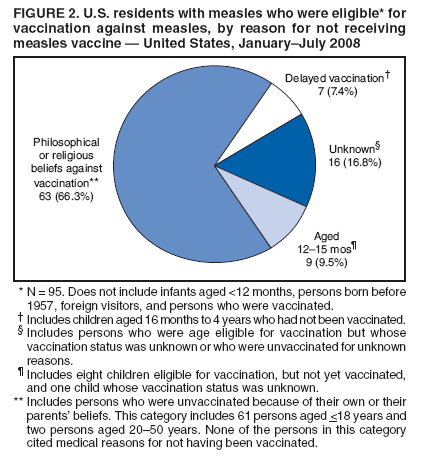
The CDC released a report this week detailing an increase in measles cases this year. From January to July there have been 131 cases all around the U.S. One hundred twenty three of those are U.S. residents and 112 were unvaccinated--63 of them for religious or philosophical reasons.


The report reminds us of the importance of immunization.

In the United States, measles caused 450 reported deaths and 4,000 cases of encephalitis annually before measles vaccine became available in the mid-1960s (1). Through a successful measles vaccination program, the United States eliminated endemic measles transmission (1). Sustaining elimination requires maintaining high MMR vaccine coverage rates, particularly among preschool (>90% 1-dose coverage) and school-aged children (>95% 2-dose coverage) (7). High coverage levels provide herd immunity, decreasing everyone's risk for measles exposure and affording protection to persons who cannot be vaccinated. However, herd immunity does not provide 100% protection, especially in communities with large numbers of unvaccinated persons. For the foreseeable future, measles importations into the United States will continue to occur because measles is still common in Europe and other regions of the world. Within the United States, the current national MMR vaccine coverage rate is adequate to prevent the sustained spread of measles. However, importations of measles likely will continue to cause outbreaks in communities that have sizeable clusters of unvaccinated persons.

It's also important to remember that vaccination does not always confer immunity; a certain percentage of vaccinated people fail to mount a protective immune response. In fact, recently a co-worker told me that they had to get the MMR vaccine as an adult because even though they were vaccinated as a child, lab tests failed to find antibodies against measles.

MMWR Weekly: August 22, 2008 / 57(33);893-896


Continue reading...

Thursday, August 21, 2008

The Science Behind the Anthrax Investigation

A Trained Eye Finally Solved the Anthrax Puzzle

The New York Times has a nice article on the scientific end of the anthrax investigation. After missing them using standard methods, scientists found that the spores used in the attacks contained several low-frequency mutants that were matched to Ivins' flask. Since Ivins was only one of a number of people with access to the flask, the science ends there. More interesting to me was that the FBI divided up the work to keep the assisting labs in the dark, just in case the culprit was working on the investigation.

As an aside, I've seen others complain about this before, but I will bring it up anyway. When journalists write about the sequencing of a genome, why are they so fond of using the word "decode"? According to my count, the second page of the story uses a form of the word seven times. Why can't they use the word that scientists use: sequence? The scientists were not decoding anything; they were determining the sequence that makes up the code. It's like saying that a doctor diagnosed a patient, when he really only took a history, performed a physical exam, and ordered lab tests.


Continue reading...

  © Blogger templates The Professional Template by Ourblogtemplates.com 2008

Back to TOP