


 Posts
Posts


Tyson on Pluto and Science Education
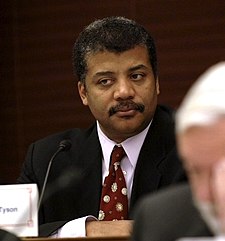
Neil deGrasse Tyson is an astrophysicist and the director of the Hayden Planetarium at the American Museum of Natural History. In March he was interviewed on Point of Inquiry about his recent book, The Pluto Files: The Rise and Fall of America's Favorite Planet. The interview is available here. I haven't read the book, so my comments are based on the interview.
Tyson was indirectly involved in the change of Pluto's status as a planet to a dwarf planet. Back in the 1990's, the museum was re-building the astronomy section, and as he and his staff looked at the current science they decided that Pluto really had more properties in common with objects in the Kuiper belt than with the rest of the planets. Sparks began to fly when the New York Times ran a front-page story pointing out that in the display Pluto was not grouped with the other planets, nor was it referred to as a planet. The rest is history, with Pluto currently classified as a dwarf planet.
Tyson points out that the whole fight has been over nomenclature, not over the actual properties of Pluto, and he thinks that the reason for the attachment of many people to Pluto as a planet has to do with how we learn about the solar system in school. Rather than comparing and contrasting the objects in the solar system and discussing the process of discovery, the solar system is presented as a finished product with a mnemonic to help in memorization. This scheme becomes cemented in people's minds such that they feel a sense of betrayal when it is altered.
Science is exploratory, and as new discoveries are made we have to find or invent words to describe or label them. But often as discovery continues it becomes clear that the old system of labels is inadequate. As Tyson points out, originally planets were just lights in the sky that wandered relative to the other stars. As their capabilities grew, astronomers identified and named more and more wanderers until we reached nine, with Pluto as the last. But as astronomers learned more about Pluto, it became clear that it was rather different from the terrestrial planets (Mercury, Venus, Earth and Mars) and the gas giants (Jupiter, Saturn, Uranus, and Neptune), and they found that it was much like objects in the Kuiper belt (which was discovered in 1992(!)).
Ultimately, Tyson puts it this way: Pluto is not the last of the planets; it is the first of a new class of objects.


8 comments:
Dear sweet Pluto, how I mourn its loss. It came into my life as a planet, when I go out, Pluto will be but a dwarf planet. A shadow of it's former glory.
But wait, in the church's official magazine the Ensign in 1986, Ted E. Brewerton of the 70, says "but our sun and its nine planets appear as one" Nine planets! It's in the Ensign. I'm saved. Pluto is a planet.
This blog is too wide for my 1024x768 screen resolution. Great content, bad layout. Not everyone has a widescreen monitor.
I've never understood how changing the classification of pluto from planet to anything else was such a big deal. Seemed like a publicity stunt. I don't understand why it matters what Pluto is called. IT doesn't change the science. It's just semantics.
Steve,
Hmm, I don't know if a 70 cuts it.
Anonymous,
Thanks for the heads up. Is it a simple matter of having to scroll, or does the text get pushed down? I think different browsers sometimes give different results.
Anyway, I'm not making any promises, but I'll look into it.
Alright, Anon. I spent some time working on the template--you should be much happier now.
Well,
The positive is: Gustav Holst' suite "The Planets" is no longer incomplete.
Jack
Now I can't open my emails!!!
Jared*: nice post. I'll have to remember this example of how science education does a poor job educating what science actually is. (All my examples until now dealt with evolution and the meaning of the word "experiment".)
SteveP: clever.
Post a Comment