


 Posts
Posts


The Spirit as a Homunculus
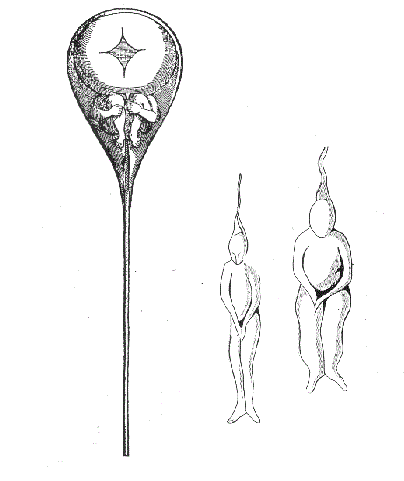
Although we take them for granted, the details of how babies are made have only been discovered over the last 150 years or so. Prior to that not much was known about it--aside from the obvious. Also a mystery was the process of development, about which there were two general schools of thought. Tracing back to Aristotle, epigenesists held that development was a process of emerging formation from formlessness. In contrast, preformists thought that the sperm (or egg) contained a miniature person--a 'homunculus'--and that development consisted of the enlargement of this preformed anatomy.
Preformists had to deal with two outstanding problems: that children had traits of both parents rather than just one, and the absurd implication that all of humanity was contained in the body of Adam (or Eve) like miniature Russian dolls. As science has progressed it has become clear that preformatism is wrong. Each person inherits genetic information from both parents, and development from a single cell occurs through a process of emerging organization, structure, and differentiation as cells alter their gene expression in response to their local environment.
The homunculus may be an outdated scientific idea, but it lives on as the spirit body in Mormonism [1]. While searching for something totally unrelated a while ago, I ran across this passage written by Joseph A. West in the May 1920 Improvement Era.The gospel teaches, however, that the life-giving, intelligent, and immortal part of man is the spirit, which is in the exact likeness of the body, the growth and development of which are occasioned, according to Orson Pratt [2], one of the former Council of the Twelve, by the elastic force of the spirit in its effort to expand the body to conform to its spirit dimensions, and that, if the body is not stunted or deformed by some abnormal act of nature, it becomes, in every function and feature, an exact counterpart of its spirit life.
Although West was more detailed than most in his explanation, it is not hard to find similar statements using D&C 77:2 and Ether 3:16 as support. For example, in Vitality of Mormonism James E. Talmage wrote (p.243), The human body, so far as it is normal, undeformed and unimpaired, is a presentment of the spirit itself.
Other Church leaders such as President Joseph F. Smith said similar things in the context of the resurrection of children. These ideas can still be found in the Church, but often there is less emphasis on the degree of correspondence between spirit and body.
The statements referenced above were all made no later than 1920, a time when science had little to say about heredity and development. For comparison, the first two decades of the twentieth century saw the emergence of the field of genetics, followed by molecular genetics in the second half of the century. Embryology and developmental biology have seen great advancements as well. From today's perspective, there doesn't seem to be any role for the spirit to shape the body, which makes the comparison to a homunculus apt in another way.
Homunculus arguments are fallacious arguments in theories of vision or mind that account for a phenomenon by invoking the same phenomenon that they are intended to explain, resulting in an infinite regression. For example, if you explain vision as the result of a little person (so to speak) inside you who views the images gathered by the eyes, you have not really explained vision; you have merely added another viewer.
Thus the spirit can be compared to a homunculus in two ways. First, there is the idea expressed by West that the expansion of the spirit is what shapes the physical body. And second, attributing physical features to the form of the spirit not only clashes with the demonstrated truths of genetics and developmental biology, but it also adds another layer to the mystery without really explaining anything. (What determines the shape of a spirit? And what determines the shape of that? And so on.)
None of this is to deny that we have a spirit, but it does raise questions about doctrinal traditions that developed in a pre-scientific environment. At the very least, I think we should be cautious in interpreting D&C 77:2 and Ether 3:16. It may also be worth re-evaluating what these scriptures mean, or looking at a range of possible meanings (for example, see Kent Condie's article, Pre-Mortal Spirits: Implications for Cloning, Abortion, Evolution, and Extinction).
Notes:
1. I don't know whether any Mormon commentators directly borrowed preformist ideas. As far as I know, the similarities are at best indirectly related.
2. I have not yet found such a discussion by Orson Pratt. If anybody knows of one, please tell me.


5 comments:
Jared*:
Excellent thoughts.
Our scriptures are NOT manuals of mechanics. We cannot discern from our sacred writings how the spirit interacts with the body. Thus, homuncular mechanics seem problematic to me.
Many assume that our consciousness is a product of spirit. Well, it may be so, but it also seems to me that the brain, as complex as it is, is fully capable of being conscious.
My scientific inclinations lead me to search for naturalistic explanations. Further, I see no reason why such explanations would be incompatible with our religion.
Thanks for these thoughts. I have recently been pondering these issues. What do we know about spirit? What do we assume about spirit?
I've always wondered, if our spirits look just like us and children look a lot like their parents, isn't that like predestination?
Interesting thoughts. I always enjoy seeing moments where history shapes how I currently think, as those "structures" (as it were)are often hidden.
I would presume that the concept that the body resembles the pre-existent spirit grows from examples of angels/ministering spirits which were visually recognizable as their mortal selves. However, all of those spirits were seen post-mortality (save the pre-mortal Christ, and I surmise that in this, as in many things, He was an exception).
I would further propose that the post-mortal spirit is recognizable as the mortal person because the spirit actually comes to resemble the body, as a hardening liquid will come to resemble its container, or through some process in which the spirit exhibits the individual's self-image.
Or it could be something else entirely.
I've always struggled with the idea that our physical body is formed after the blueprint of our spirit. But we also know that our spirits have existed and were mature (in the appearance of a human body I assume) long before we came to this Earth.
My personal approach to resolving this dilemma is that our Spirits are somewhat moldable, giving life to the physical form they are in. Satan wanted his spirits to possess the bodies God created through Adam and Eve. In essence, I don't think a specific spirit had to enter a specific body.
Other interesting thoughts I've had about this topic are with regards to deformed physical bodies. Surely the spirit wasn't deformed. But if the body is missing a limb (congenital or acquired) is the Spirit limb hanging outside the body? My opinion is that the Spirit just adapts to its new surroundings. It grows with our bodies from birth to adulthood. It adapts to fill the physical tabernacle it is given. It may be mature but its appearance can change.
I find it interesting that our mortal existence is so short (time-wise) in the eternal scheme of things, yet it is so important that our eternal judgment is based on it. Would it be unreasonable to also think our future eternal appearance is also determined by it, based on which body our Spirit is assigned to?
Who knows? But it is interesting to think about. Maybe there is more predestination than I think and all my opinions are just ludicrous.
Post a Comment