Friday, March 28, 2025

We Can Do All Things Through Christ

This is just a reminder that anything done in the name of Christ is OK. Nobody has ever done anything unethical, dishonest, unwise, wicked, or fraudulent under his name, nor have they ever flaunted their Christianity as a cover for bad behavior [1]. Jesus would never allow his name to be misused [2]. So if someone claims to be a Christian, then their public or political words and actions should not be criticized. To do so is to criticize Jesus [3].

The Bible says so (Philippians 4:13). I don't make the rules.

Notes:
1. I didn't include "illegal" because laws are made by men and often used to oppress true Christians. Therefore, breaking the law in the name of Jesus is OK.
2. Since Jesus knows the end from the beginning, anything a Christian does is according to his plan.
3. What if some Christians don't like what other Christians are doing in the name of Jesus? That's not a question a true Christian would ask.


Continue reading...

Tuesday, March 18, 2025

Time to Get Your Year Supply of Excuses Ready

Now that Trump is regularly making menacing statements about annexing Canada and Greenland, it's time to make sure you are stocked up on excuses for supporting him. If you've made it through the lies about the 2020 election, January 6, his court convictions, pardoning J6 insurrectionists, turning the management of the executive branch over to Elon Musk, purging the Department of Justice and the Department of Defense of anyone who might stand between him and illegal or unconstitutional orders, halting humanitarian aid, deciding that he can deport virtually anyone if he wants to, working to nulify the 14th amendment, turning against European allies and increasingly aligning with Russia, threatening the press, universities, and companies that don't align themselves to his will, his on-again-off-again tariffs, and so on, and so on...

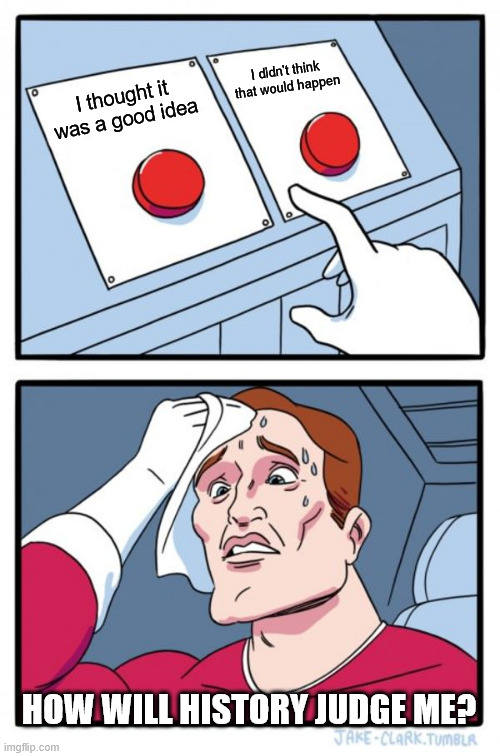
...if you've made it through all of that, you may find your short-term supplies of excuses dwindling. And if you think you aren't going to need more, you are kidding yourself. You definitely need to stock up a least a year supply, if not more. You can start small and just regularly add to your supply. Perhaps you think you can just get by with, "I never thought that would happen". A little bit is certainly helpful, but you really are going to need something more substantial.

Probably the most cost-effective way to stock up on excuses is to go to the storehouse of Fox News. They regularly feature excuses that, although not of high quality, will sustain you in a pinch. For example, just recently they had a guest on claiming that Canada has been taken over by Mexican drug cartels. Sure it's stupid, but down the road when the U.S. is taking military action against Canada you are going to need something to justify your support. Other excuse suppliers that you find on social media or in podcasts can also be helpful, but I would recommend comparison shopping by cross-checking with Fox News to make sure that your excuses are of the best MAGA quality.

While you are building your supply of excuses to make it through the short-to-medium term, you also need to start working on your long-term excuses. Generations after you are going to ask, "Why on earth would you do that?" Providing excuses to them is beyond the scope of this post, but I recommend that you start building a story about how it's what God wanted. Few excuses are as durable.


Continue reading...

Tuesday, March 04, 2025

America Needs A Crypto Strategic Reserve So That...

America Needs A Crypto Strategic Reserve...

In light of Trump's announcement last Sunday that a cryto strategic reserve would be forthcoming, can anyone complete the above sentence without using some combination of the following:

...so that Donald Trump can use taxpayer money to prop up assets with no underlying value as a gift to the crypto industry, which spent so much to help get him elected.

...so that Donald Trump can enrich himself and his friends by insider trading and pump-and-dump schemes [1].

...to ensure that countries like North Korea are able to continue to fund their hostile activities.

...so that gullible people hoping to get ahead willingly throw their money away to unknowingly support one of the above.

...in case the United States runs out of dollars [2].

Notes:
1. Somebody made a killing off of Trump's announcement last Sunday. According to Forbes:

Mere hours before Trump made the announcement, an anonymous trader opened a 50x leveraged long position on BTC and ETH with $4 million on margin. As crypto prices surged on Trump’s news, the trader closed the position, netting over $6.8 million in profit. The timing was fortunate, and the bet was structured with little downside protection, making some wonder if it may not have been fortuitous and if the trader had advanced knowledge of Trump’s announcement....To reiterate and put the risk in perspective, the long positions were so highly leveraged that a price dip of merely ~2 percent in BTC or ETH would have liquidated the trader’s entire $4M stake​. Yet, instead of faltering, prices rose precisely when needed.
I'm sure the Trump-loyal SEC and DOJ will get right on that.

2. The United States is the source of dollars. It cannot run out.


Continue reading...

Sunday, February 23, 2025

We Are Trading Dollars for Pennies

When I was in grade school I learned of a cruel trick that you could play on younger kids of about 5-6 years old. (I'm happy to report that I never tried to do this.) The trick was simply this: offer to trade them a few pennies for a dollar, with the explanation that the pennies are (numerically) more than a dollar. To a young mind that understands numeric values but doesn't yet comprehend the relative worth of units of money, this seems like a good deal. It is, of course, a dishonest and cruel exploitation of their naivety.

I keep thinking about this trick as a metaphor for this political moment. Voters have been bombarded for decades with messaging that tells them that their taxes are being wasted and that our country can't afford it's current services and the debt that it has accumulated. The solution Republican politicians have proposed has been to trade government spending for tax cuts [1].

The cruelty of this trick, as more people are beginning to realize, is that government spending is mostly "wasted" on...we the people. One way to see this is to look at how much states pay into the federal system vs how much they receive in benefits. It quickly becomes obvious that states like Washington, New Jersey, Massachusetts, and especially California are helping to fund everyone else, while virtually the whole southern United States receives more than it contributes.

Social Security, Medicare, and Medicaid are the largest and most direct examples of how federal spending benefits citizens, but federal spending extends deeply into the national economy in less obvious ways and helps create demand for entire industries. Again, some of this is direct, but some of it is indirect and easily overlooked until it is gone. For example, Alabama is realizing that cuts to scientific funding could greatly damage one of the largest employers of the state (University of Alabama at Birmingham), the effects of which will ripple further into the Alabama economy. And all of this doesn't even consider the intangible benefits we all receive from federal spending--things that make our lives better without us knowing, or the fact that many government workers are actually underpaid relative to the services they provide. There is a real sense in which federal spending is like fertilizer to the soil of our economy.

The benefit we are to receive for trading these things away is lower taxes. This is a great deal for people like Elon Musk because they have very high income and therefore stand to save a lot in taxes [2]. But they can buy virtually anything they want anyway (including politicians). If you have the median household income, on the other hand, your benefit is a relative pitance. And even then you will likely end up spending it (and even more) on things like more expensive household appliances and cars due to the Trump tariffs, or more expensive tuition because universities have to make up for loss of federal funds, or specialized therapy for your disabled child because public schools have lost funding for those services. And if Social Security, Medcaid, or Medicare get cut, there's no making up for what you lose.

Moneyed interests and politicians are taking advantage of our naivety, having stirred us up to anger against a system upon which we all depend. As a result, the average person is trading dollars for pennies.

Notes:
1. Talking about the federal debt is complicated by the fact that there's not a known threshold above which it becomes a big problem. Even at current levels it doesn't seem to be causing much harm to our country, but that's not to say that it should be allowed to grow without restraint. Republicans have railed against federal debt for as long as I can remember (usually only when Democrats are in power), as if it violates some law of nature or offends God. However, cutting taxes gives away the game. If you truly care about the debt then it makes no sense to cut taxes. If anything, in times of prosperity taxes should be raised a little. And here again, most of that federal debt is owed to...we the people.
2. Financial commentator Ben Carlson once quipped that rich people hate paying taxes more than they like making money.


Continue reading...

Wednesday, February 19, 2025

Am I Allowed to Refer to Trump Supporters as King-men Now?

Now that Donald Trump is referring to himself as a king, and the White House X [Twitter] account is providing the imagery, am I allowed to refer to Trump supporters as king-men, or is that in bad taste (even though he is working to eliminate any checks or accountability on his power) [1,2,3]?


Notes:
1. For example, firing of Inspectors General, turning the Department of Justice into his personal protection/enforcement racket, firing prosecutors who worked on J6 cases, pardoning criminals (including but not limited to J6) for personal political advantage, indescriminate firing of federal employees in violation of law, blocking funding appropriated by Congress, getting the Supreme Court to rule that he can't be prosecuted for any "official actions", his Vice-President floating the idea of ignoring the courts, and more.
2. I'm not an expert, but I seem to remember the Book of Mormon taking a dim view on kings...hence the term king-men. Also I'm not a historian, but I remember that even in the pre-woke days America rejected the idea of kings and crafted the Constitution accordingly.
3. This is all just braggadocio you say? I would be more inclined to dismiss it as such if not for #1 above.


Continue reading...

Thursday, February 13, 2025

RFK Jr is the Health Leader America Deserves, and is Already Set to Fail

That a kook and con like Robert Kennedy Jr would be appointed to oversee the medical science agency that includes the NIH and FDA is abusrd on its face, and an insult to the medical science profession. But that's the America we live in now, so America deserves him. Republican Senators know better. Senator Bill Cassidy was a physician and knows full well that Kennedy is a ludicrous choice. But the MAGA pressure was too great, and after receiving unspecified assurances from Kennedy and the White House (that are likely worth less than Trump and Melania memecoins) [1], he folded along with the rest of the Republican senators (except McConnell).

Whether Kennedy will pursue his jihad against vaccines or not remains to be seen. Aside from fading into irrelevance, the best that one could hope for is that he focuses on advancing other health issues such as chronic diseases like diabetes. Even so, he is set to fail--assuming success means ACTUALLY improving the health of Americans. One reason is that he's obviously not an evidence-based thinker, which means that he's likely to charge down fruitless dead ends, dragging federal agencies with him. But beyond that, chronic diseases are complex, and a good chunk of Republican voters are, by temperment and ideology, ill equiped to address them. Consider the following:

- Republicans hate being told how to live or what to do by the government, even when it's just a recommendation. (See COVID; also when Michelle Obama tried to encourage healthy eating and exercise, Republicans told her to shut the @#$% up.)
- Republicans won't like having their favorite foods tampered with.
- Republicans hate government regulation (to the extent that it doesn't favor them, of course).
- The food industry, and by extention, farmers and the agriculture industry (represented by USDA), will not appreciate Kennedy's agency discouraging use of their products, and will act accordingly.
- Republicans hate any degree of socialzed health care, as well as spending tax dollars that benefit other people. That means that they will oppose helping to make drugs that actually work more affordable and available more broadly.

Furthermore, Kennedy is likely to preside over a disfunctional FDA that make new drugs more difficult to register, continue to demonize the pharmaceutical industry, and continue presiding over the broader damage being done to medical science through cuts to government funding via NIH.

In the end, even if Kennedy pours his heart and soul into chronic diseases, he's unlikely to make any positive contributions.

So good luck, America!

Notes:
1. And when those promises are broken, Cassidy will act shocked...and then probably lose to his primary challenger anyway.


Continue reading...

Saturday, February 08, 2025

A Brief Meditation on Large Numbers and Extreme Wealth: Let Us Weep for Elon

Large numbers are difficult for our brains to comprehend, and I think in some ways our language works against us. We have different terms for different orders of magnitude (thousand, million, billion, trillion), but they don't really help us in our mental comparisons of relative size. Ten billion dollars is a lot of money, but then so is 30 million. And things get even more difficult to comprehend when percentages get thrown around. Taxes, tithing, and other such things give us a gut-level feel for the magnitudes most of us encounter in our daily life, but those gut feelings don't apply as well to larger magnitudes.

Sometimes I like to fall back on scientific notation because it allows you to quickly understand differences in orders of magnitude when dealing with large numbers. For most people scientific notation probably brings back dreaded memories of middle school where you had to convert back and forth between normal numbers. I will spare you a lesson on how to do that. The key thing to understand is that each increase in the exponent means multiplying by 10. For example, you have to multiply 5x10^3 (i.e. 5,000) by 10 four times (e.g. (5x10^3) x 10 x 10 x 10 x 10) to get to 5x10^7 (i.e. 50 million). In other words, 5x10^7 is four orders of magnitude larger than 5x10^3. The following chart relates different orders of magnitude, as we describe them in English, with scientific notation. I have also included Excel's way of expressing scientific notation so that the calculations I show in a moment make sense.

Now let's turn to extreme wealth using Elon Musk as an example. As of this writing, he is reportedly worth about $420 billion (4.2x10^11). For reference, the median U.S. household income is approximately $80,000 (8x10^4). That's a difference of 7 orders of magnitude. On the other hand, the annual federal budget of the U.S. for 2024 was 6.8 trillion dollars (6.8x10^12). That means that the entire federal budget is only 1 order of magnitude larger than Elon's wealth. Also, the proposed 2025 budget for the state of California is just a little less than Elon's wealth at $323 billion.

Let's assume that the government decided to levy a one-time wealth tax on Elon of 50% (half of his wealth!). What would poor Elon be left with? $2.1x10^11 is the answer. No change in the order of magnitude. Let's assume instead that the tax was an agressive 99%. This would be an admittedly severe hit to Elon's wealth, but don't break out your violins yet. He would be left with $4.2 billion (4.2x10^9). That's a drop by 2 orders of magnitude, but still 5 orders of magnitude higher than the median household income. The following chart shows a few different tax rates and what Elon would be left with.
Now I recognize that most of Elon's wealth is in stock and other investments rather than cash. So let's imagine a different scenario. Suppose Elon seeks to just live off of the interest of his wealth. Let's further assume that he's only making 3% per year on his wealth. (For reference, 10 year Treasury bonds are currently at about 4.5%.) That means before taxes he is earning $12.6 billion (1.26x10^10) per year. Let's impose a severe tax of 99%. Now you can break out your violins, for Elon is only left with $130 million (1.3x10^8) per year to live on, which is a mere 4 orders of magnitude higher than the median household income [1].

I recognize that everyone has different opinions about how progressive our tax system should be, but at certain levels of wealth it just becomes a different reality. Yet the pity that the multi-billionare class is regularly able to drum up among us (relative) peasants on their behalf is really something to behold. Even more strange is that someone who doesn't financially need anything from anybody gets to decide what constitutes a good use of taxpayer money [2], and that people think that he has their best interest at heart [3].

Notes:
1. It's also less than half of what he spent to help get Trump elected. Another fun fact is that what Elon spent to get Trump elected ($288 billion) was 7 times more than the entire budget of USAID ($40 billion).[Oops.] Let's do this instead: The USAID budget was about what Elon paid for Twitter.
2. Just as the Founders intended, I'm sure.
3. He doesn't.


Continue reading...

Thursday, January 30, 2025

A Lazy Guy's Guide to Fitness

I started doing strength training a few years ago, and I'm proud to say that I've stuck with it. In fact, I generally exercise 5 days a week for about an hour each day. (Not to brag. Well, maybe a little.) The paradox is that I'm a pretty lazy person. I thought I would share how I approach fitness in case it's helpful or motivating for anyone else.

Build Instead of Burn
Part of the spark for starting in the first place was coming to the realization that, although strength training is great for you at any point in life, building muscle becomes more difficult in your 50's and beyond. In fact, as we advance into our senior years, we tend to lose muscle and strength and thereby trade vigor for frailty. Since muscle is much easier to maintain than to build in the first place, I figured I better get at it so that I would have a good foundation when the decline starts. And then there's the fact that I do not enjoy aerobic exercise. So if I was going to exercise at all, strength training was the way to go. Besides, I would rather build muscle than just burn calories. (I do recognize that I should incorporate some cardio. There will be time for that after I'm done building. Also, there are ways to do strength training that really get your heart going, such as minimizing rest between exercises.)

By the way, ladies, strength training is for you too. If you are worried about looking too bulky, trust me: There is a long way between there and where you are now. Significant muscle takes a long time to build, and you can dial back at any point.

Consistency is King
The most important thing to highlight up front is that the biggest key to fitness is establishing consistency. Bursts of activity are nice, but consistency is where the results are. Make consistency your first priority, and the rest will follow.

Tips for Lazy Exercising
1. I workout at home, which means that although I don't have access to all of the equipment that I would like, I actually use what I have and I save the time and hassle of having to go someplace else and wait for someone else to finish with equipment I want to use. I also don't have to worry about what other people think about what I'm doing.

2. I workout in the evening after I get home from work because 1) I hate getting out of bed any earlier than I have to, and 2) exercising in the morning makes me feel tired the rest of the day. I much prefer exercising and then going to bed than the other way around. I know some people prefer the opposite. The key is to do whatever works for you.

3. Since I'm doing strength training rather than cardio, I don't tend to get that sweaty. That means I don't have to take an extra shower.

4. Although I don't get that sweaty, I do change into exercise clothes. Changing clothes doesn't take that much willpower, and once I'm in them it's basically a done deal that I will exercise.

5. I didn't just jump into exercising for an hour 5 days a week. I started with a more modest goal of 15-20 minutes at least three times a week. You can do a lot in that little amount of time, especially when you are just starting out. My mantra was that some is better than none. However, as exercise became part of my weekly routine, my goals began to change and expand. Now I don't approach exercise from a time perspective (unless I'm under a time constraint). Rather, I approach it in terms of which muscle groups I want to work and on which days to acheive the number of sets I want to do in a week. I generally take Saturdays and Sundays off in order to help facilitate recovery (rest is important too!), but sometimes I will sneak in some physical therapy-type exercises.

6. I go for fatigue rather than burn. That's simplifying a little bit, but some people seem to think that strength training is about enduring burning muscles, perhaps because that's what following an exercise video usually makes you do. And since burning muscles are unpleasant, those people naturally grow to dislike lifting weights. There's a place for that kind of thing if endurance is what you after, but building muscle is about moving them under tension. You want to tire them out relatively quickly. I generally try to choose a weight such that I can't do another rep with good form somewhere between 8 and 20 reps. Rest and repeat for as many sets as fits my goal. There's a balance to be struck: Heavier weight and fewer reps is harder on the joints and tendons. Or you can go higher than 20 reps with lighter weight, which is easier on the joints and tendons, but then you are more likely to be in the burn zone and give up before the muscle has actually been fatigued enough to stimulate growth. Striking the right balance will vary by muscle group. On a side note, while you do need to push yourself into some discomfort, you don't have to destroy yourself. A few good quality sets is sufficient.

7. Compound movements give you the best bang for your buck. I do isolation movements as well, but there are a lot of muscles in the human body. It's more efficient if you focus on good compound exercises first, and then fill in with isolation exercises as desired.

8. Don't spend more time on your core than you need to. The biggest determinate of whether you have visible abs is how much fat you are carrying, and working your abs won't get rid of it. So unless weakness in your abdominal muscles is limiting your daily movements, ability to engage in other exercises, or some other goal, you probably don't need to spend much time and energy exercising your core. This may seem counterintuitive, since fitness influencers and exercise videos are always doing planks and crunches and such. A lot of this is fitness theater. If you want to have visible abs you'll need to focus on losing fat, which is best addressed by what you eat. Spend your precious workout time and energy on more productive exercises.

9. Don't follow a video. This is more of an issue of efficiency and efficacy than laziness, but I don't follow a workout video. They can be motivating and helpful for learning exercises, but a video does not adjust to your goals. You are under no obligation to do what a person on a video is doing for the amount of time they are doing it. If you are trying to build muscle, then your muscles are done when they are done, not when you reach an arbitrary timepoint dictated by the video. If you like following along with a video and find that it helps to push you, then that's great. Just make sure that your weight and rep range is appropriate for your goal (see #6 above). I would suggest that a better method is to watch videos to get ideas and instruction on proper form, and then go do the workout on your own.

Diet
I will be the first to admit that I benefit from good genetics with respect to metabolism and body size. However, good genetics can only get you so far, and as you become invested in your fitness you eventually have to pay some attention to what you are eating, if for no other reason than to make sure that you are getting enough protein to build muscle. After all, what's the point of doing all the work if your body doesn't have enough energy or protein to build the muscle you want? Thus far I have been too lazy to get very scientific about my diet, but I have some practices and rules of thumb that help.

9. I eat basically the same breakfast every day, and the same lunch every weekday. This is mostly a matter of laziness because I don't want to have to think about what to pack for my lunch each day. A side benefit is that my calories and nutrition for 2 meals a day are pretty much locked in, so then it's just a question of what dinner and snacks are adding to my diet. If I ever do decide to track my diet more closely, I'll have a head start.

10. I don't drink soda on a regular basis. I am not anti-soda by any means, and when I go to a work dinner or something I may suck down several glasses of my favorite soft drink. It's just that I don't want soda baked into my daily life because, over the course of a year, it adds up to a lot of calories. The same principle applies to other high-calorie/low-nutrition foods. I eat them, but I'm cautious about engineering them into my daily life.

11. In line with the points above, I don't count calories. However, I do try to pay at least a little attention to how many calories are in the packaged foods I eat. Years ago my wife and I split a frozen pizza. Afterwards, I looked at the box and was shocked to see that I had just consumed about 1000 calories. There's nothing wrong with that, per se, but eating completely blind day after day is like going shopping and never looking at the prices. You may be able to manage your weight (by which I actually mean fat percentage; see below) without counting calories, but it's still a good idea to have a sense of what you are eating. Incidentally, the holidays can be a great time to do a bulk (i.e. eating excess calories to fuel muscle building). Or at least that's my excuse.

12. Rotiserie chicken from Costco is awesome. My wife does the family cooking, but there are still plenty of evenings where I have to make my own dinner. Rotiserie chicken is a great solution for my protein needs. They are cheap and ready for eating. You can clean the meat off of them (even better if, like me, your spouse does it) and freeze it in a re-sealable bag. Then when you need protein, just break off a hunk and re-heat it. You can eat it plain, in a taco, or whatever.

13. Weight isn't everything. Worrying specifically about how much you weigh can be counter-productive because your weight can mask positive changes. For example, if you are gaining muscle and losing fat, your weight may stay about the same--or even increase--but this is a good thing! On the other hand, if your weight is dropping and you are working hard but aren't getting stronger, it may be a sign that you aren't eating enough to build muscle. So it's best to interpret your weight within the context of what else is going on in your life, and whether you are getting stronger. I do keep tabs on my weight, but I don't obsess over it. The point is to detect trends so that I can autoregulate. For example, last summer I returned from a long vacation with an approximately 7 pound gain. I knew that gain didn't come from building muscle! So it was a signal that I needed to be a little more conservative in what I ate for a while.

14. I don't use any dietary supplements. For one thing, aside from protein supplements, they are almost all a complete waste of money. The only non-protein supplement I have considered is creatine. The problem is that you have to use it everyday to keep your body charged with it, so to speak. I'm too lazy (and cheap) for that. Also, it pulls water into muscles making them look bigger. That sounds great until you stop using it for whatever reason. I think it would be deflating (pun intended) to see the pay-off in the mirror partially evaporate simply because I stopped taking creatine. I reserve the right to change my mind on creatine, and may eventually use it to fight muscle loss, but for now I don't bother with it.

So that's how this lazy guy does fitness. I hope you find it useful.

Continue reading...

  © Blogger templates The Professional Template by Ourblogtemplates.com 2008

Back to TOP