

Gallup Poll on Evolution
The following figure, derived from Gallup, is in an article from this week's Nature. There are certainly nuances lacking, but it seems pretty reasonable in the way it breaks up the groups.
Continue Reading


 Posts
All Comments
Posts
All Comments

The following figure, derived from Gallup, is in an article from this week's Nature. There are certainly nuances lacking, but it seems pretty reasonable in the way it breaks up the groups.
Continue Reading
This new story from Scientific American.com suggests that we may be able to harness microorganisms breaking down organic matter as a means of producing hydrogen. One of the main criticisms I've seen of using hydrogen fuel cells is that there are no readily useable sources of hydrogen around. Instead, we would have to produce hydrogen by (the only example I know off the top of my head) splitting water into hydrogen and oxygen. But that requires energy, so we would have to burn fossil fuels in order to produce the hydrogen that replaces our use of fossil fuels. It doesn't make sense to me either--maybe someone more knowledgable can explain. Anyway, this news article suggests that microorganisms--those master chemists--may be able to help us out.
Microbes don't get the attention and respect that they deserve--they really form the foundation of life on this planet. Evidence suggests that the very mitochondria and chloroplasts that provide us and plants with energy are derived from microorganisms. There are areas of research that seek to harness their abilites. Research in bioremediation, for example, seeks to harness microbes in the breaking down of man-made toxic chemicals. How practical these strategies are, I don't know--but they sound good.
While I'm at it, here are a few factoids I heard at a meeting: There are 50 million viruses per milliliter of coastal sea water. Viruses in the ocean constitute 27-270 megatons of carbon; whales constitute 4-12. Ninety-five percent of biomass in the ocean is microbial. Between 5 and 40% of marine microbes are lysed (broken open) by viruses each day. Viruses are therefore responsible for an enormous turnover of organic material in the ocean.
No, this is not a strange, yet suprisingly frank, personal add. I just wanted to call attention to two unrelated items.
First from Dienekes' Anthropology Blog, a study concludes that most women don't know when they ovulate. "The most motivated study participants were right about half of the time." I don't know what relevance this might have to your life, but you have been informed--act accordingly.
Second is commentary by John Rennie at SciAm Perspectives, where he worries that people may be misinterpreting the news about the CDC's recent study on obesity.
If anything, the JAMA study suggests that people who exercise and eat a moderate, balanced diet should probably not worry if their weight has stalled a few pounds above some "ideal weight" on an actuarial table. And even that interpretation could be premature because what's most clear now is that we need to study the consequences of overweight much more carefully to sort out what they mean. To use the work as an excuse for saluting the joys of immoderation and ridiculing the fit is asinine.
PZ Myers of Pharyngula had an op-ed published in the Minneapolis Star-Tribune arguing why ID should be left out of science classes. Here is an excerpt:
Science is a conservative process. Most college-level introductory textbooks contain only material that has stood the test of time and has been confirmed independently. ID proponents have not only failed to provide any evidence for their thesis, they aren't even trying. There are no labs doing research on this subject; all the papers the Discovery Institute has tried to publish are exercises in spin, in which they try to distort biology researchers' work to fit their preconceptions.
With no established body of results, no current work and no promising prospects for future research, why should ID be supported? It's a dead end. It is absurd to propose that our kids learn about a subject that no legitimate scientists are pursuing and that has no utility. With no track record to earn the respect of scientists and educators, ID is attempting to circumvent the accepted standards of testing and validation to sneak into our schoolrooms -- it's cheating. It takes a great deal of hard work and persistence and time and evidence to establish a scientific idea, work that should not be shirked by taking the easy route and asking the government to legislate a concept into the schoolrooms. Yet this is exactly the strategy ID proponents are following: spreading propaganda to persuade school boards and state education departments to insert the ideological dogma of ID into classrooms.
Contrast ID with how legitimate scientific work gets into the curriculum. There is an active ferment of new ideas, new experiments, and new evidence constantly bubbling up in the scientific literature. Many controversies work themselves out in the pages of Nature or Science or other journals, and prompt hypothesis testing and the gathering of new evidence. If an idea is well-supported by the evidence, it gains wider currency within the scientific community, and eventually works its way into the science textbooks. Biology books are written by biologists, not by the hodge-podge of lawyers, philosophers, theologians, rhetoricians and rare scientists willing to abandon scientific principles found in the ID movement. Textbook content should accurately reflect the general opinion of the scientists who do real work in a field.
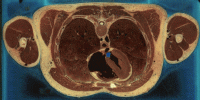
I saw a documentary recently on the National Library of Medicine's Visible Human project. The documentary discussed the project as well as the background of the man who was used. The goal of the project was "the creation of complete, anatomically detailed, three-dimensional representations of the normal male and female human bodies."
The Washington Post reported:
Continue ReadingThe convict who became the Visible Human male was Joseph Paul Jernigan. On July 3, 1981, he stabbed and then killed with a shotgun a 75-year-old man who surprised him during a robbery. He was convicted of murder and, after more than a decade on death row, was executed Aug. 5, 1993.
Jernigan had willed his body to the Texas anatomy board but almost certainly did not know that he was a candidate for the Visible Human Project at the time of his death... The advantage of using executed prisoners was obvious. Their deaths could be anticipated, and work on preserving their remains could begin almost as soon as they were officially declared dead. Of seven male cadavers under consideration, one other besides Jernigan's was that of an executed murderer.
Jernigan's body was not perfect. He had gained nearly 50 pounds since his arrest and was just under the weight limit. One testicle had been removed surgically when he was 15, and his appendix was taken out when he was 21. He was missing a tooth.
His body was frozen and cut into thirds. Then, millimeter by millimeter, layers were ground off and the remains were photographed. The ground-up bits were ultimately cremated. The result can be seen in this movie. Also you can browse the resources available through these links. I recommend the "real-time slice navigation" at this site.
A few days ago I posted about the Genographic Project and briefly compared it to the Sorenson Molecular Geneology Foundation project. When talking about the history of your genes it is easy to be misled, because different parts of your genome can have different histories, and some of your ancestors are not detectable in your genome. In light of this, it seems to me that the SMGF has a more practical immediate benefit to participants. However, as we look back through time, there may be some suprises.
Continue Reading
For example, in discussing a video promoting the Genographic Project, Dienekes at his (I'm assuming gender) anthropology blog asks:It would be much more realistic to show some unexpected results, e.g., a Native American who was descended from a European, or a European who was descended from an African. What goes through the mind of a black man when he is told that his forefather was white? What happens to a would-be-jihadi when he is told that he is carrying Crusader DNA? What are the consequences when a people who think that they are descended from Alexander the Great are told that they are actually not?
In The Ancestor's Tale, Richard Dawkins describes a documentary where black people, whose families came to Britain from Jamaica, had their Y chromosome and mitochondrial DNA characterized and matched against databases in order to find their long lost relatives in Africa. After describing some of the emotional meetings, Dawkins says:Sentimental rubbish, and she should never have ben deceived into thinking this. All that she, or Mark, were really visiting--at least as far as there was any evidence to suppose--were individuals who shared their mitochondra. As a matter of fact, Mark had already been told that his Y chromosome came from Europe (which upset him and he was later palpably relieved to discover respectable African roots for his mitochondria!). Beaula, of course, has no Y chromosome, and apparently they didn't bother to look at her father's although that would have been interesting, for she was quite light-skinned. But it was explained to neither Beaula nor Mark, nor the television audience, that genes outside their mitochondria almost certainly came from a huge variety of 'homelands,' nowhere near those identified for purposes of the documentary. If their other genes had been traced, they could have had equally emotional 'reunions' in hundreds of different sites, all over Africa, Europe and very probably Asia too. That would have spoiled the dramatic impact, of course. (p. 55-56)

The Virgin Mary has appeared in an underpass in Chicago. You can read the CNN story here.
She sure picks some unexpected places to appear.
I don't think this news story received much attention, but in justice it should have. The bottom line is that there is no evidence that Michael Schiavo abused Terri.
You know, I felt bad for her parents, but there is a part of me that wonders if they just might be psycho in-laws from hell. Some of you have in-laws in that category, or at least you know someone who does, so don't tell me it isn't possible. [Disclaimer: my in-laws are great.]

© Blogger templates The Professional Template by Ourblogtemplates.com 2008
Back to TOP
